
Exploring the Meaning of Akouo in Greek
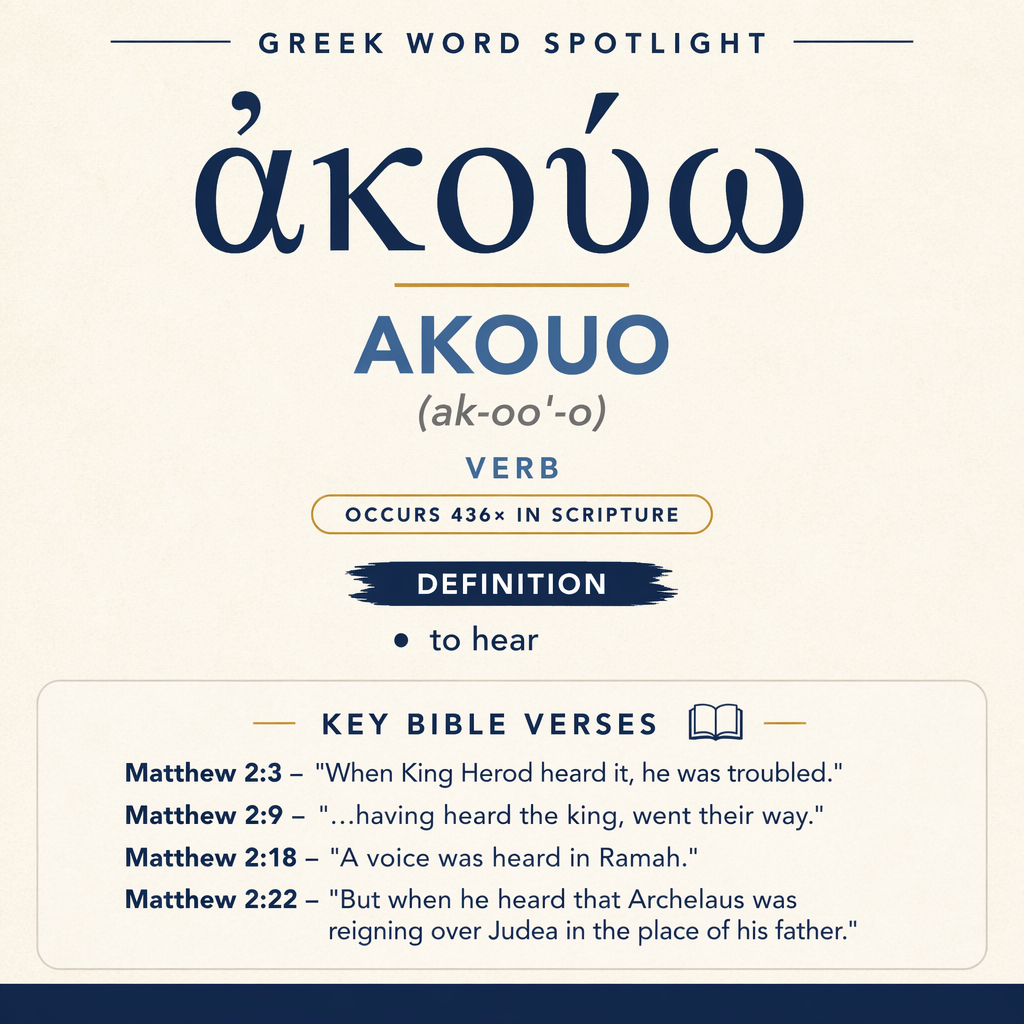
ἀκούω (Akouo) means “to hear” and occurs 436 times in Scripture, including in Matthew 2, 4, and 5.
Core Meaning
ἀκούω (Akouo) is defined as “to hear.” It appears in narratives and quotations where hearing triggers response.
Learn More →Matthew Examples
In Matthew 2:3 and 2:22, it describes Herod hearing news and reacting with trouble or fear. In Matthew 4:12, Jesus hears of John’s arrest and withdraws into Galilee.
Learn More →Heard Teachings
In Matthew 5:21, 5:27, 5:33, it introduces teachings already heard: “You have heard that it was said…” This use frames Jesus’ engagement with what listeners have previously heard.
Learn More →ἀκούω (Akouo) means “to hear,” and in these passages it marks the moment when information, speech, or a report reaches someone and alters what follows. The occurrences below show the verb in narrative scenes of receiving news, in a quotation about a “voice” heard, and in Jesus’ teaching about hearing his words.
Occurrences
Matthew 2:3 — “When King Herod heard it, he was troubled, and all Jerusalem with him.”
Here ἀκούω introduces a report reaching the king: the reaction (“he was troubled”) is explicitly tied to what he hears. The verb frames hearing as the trigger for public disturbance as well—“all Jerusalem with him”—so the act of hearing extends beyond private perception to communal agitation and rumor spreading.

Matthew 2:9 — “They, having heard the king, went their way; and behold, the star, which they saw in the east, went before them, until it came and stood over where the young child was.”
In this travel scene, “having heard the king” places ἀκούω in the realm of receiving a spoken message from an authority. Their hearing is presented as the pivot between an audience (“heard the king”) and immediate action (“went their way”). The verse also sets hearing alongside seeing: they hear the king and then they see the star leading them, so the narrative coordinates what is received by ear with what is perceived by sight.
Matthew 2:18 — ““A voice was heard in Ramah, lamentation, weeping and great mourning, Rachel weeping for her children; she wouldn’t be comforted, because they are no more.””
ἀκούω here is used in the passive (“was heard”), focusing attention on the audibility of grief rather than on a specific listener. What is heard is “a voice,” characterized by “lamentation, weeping and great mourning.” The verb makes the sorrow public and perceptible: mourning is not only felt but becomes a sound that carries, defining the scene by what can be heard.
Matthew 2:22 — “But when he heard that Archelaus was reigning over Judea in the place of his father, Herod, he was afraid to go there. Being warned in a dream, he withdrew into the region of Galilee,”
In this account, ἀκούω introduces news content (“that Archelaus was reigning over Judea…”). Hearing produces fear (“he was afraid to go there”) and helps explain a change of plans (“he withdrew into the region of Galilee”). The verse also places hearing alongside another mode of receiving direction—“Being warned in a dream”—so the narrative presents hearing of public developments together with a warning that guides the next step.
Matthew 4:12 — “Now when Jesus heard that John was delivered up, he withdrew into Galilee.”
Again the verb marks reception of a report (“heard that John was delivered up”) and immediately links it to movement (“he withdrew into Galilee”). The hearing is not mere awareness; it functions as the narrative hinge that explains withdrawal. The clause “when Jesus heard…” sets the timing of the action: the hearing event itself is the moment when the situation changes.
Matthew 5:21 — ““You have heard that it was said to the ancient ones, ‘You shall not murder;’ and ‘Whoever murders will be in danger of the judgment.’”
Here ἀκούω is used of the audience’s prior exposure to a traditional formulation (“You have heard that it was said…”). The verb points to teaching received by ear over time—something learned as a heard saying. It also frames what follows as a quotation of established instruction, positioning the hearers as those already acquainted with a known command and its stated consequence.
Matthew 5:27 — ““You have heard that it was said, ‘You shall not commit adultery;’”
The same pattern continues: “You have heard that it was said” uses ἀκούω to evoke remembered instruction. The verb highlights that the audience’s knowledge is mediated through hearing a reported saying, preparing for further teaching by anchoring it in what has already been heard.
Matthew 5:33 — ““Again you have heard that it was said to the ancient ones, ‘You shall not make false vows, but shall perform to the Lord your vows,’”
Here ἀκούω again marks received tradition (“Again you have heard…”), and the content concerns vows and truthful speech. The verb’s role is to establish continuity: the audience has previously heard this instruction, and the repetition (“Again”) signals an ongoing series of remembered teachings that Jesus is invoking as he addresses conduct.
Matthew 5:38 — ““You have heard that it was said, ‘An eye for an eye, and a tooth for a tooth.’”
In this quotation, ἀκούω functions to introduce a familiar legal-sounding maxim as something transmitted by hearing. The phrasing keeps the focus on how the audience received it—heard as a saying—and sets up the idea that what people have heard can be brought into fresh scrutiny and application.
Matthew 5:43 — ““You have heard that it was said, ‘You shall love your neighbor and hate your enemy.’”
Once more, ἀκούω identifies the audience as recipients of a known formulation. The verb is significant for the rhetoric of the discourse: Jesus appeals to what has been heard as the shared starting point. The content is relational (“love your neighbor… hate your enemy”), and the “heard” framing underscores that ethical patterns can be adopted through repeated hearing of a slogan-like statement.
Matthew 7:24 — ““Everyone therefore who hears these words of mine, and does them, I will liken him to a wise man, who built his house on a rock.”
Here ἀκούω moves from past heard tradition to present encounter with Jesus’ own “words.” Hearing is paired with action: “hears these words of mine, and does them.” The verb marks the intake of speech that calls for a response, and the simile (“wise man, who built his house on a rock”) assigns weight to hearing as the first step in a sequence that culminates in a stable, well-founded life.
Matthew 7:26 — “Everyone who hears these words of mine, and doesn’t do them will be like a foolish man, who built his house on the sand.”
This companion sentence uses the same hearing language but contrasts the outcome: the person “hears… and doesn’t do them.” ἀκούω is thus shown to be compatible with two divergent paths—obedient doing or failure to do. The image of building “on the sand” makes the difference not about whether the words were heard, but about what follows hearing.

Sense and Usage
Across these passages, ἀκούω consistently marks reception of communication, whether as news, authoritative instruction, public lament, or direct teaching. In narrative settings (Matthew 2:3; 2:22; 4:12), hearing functions as a turning point: once a report is heard, emotions and plans shift—trouble spreads, fear redirects travel, and withdrawal follows arrest news. The verb’s contribution is temporal as well as causal: “when… heard” pinpoints the moment when knowledge arrives and the story moves.
In Matthew 2:9, hearing is explicitly interpersonal and linked to authority (“heard the king”), and it sits alongside vision (“they saw in the east”), showing that the narrative can coordinate multiple channels of guidance: hearing a spoken word and seeing a sign. In Matthew 2:18, the passive form (“A voice was heard”) foregrounds sound itself, emphasizing that grief becomes an audible reality filling a place-name setting (“in Ramah”) with lament. The verb there does not mainly advance a decision but paints the scene in acoustic terms—what the situation sounds like.
In the teaching sections (Matthew 5:21, 27, 33, 38, 43), ἀκούω introduces inherited sayings as already familiar: “You have heard that it was said….” The repeated formula depicts moral instruction as something carried by repeated hearing; the audience’s ethical vocabulary is shaped by what has circulated as spoken teaching. Then in Matthew 7:24, 26 the same verb becomes a test case: hearing Jesus’ words creates responsibility, and the crucial distinction is not access to the words but the response that follows. The pairing of hearing with doing (or not doing) shows hearing as the gateway to enacted obedience or to empty reception that leaves one’s “house” without a firm base.
Imagery
These passages give ἀκούω an unmistakably concrete feel: hearing can trouble a city (Matthew 2:3), launch a journey (Matthew 2:9), fill the air with weeping (Matthew 2:18), redirect a family’s route (Matthew 2:22), or move Jesus to withdraw (Matthew 4:12). In Jesus’ discourse, hearing is the common experience shared by all—both the “wise man” and the “foolish man” hear—yet the images of rock and sand (Matthew 7:24, 26) portray how the same heard words can lead either to stability or to collapse depending on what is done afterward.
Sources: Lexical data from Strong’s Exhaustive Concordance and the Translators Brief Lexicon of Extended Strongs for Greek (STEPBible, CC BY). Occurrence data from the Translators Amalgamated Greek New Testament (STEPBible, CC BY). Scripture quotations from the World English Bible (public domain).




