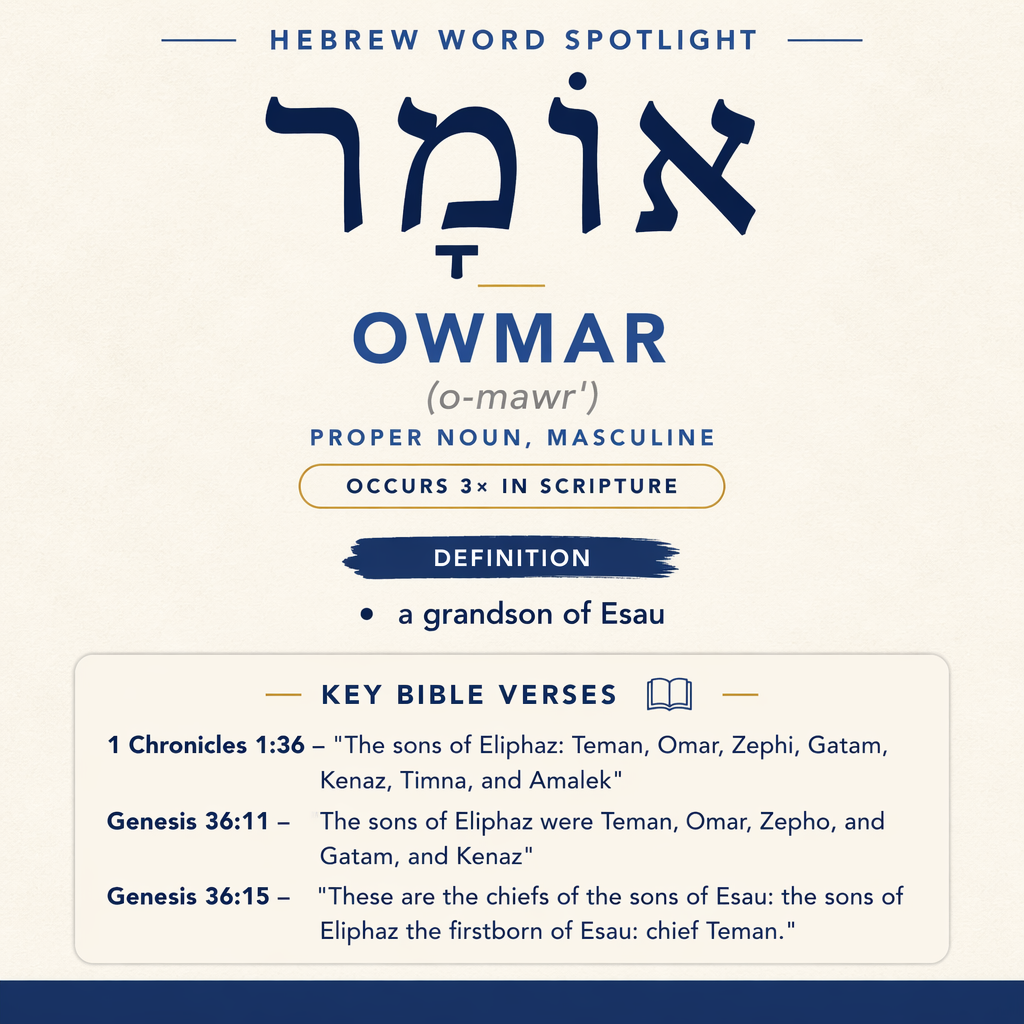
‘Owmar

o-mawr’
Parts of Speech: Proper Name Masculine

‘Owmar Definition

NAS Word Usage – Total: 3
Omar = “speaker” or “eloquent”

  1. grandson of Esau

Understanding ‘Owmar: Definition and Context in Hebrew

What Does ‘Owmar Mean?

The Hebrew word ‘Owmar (עֹמַר) translates to “sheaf” in English. In biblical texts, it often refers to a bundle of grain that has been harvested and gathered together. This term appears in various scriptures and carries both literal and symbolic meanings. Its agricultural roots are crucial, considering the historical context of farming in ancient Israel.

Books Worth Reading:
Sponsored
Book 3161Book 3154Book 3131Book 3129Book 3162

Biblical Context of ‘Owmar

The significance of ‘Owmar extends beyond its basic translation. In the Hebrew Bible, the concept of a sheaf represents not only the harvest but also the idea of God’s providence. One key scripture is found in Genesis, where Joseph interprets dreams involving sheaves. In Genesis 37:7, Joseph tells his brothers, “We were binding sheaves in the field, and behold, my sheaf arose and stood upright.” Here, the sheaf symbolizes Joseph’s future prominence and his role within God’s plan.

‘Owmar in Jewish Rituals

In Jewish tradition, ‘Owmar is more than just an agricultural term; it has specific implications during harvest festivals. For example, during the Feast of Weeks (Shavuot), the offering of the ‘Owmar (sheaf of barley) marks the beginning of the harvest season. This ceremony reflects gratitude and acknowledgment of the blessings received from God. It serves as a reminder of the dependence on divine providence for sustenance.

Symbolic Meanings of ‘Owmar

The sheaf, or ‘Owmar, also has rich symbolic implications in a spiritual context. It signifies abundance, community, and gratitude. The gathering of sheaves evokes images of collective labor and the joy of shared bounty during harvest time. In ancient Israel, farmers worked together during harvest, which fostered a sense of community and interdependence.

Books Worth Reading:
Sponsored
Book 3161Book 3154Book 3131Book 3129Book 3162

For example, imagine a small village anticipating the harvest season. As families join together to gather their crops, the act of bundling the sheaves symbolizes not only individual efforts but also a shared outcome. This communal reality is reflected in 1 Corinthians 3:9 in the Christian tradition, “For we are God’s fellow workers; you are God’s field, God’s building.” Thus, ‘Owmar extends beyond mere agriculture into the realm of spiritual cooperation.

Linguistic Dimensions of ‘Owmar

On a linguistic level, the word ‘Owmar is derived from the root עמר (Ayin-Mem-Resh), which has to do with gathering and binding. Understanding the root adds depth to the meaning of ‘Owmar. In Hebrew, the way words are formed and connected can provide insights into their meanings and uses. Other forms of this root appear in different contexts, indicating a consistent theme of gathering and abundance throughout Hebrew literature.

For example, the verb form of this root means to bind or gather. You might encounter a phrase in contemporary Hebrew that uses a related verb when talking about coming together for a common purpose. This linguistic connection reinforces the interpretation of ‘Owmar not only as a physical sheaf but as a symbol of unity and collective effort.

Books Worth Reading:
Sponsored
Book 3161Book 3154Book 3131Book 3129Book 3162

‘Owmar in Modern Hebrew

In modern Hebrew, ‘Owmar is less commonly used but still can be found within agricultural discussions or celebrations. It serves as a reminder of the country’s agrarian roots. In Hebrew education, children might learn about ‘Owmar when discussing the cycle of planting and harvesting. Moreover, during events like Yom Ha’atzmaut (Israeli Independence Day), the agricultural symbolism might be revisited to celebrate the land’s renewal and fertility.

‘Owmar as a Metaphor for Life

Interestingly, ‘Owmar can also serve as a metaphor for life experiences. Just as sheaves are gathered and bundled, human lives are interconnected through experiences and relationships. In discussions focusing on personal growth and community, one might refer to ‘Owmar to illustrate the idea of gathering wisdom from various life stages, showing how they contribute to one’s identity.

In practical terms, consider a youth group discussing their individual experiences. They could relate each personal story to a “sheaf,” showing how these separate narratives create a larger, richer tapestry of shared knowledge and growth. This makes ‘Owmar not only relevant in a historical and agricultural sense but also in today’s social context.

Books Worth Reading:
Sponsored
Book 3161Book 3154Book 3131Book 3129Book 3162

Relationship with Other Hebrew Words

The word ‘Owmar has relationships with other Hebrew words that enhance its meaning. For example, ‘Omer (אֹמֶר) is similar and often used in statistical contexts related to grains. This term, derived from the same root, refers to an ancient measure of grain. When examining relationships between these words, a deeper understanding of agricultural life in biblical times emerges.

Consider the blending of ‘Owmar with ‘Omer. When discussing a harvest, one might say they gathered ten ‘Omer of wheat, effectively using both terms to describe specific quantities. This cultural relevance underlines the importance of understanding these terms not only as standalone words but as part of a broader agricultural vocabulary.

Cultural Impact of ‘Owmar in Literature

In Jewish literature and folklore, the imagery of the sheaf has inspired various writings and stories. Poets and scholars have drawn on ‘Owmar to articulate themes of labor, fertility, and seasonality. The presence of ‘Owmar in such texts reflects the integral relationship people had with their environment and the cycles of life.

Books Worth Reading:
Sponsored
Book 3161Book 3154Book 3131Book 3129Book 3162

For example, a song recounting the joys of harvest might mention ‘Owmar to evoke a sense of nostalgia and celebration. Even in modern literature, the term can inspire creatives looking for ways to connect their themes to the agrarian roots of Hebrew culture. The word serves as a bridge, linking contemporary exploration with historical depth.

Educational Applications of ‘Owmar

Teachers and students studying the Hebrew Bible can engage with the concept of ‘Owmar by examining related texts, rituals, and agricultural practices. For example, a lesson plan might involve reading passages from Genesis while discussing the necessary conditions for growing wheat. This approach can lead to larger discussions about the environmental factors that affect crops, allowing for cross-disciplinary learning involving history, science, and language.

Moreover, in class projects, students may create presentations illustrating the role of ‘Owmar in biblical stories. By showcasing visual representations or even farming techniques, the learning experience becomes more relatable and grounded in real-world applications.

Books Worth Reading:
Sponsored
Book 3161Book 3154Book 3131Book 3129Book 3162

‘Owmar and Community Practices

Beyond education, ‘Owmar encourages community practices centered around agriculture and celebration. Many local farmers’ markets or communities committed to sustainability could adopt the term to promote collective harvests, reinforcing communal bonds. Initiatives that focus on local agriculture often highlight the need for cooperation and gratitude, perfectly embodying the spirit of ‘Owmar.

An event could feature a “sheaf celebration” where families come together to share produce, sow seeds, and teach children about the significance of agricultural customs. This dynamic evokes the historical traditions that surrounded the gathering of sheaves and strengthens present-day community ties.

The Role of ‘Owmar in Festivals and Holidays

During certain Jewish holidays, ‘Owmar is recalled in celebrations and rites. During Shavuot, the offering of the sheaf symbolizes the start of a new season while expressing thankfulness for the harvest’s bounty. Each season presents a context for remembering agricultural practices and their relation to spirituality.

Books Worth Reading:
Sponsored
Book 3161Book 3154Book 3131Book 3129Book 3162

For instance, Sukkot, the Feast of Tabernacles, incorporates the theme of harvest, where sheaves may also be mentioned in prayers. By connecting ‘Owmar with festivals, its significance transcends the individual quality of a sheaf into a larger communal expression of faith and gratitude.

Reflections on Agricultural Practices and Humanity

As agricultural practices reflect human experiences, ‘Owmar reminds us of the interconnectedness of life and labor. The idea of harvesting sheaves makes its way into narratives and values surrounding hard work and community effort. It resonates with the universal experience of contributing to something larger than oneself.

The act of gathering sheaves, therefore, embodies both the physical and spiritual aspects of human existence. The word ‘Owmar serves as a reminder of the labor involved in sustaining both communities and souls, showing how language captures essential truths about our experiences and connections in life.

Books Worth Reading:
Sponsored
Book 3161Book 3154Book 3131Book 3129Book 3162

Little Known Secrets

The Hebrew word ‘Owmar carries deeper meanings and connections that many may not know.

  • ‘Owmar is often translated as “to speak” or “to declare,” but it also implies a sense of creativity and the power of spoken words in shaping reality.
  • In some biblical contexts, ‘Owmar is associated with the act of raising one’s voice, emphasizing the importance of proclamation and the authority behind the words spoken.
  • The root of ‘Owmar is connected to words in Hebrew that convey an idea of formation, revealing how speaking can be an act of creating or bringing forth new ideas and actions.
  • In the book of Job, ‘Owmar is used in a way that reflects the struggle between humanity and the divine, where speaking becomes a way to express human doubts and questions about faith.
  • Scholars note that ‘Owmar can also relate to the concept of storytelling, suggesting that sharing experiences through words is vital for maintaining cultural identity and history in ancient Hebrew society.
  • The word’s usage in prophetic literature highlights how the pronouncements made by prophets were not just statements but powerful declarations that shaped the fate of nations and individuals.
  • ‘Owmar is sometimes found in conjunction with other Hebrew words, creating phrases that deepen its meaning, such as when it’s paired with ‘aḇaḏ, meaning “to work,” highlighting the connection between speech and action.

Conclusion

In summary, the Hebrew word “owmar” is rich in meaning and significance. It generally translates to “speak” or “say,” highlighting the importance of communication in Jewish culture and scripture. Throughout the Bible, “owmar” appears in various contexts, showing how words can convey God’s messages, promises, and teachings. Understanding this word helps us appreciate the deep connections between language, faith, and community in Hebrew texts. As we explore these ancient words, we uncover layers of meaning that continue to speak to us today.

Common Questions Related to What Does ‘Owmar Mean In Hebrew

Q. What does the Hebrew word ‘Owmar mean?
A. The Hebrew word ‘Owmar means “to say” or “to speak.” It is often used when someone is expressing something verbally.

Books Worth Reading:
Sponsored
Book 3161Book 3154Book 3131Book 3129Book 3162

Q. Can ‘Owmar be found in the Bible?
A. Yes, ‘Owmar appears in the Hebrew Bible in various contexts, often related to speaking or declaring something important.

Q. Is ‘Owmar used in everyday Hebrew language?
A. Yes, ‘Owmar is still used in modern Hebrew to mean “to say” or “to tell” when people are having conversations.

Q. How is ‘Owmar related to other Hebrew words?
A. ‘Owmar is related to other words in Hebrew that deal with speech or communication, such as “davar,” which means “word” or “thing.”

Books Worth Reading:
Sponsored
Book 3161Book 3154Book 3131Book 3129Book 3162

Q. In what context might someone use ‘Owmar in a sentence?
A. Someone might say, “I want to ‘Owmar my thoughts about this topic,” meaning they want to express their ideas.

Q. Does ‘Owmar have a noun form in Hebrew?
A. Yes, the noun form related to ‘Owmar is “omer,” which refers to a speech or saying.

Q. Is there a specific tense or form for ‘Owmar?
A. ‘Owmar is a verb in its infinitive form, and it can change based on the tense or subject in sentences.

Books Worth Reading:
Sponsored
Book 3161Book 3154Book 3131Book 3129Book 3162

Q. Are there similar words to ‘Owmar in other Semitic languages?
A. Yes, similar words exist in other Semitic languages like Arabic, where a similar root also relates to speech or speaking.

Q. How can understanding ‘Owmar help us in Bible study?
A. Understanding ‘Owmar helps us grasp the importance of verbal communication in the Bible, where speaking often conveys God’s messages or commands.

Q. Are there any famous verses in the Bible that include ‘Owmar?
A. Yes, many verses, especially in the books of the Prophets, include ‘Owmar, where God tells His messages to the people through verbal proclamation.

Books Worth Reading:
Sponsored
Book 3161Book 3154Book 3131Book 3129Book 3162

About the Author

Ministry Voice

{"email":"Email address invalid","url":"Website address invalid","required":"Required field missing"}

Want More Great Content?

Check Out These Articles 

mba ads=84