Uncovering the Meaning of ‘owdowth in Hebrew
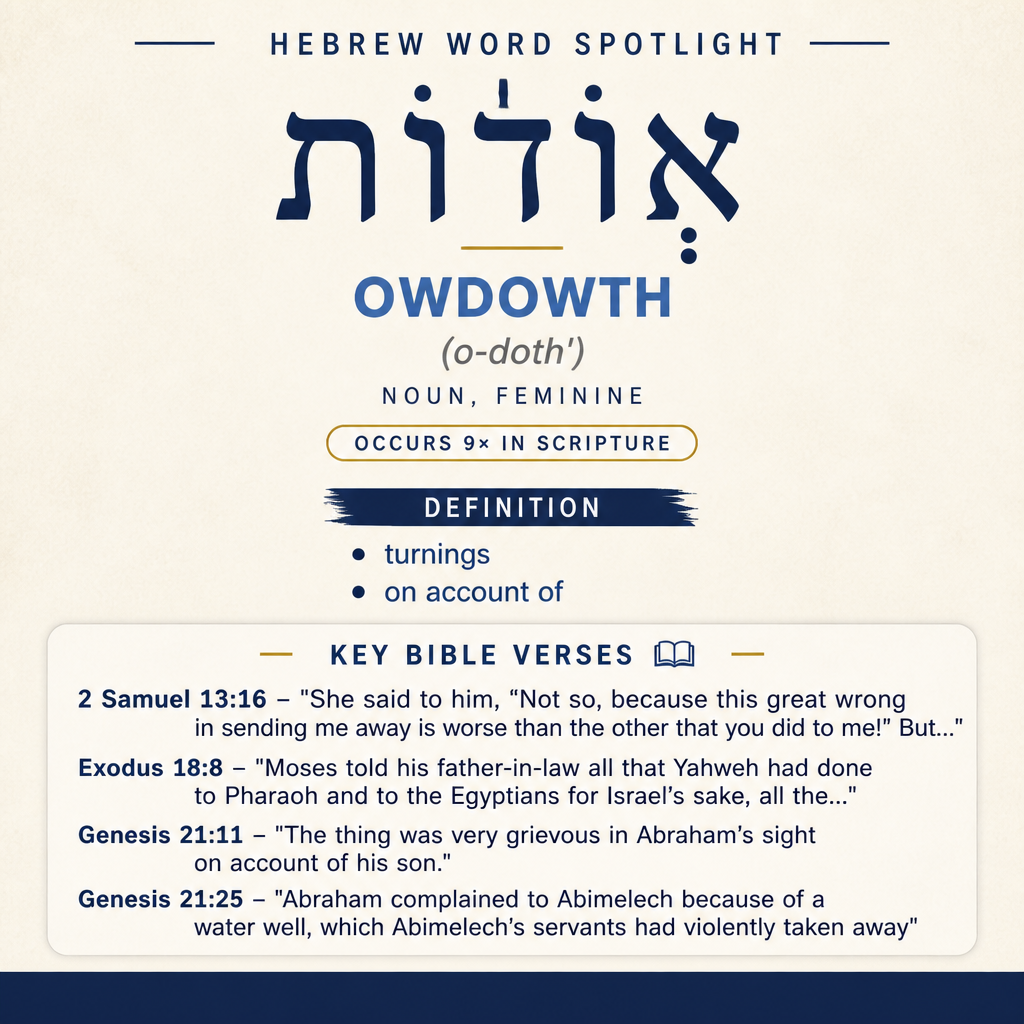
אוֹדוֹת means “turnings” and “on account of,” occurring nine times in Scripture, including Genesis 21:11, Exodus 18:8, and Jeremiah 3:8.
Core Meaning
אוֹדוֹת is defined as “turnings” and “on account of.” The listed occurrences show it used to express cause or reason (“on account of”).
Learn More →Occurrence Profile
This word occurs 9 times in Scripture. References provided include Genesis 21:11, Genesis 21:25, Exodus 18:8, and Jeremiah 3:8.
Learn More →Context Examples
In Genesis 21:11 it appears in the phrase “on account of his son.” In Judges 6:7 it appears in the context of Israel crying to Yahweh because of Midian.
Learn More →אוֹדוֹת (owdowth) expresses “turnings” and, in usage, functions to mark causation (“on account of”) in a small set of narrative and prophetic scenes. It appears in nine passages ranging from patriarchal disputes over wells to covenant-history recollections and indictments of unfaithfulness.

Occurrences
“She said to him, “Not so, because this great wrong in sending me away is worse than the other that you did to me!” But he would not listen to her.” (2 Samuel 13:16)
Here the word sits inside a protest that hinges on a stated reason. The speaker points to the act of being sent away and frames it as “this great wrong,” weighing it against what came before (“the other that you did to me”). The causal marker (“because”) forces attention onto the grounds of the complaint: the later act is evaluated on account of its character as an additional and greater wrong.
“Moses told his father-in-law all that Yahweh had done to Pharaoh and to the Egyptians for Israel’s sake, all the hardships that had come on them on the way, and how Yahweh delivered them.” (Exodus 18:8)
In Moses’ report, the word serves to connect actions and experiences to the interests they serve. “For Israel’s sake” identifies the account’s orientation: Yahweh’s deeds toward Pharaoh and Egypt are narrated as done on account of Israel. The same verse then stacks a second layer of explanation—hardships encountered “on the way” and deliverance—so the causal phrase helps organize the story as an interpretation of events with an explicit beneficiary.
“The thing was very grievous in Abraham’s sight on account of his son.” (Genesis 21:11)
This sentence turns on a stated cause for Abraham’s distress. The grief is not left as a bare emotion; it is tied “on account of his son,” specifying what makes “the thing” grievous. The phrase narrows the reader’s focus from the unspecified “thing” to its relational impact, grounding the emotional reaction in a personal connection named in the text.
“Abraham complained to Abimelech because of a water well, which Abimelech’s servants had violently taken away.” (Genesis 21:25)
In this dispute scene, the word introduces the legal and practical basis for a complaint. Abraham’s grievance is “because of a water well,” and the verse immediately supplies the precipitating action: the servants “had violently taken away” the well. The causal link frames the complaint as a response to a concrete wrong with clear stakes in access to water.
“The same day, Isaac’s servants came, and told him concerning the well which they had dug, and said to him, “We have found water.”” (Genesis 26:32)
Here the word appears in a report “concerning the well.” While the verse is celebratory—“We have found water”—the phrasing highlights the topic that occasions the announcement. The word marks what the message is about and why the servants come at that moment: the newly dug well and the discovery of water are the basis for the communication.
“I saw when, for this very cause, that backsliding Israel had committed adultery, I had put her away and given her a certificate of divorce, yet treacherous Judah, her sister, had no fear; but she also went and played the prostitute.” (Jeremiah 3:8)
In prophetic accusation, the word is strengthened: “for this very cause.” The phrase functions like a pointed finger at a stated ground for judgment. The verse itself supplies that ground—Israel “had committed adultery”—and links it to the consequent action (“I had put her away and given her a certificate of divorce”). The causal marker does more than explain; it organizes the sequence of offense and response, and then contrasts Judah’s lack of fear despite seeing the cause-and-effect.
“Then the children of Judah came near to Joshua in Gilgal. Caleb the son of Jephunneh the Kenizzite said to him, “You know the thing that Yahweh spoke to Moses the man of God concerning me and concerning you in Kadesh Barnea.” (Joshua 14:6)
In Caleb’s appeal, the word introduces what a prior divine word was about: it was spoken “concerning me and concerning you.” The phrase anchors the coming request (implied by the approach and the address to Joshua) in a remembered statement with personal relevance. The causal/relational force lies in the fact that the “thing” is not abstract; its significance turns on whom it concerns.
“When the children of Israel cried to Yahweh because of Midian,” (Judges 6:7)
This clause sets the trigger for the cry: it is “because of Midian.” Even without further detail in the quoted line, the word marks Midian as the pressure-point that drives Israel to appeal to Yahweh. The causation is straightforward and collective: a people’s action (crying out) is explained on account of an external threat named in a single word.
“That place was called the valley of Eshcol, because of the cluster which the children of Israel cut down from there.” (Numbers 13:24)
In a naming notice, the word ties a geographic label to a remembered event. The valley’s name is given “because of the cluster” taken from it, and the verse identifies the actors: “the children of Israel cut down” the cluster there. The causal phrase connects language to experience—an act in the landscape becomes the reason for what the place is called.
Sense and Usage
Across these passages, אוֹדוֹת (owdowth) works as a hinge between an outcome and the grounds that explain it. Sometimes the outcome is emotional evaluation: something is “very grievous” with the reason stated “on account of his son” (Genesis 21:11), or a wrong is judged worse “because this great wrong in sending me away is worse” than a prior act (2 Samuel 13:16). In these cases, the word supplies the reason that makes the speaker’s response intelligible within the sentence itself.
In other scenes the word connects formal speech to the issue at hand. Abraham “complained … because of a water well” (Genesis 21:25), and Isaac’s servants report “concerning the well” (Genesis 26:32). Caleb appeals to Joshua by pointing to what Yahweh spoke “concerning me and concerning you” (Joshua 14:6). Here the term functions to frame discourse—complaint, report, or appeal—by specifying the matter that occasions it and gives it direction.
The word also anchors broader interpretive narration. Moses recounts events “for Israel’s sake” (Exodus 18:8), making Israel’s welfare the explanatory center for what Yahweh did to Pharaoh and the Egyptians. The naming of the valley of Eshcol is explained “because of the cluster” cut down there (Numbers 13:24), showing how a concrete action becomes the basis for a lasting designation. Judges 6:7 compresses the same logic into a single causal line: Israel cries to Yahweh “because of Midian,” a concise explanation that identifies the catalyst for communal prayer.
Jeremiah 3:8 intensifies the explanatory function by turning it into a moral argument: “for this very cause” introduces the ground (Israel’s adultery) and ties it to a declared response (divorce imagery), then uses that established cause to expose Judah’s lack of fear. In that setting, the word’s causal force supports an indictment: the reason is not merely informative but accusatory, pressing the listener to recognize the connection between conduct and consequence presented in the verse.
Imagery in Context
Although the word itself is an explanatory connector, the passages attach it to vivid, concrete triggers: a sent-away woman naming “this great wrong” (2 Samuel 13:16), wells taken and dug with the relief of “We have found water” (Genesis 21:25; Genesis 26:32), a people driven to cry out “because of Midian” (Judges 6:7), and a valley named from a “cluster” cut down there (Numbers 13:24). Even in the more formal scenes—Moses’ retelling “for Israel’s sake” (Exodus 18:8) and Jeremiah’s “for this very cause” (Jeremiah 3:8)—the word keeps pulling the reader from mere events to the stated grounds that explain why those events are told, judged, or remembered as they are.
Sources: Lexical data from Strong’s Exhaustive Concordance and the Open Scriptures Hebrew Lexicon. Occurrence data from the Westminster Leningrad Codex with STEPBible reference data (CC BY). Scripture quotations from the World English Bible (public domain).