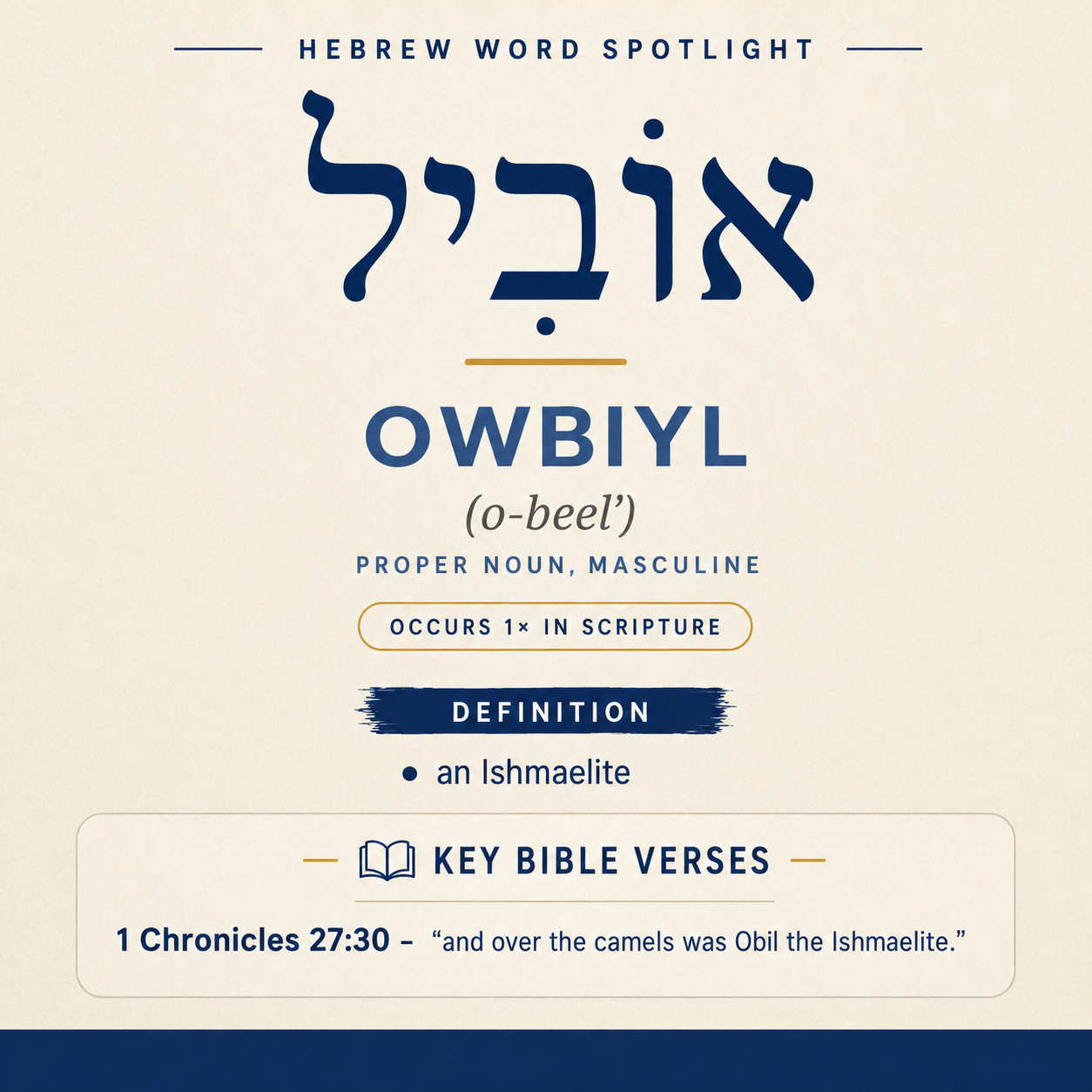
‘owbiyl

o-beel’
Parts of Speech: Proper Name Masculine

‘owbiyl Definition

NAS Word Usage – Total: 1
Obil = “camel driver”

  1. manager of David’s camels

What Does ‘Owbiyl Mean in Hebrew?

The Hebrew word ‘owbiyl (אוביל) translates roughly to “to bring or carry.” It can also convey nuances of assistance or transportation, especially within a context concerning guidance. Understanding this word helps to unlock deeper meanings in biblical texts where it appears.

Books Worth Reading:
Sponsored
Book 3154Book 3131Book 3162Book 3129Book 3161

Etymology of ‘Owbiyl

The roots of ‘owbiyl come from the Hebrew language’s rich and ancient past. The root of this word is ‘ab, which generally relates to strength or power. In the semantic range, ‘owbiyl reflects actions related to carrying or leading, indicating not just a physical act but also a figurative one, such as guiding someone through moral or spiritual challenges.

Context in Biblical Scripture

In the Hebrew Bible, ‘owbiyl has significant theological and practical implications. One example includes its use when discussing the Exodus, where God ‘owbiyl (carries or brings) the Israelites out of Egypt. This event wasn’t merely a physical liberation but also a spiritual guidance towards a promised land, underscoring the multifaceted meanings of the term.

Different Uses of ‘Owbiyl in Hebrew Texts

Within various contexts, ‘owbiyl carries different connotations.

Books Worth Reading:
Sponsored
Book 3154Book 3131Book 3162Book 3129Book 3161

Physical Carrying

One prominent use is in the context of physically carrying burdens or objects. For instance, in a situation where individuals are instructed to carry the Ark of the Covenant, the use of ‘owbiyl emphasizes not only the act of taking responsibility but also the honor and significance attached to this transmission.

Guidance

Another important dimension of ‘owbiyl is its application in guidance. For example, a leader guiding their people can be metaphorically described as ‘owbiyl. When Moses leads the Israelites through the desert, he ‘owbiyl them by teaching them the laws and helping them navigate challenges they face. This illustrates that leadership involves both responsibility and revelation.

Symbolic Meaning

On a more symbolic level, ‘owbiyl can refer to the way individuals may carry their faith or beliefs. When speaking about carrying the Word of God, believers might express this as ‘owbiyl their faith in daily practices. It underscores how responsibilities and teachings are transmitted over generations.

Books Worth Reading:
Sponsored
Book 3154Book 3131Book 3162Book 3129Book 3161

The Nuances of ‘Owbiyl

The usage of ‘owbiyl extends into the emotional and spiritual realms as well. The idea of carrying burdens is a recurring theme in literature and theological discussions.

Burden Bearing

For example, in a community setting, the term ‘owbiyl may be brought up during discussions about supporting one another. This notion suggests that members of a community help ‘owbiyl each other’s burdens, be it through emotional support or tangible assistance. This reflection reinforces the idea of collective responsibility.

Spiritual Guidance

In a more abstract sense, ‘owbiyl can reflect spiritual guidance provided by mentors, leaders, or religious figures. Such guidance is crucial in times of confusion or moral dilemmas. It invokes the imagery of divine support, often depicted in biblical narratives where God or a prophetic figure ‘owbiyl individuals towards righteous choices.

Books Worth Reading:
Sponsored
Book 3154Book 3131Book 3162Book 3129Book 3161

Examples From Biblical Texts

Biblical texts showcase various instances where ‘owbiyl is pertinent. Let’s look at some examples that encapsulate the essence of the term.

Exodus Narrative

In Exodus 3:8, God tells Moses that He has come to deliver the Israelites from Egyptian bondage. Here, ‘owbiyl represents not just geographical relocation but an act of divine involvement in guiding a nation towards freedom. This shows how God ‘owbiyl them to a better future, connoting both physical and moral deliverance.

Priestly Duties

In the Book of Numbers, ‘owbiyl appears in discussions about the priests carrying the holiness of the Tabernacle. This image conveys how spiritual leaders have the role of ‘owbiyl sacred duties, serving the community while guiding their spiritual journey.

Books Worth Reading:
Sponsored
Book 3154Book 3131Book 3162Book 3129Book 3161

Usage in Modern Hebrew

In modern Hebrew, while the word ‘owbiyl is not commonly used in daily conversations, its essence continues to play a role in cultural and educational contexts.

Education and Leadership

For instance, educators may express how they ‘owbiyl students through their studies, guiding them in both academic and personal growth. This reflects societal values where creating a supportive learning environment is paramount.

Community Initiatives

Similarly, in community service groups, organizers might refer to how they ‘owbiyl each other during different projects. By carrying responsibilities together, they foster a sense of camaraderie and shared mission.

Books Worth Reading:
Sponsored
Book 3154Book 3131Book 3162Book 3129Book 3161

Related Terms and Concepts

To fully grasp ‘owbiyl, it is helpful to explore related Hebrew words that share the same essence.

Tsa’ar

The word tsa’ar (צער) relates to pain or burden. It often highlights emotional challenges, suggesting that carrying someone’s burden can also involve dealing with foundational issues. In a narrative where ‘owbiyl and tsa’ar meet, one can visualize compassionate guidance through hardships.

Nimshal

Another related term is nimshal (נמשל), which indicates a metaphorical application of meanings and concepts. When teaching, one might ‘owbiyl students through metaphors, helping them understand complex ideas by connecting them to real-life experiences.

Books Worth Reading:
Sponsored
Book 3154Book 3131Book 3162Book 3129Book 3161

Practical Application in Society

Understanding the term ‘owbiyl has practical implications beyond its original biblical text.

Counseling and Support

In counseling practices, the idea of ‘owbiyl can be vital. Counselors often help individuals carry their emotional burdens by offering support and constructive guidance through difficult times, making this concept relevant in real-world applications of psychology and community service.

Teamwork Dynamics

In a workplace setting, ‘owbiyl could be applied to situations where team members help each other carry workloads or share responsibilities. This cooperative dynamic leads to a more effective and harmonious working environment.

Books Worth Reading:
Sponsored
Book 3154Book 3131Book 3162Book 3129Book 3161

Summary of ‘Owbiyl’s Significance

The significance of ‘owbiyl in Hebrew highlights the complexities of carrying and guidance across various domains—spiritual, emotional, and physical. The multifaceted applications of this term elevate its relevance throughout significant narratives and everyday life experiences. Understanding ‘owbiyl enhances our comprehension of relationships and responsibilities in both biblical and modern contexts.

Conclusion

Although this article delves into the rich meanings and applications of ‘owbiyl, it is essential to acknowledge that its implications can stretch even further within various cultural and social contexts. The exploration of this word unveils layers of meaning yet to be fully pieced together in the tapestry of human experience and understanding rooted in the Hebrew Bible.

By engaging with ‘owbiyl, individuals can not only gain insight into ancient texts but also find inspiration for their modern lives, affirming the timeless resonance of scriptural teachings.

Books Worth Reading:
Sponsored
Book 3154Book 3131Book 3162Book 3129Book 3161

Little Known Secrets

The Hebrew word ‘owbiyl (אוביאל) has interesting layers of meaning and historical significance.

  • Root Connection: ‘Owbiyl is connected to the root word ‘ab, which means “father.” This connection hints at themes of leadership or protection within familial relationships.
  • Occult Associations: In some contexts, ‘owbiyl refers to a specific kind of necromancer or medium, showing a link to ancient practices of communicating with the dead, which were often condemned in biblical texts.
  • Cultural Context: The practice of seeking guidance from ‘owbiyl figures illustrates the tension between the worship of Yahweh and the surrounding cultures that engaged in spiritism and divination.
  • Translation Variations: Depending on the translation, ‘owbiyl may appear as “ghost,” “spirit,” or “medium,” which can change the understanding of the passages where it appears.
  • Biblical Instances: The term is notably used in 1 Samuel 28, where King Saul seeks out a medium to summon the spirit of Samuel, revealing deep fears and desperation in his character.
  • Linguistic Features: The pronunciation and spelling of ‘owbiyl can vary slightly in different Hebrew dialects, which may affect its interpretation in various religious contexts.
  • Moral Implications: The use of ‘owbiyl raises questions about morality and faith, challenging characters in biblical stories to reflect on their reliance on spiritual versus physical guidance.
  • Connection to Idolatry: Engaging with ‘owbiyl is often seen as a form of idolatry, showing how the ancient Israelites struggled with remaining faithful to their God amid competing beliefs and practices.
  • Scholarly Debate: Scholars frequently debate the exact meaning and implications of ‘owbiyl, with some suggesting its use may have evolved over time to reflect changing societal views on the afterlife and communication with spirits.

Conclusion

In understanding the Hebrew word “owbiyl,” we uncover its deep roots and rich meanings. This term, which can relate to the ideas of purpose and intention, highlights the importance of thoughtful actions and the motivations behind them. By studying words like “owbiyl,” we gain a better appreciation for the language of the Bible and the messages it carries. This exploration not only helps us grasp ancient texts but also encourages us to reflect on our own lives and choices. Whether in everyday language or spiritual practice, the meanings of such words continue to resonate today.

Common Questions Related to What Does ‘owbiyl Mean In Hebrew

Q. What does the Hebrew word ‘owbiyl mean?
A. The Hebrew word ‘owbiyl means “to give a drink” or “to cause to drink.” It is derived from a root that connects to the act of watering or feeding.

Books Worth Reading:
Sponsored
Book 3154Book 3131Book 3162Book 3129Book 3161

Q. Where in the Bible can we find the word ‘owbiyl?
A. The word ‘owbiyl appears in Hebrew texts and can be found in some translations of the Old Testament, especially in contexts referring to providing water.

Q. What is the root word of ‘owbiyl?
A. The root word of ‘owbiyl is from the Hebrew root ע-ב-ל (A-B-L), which has meanings related to drinking or providing beverages.

Q. How is ‘owbiyl used in everyday Hebrew language?
A. In modern Hebrew, ‘owbiyl is not commonly used in everyday conversation, but it helps in understanding the historical and biblical context of providing nourishment.

Books Worth Reading:
Sponsored
Book 3154Book 3131Book 3162Book 3129Book 3161

Q. In what kinds of biblical passages might ‘owbiyl be important?
A. ‘Owbiyl is important in passages that discuss agriculture, hospitality, and the care of livestock, as they often emphasize the importance of providing water and sustenance.

Q. Can ‘owbiyl be seen as a metaphor in the Bible?
A. Yes, ‘owbiyl can be used metaphorically to represent spiritual nourishment, such as God providing for His people, just as water nourishes the body.

Q. Are there other words in Hebrew that relate to ‘owbiyl?
A. Yes, words like מַשְׁקֶה (mashkeh), which also means drink or beverage, relate closely to ‘owbiyl and provide context to how nourishment is viewed in Hebrew.

Books Worth Reading:
Sponsored
Book 3154Book 3131Book 3162Book 3129Book 3161

Q. How does the meaning of ‘owbiyl connect to the culture of ancient Israel?
A. In ancient Israel, water was vital for survival, so ‘owbiyl’s meaning highlights the importance of caring for others and the land, which were key values in their culture.

Q. What is one example of ‘owbiyl being used in a biblical story?
A. An example of a similar theme is in the story of Jesus meeting the Samaritan woman at the well, where providing water takes on both literal and spiritual significance.

Q. Can we find ‘owbiyl in both the Old and New Testaments?
A. ‘Owbiyl itself is a Hebrew term and primarily appears in the Old Testament. However, its concepts regarding water and nourishment are echoed in the New Testament through teachings and parables.

Books Worth Reading:
Sponsored
Book 3154Book 3131Book 3162Book 3129Book 3161

About the Author

Ministry Voice

{"email":"Email address invalid","url":"Website address invalid","required":"Required field missing"}

Want More Great Content?

Check Out These Articles 

mba ads=90