Discovering the Meaning of ‘Adrammelek in Hebrew
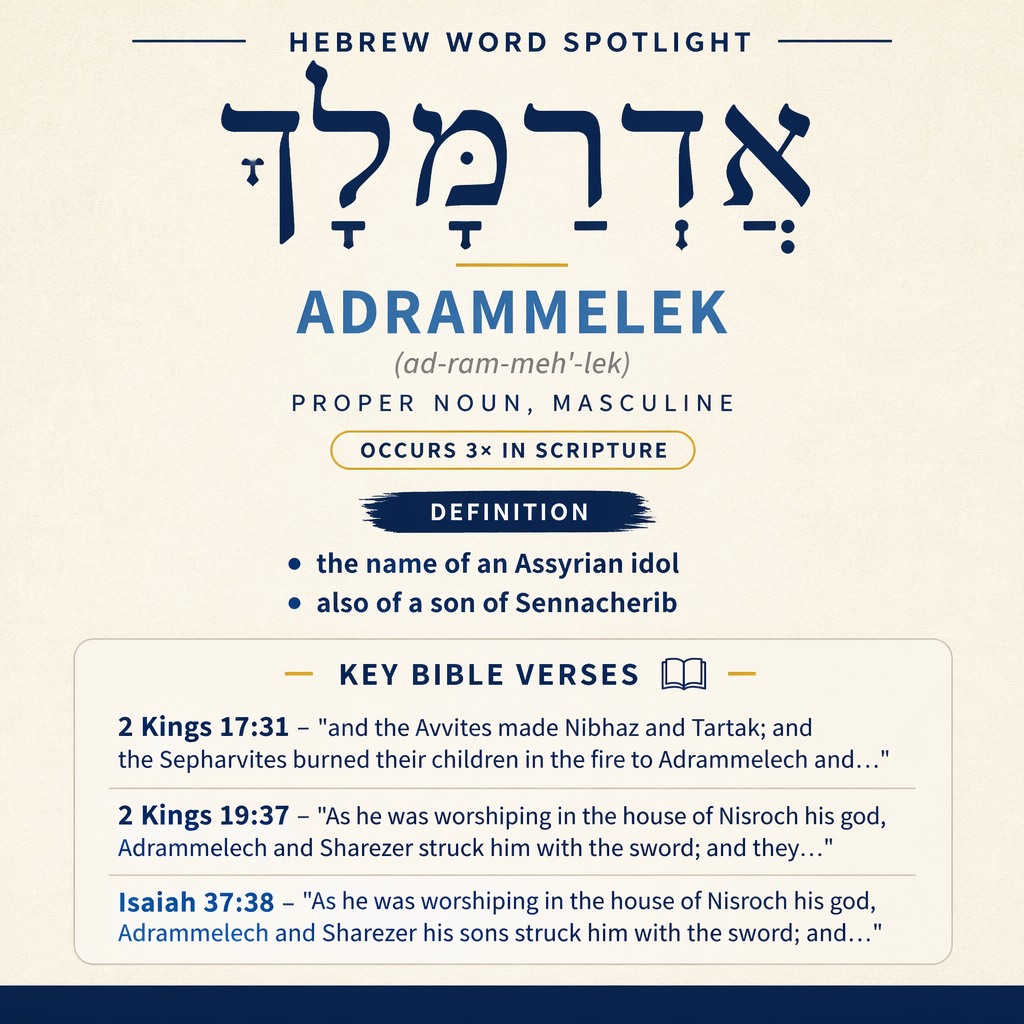
אֲדְרַמֶּלֶךְ (Adrammelek) names an Assyrian idol and a son of Sennacherib, appearing in 2 Kings 17:31; 2 Kings 19:37; Isaiah 37:38.
Name & Referent
Adrammelek is the name of an Assyrian idol. It is also the name of a son of Sennacherib.
Learn More →Idol Worship
In 2 Kings 17:31, the Sepharvites burned their children in the fire to Adrammelek and Anammel.
Learn More →Sennacherib’s Death
In 2 Kings 19:37 and Isaiah 37:38, Adrammelech and Sharezer struck Sennacherib with the sword while he worshiped in Nisroch’s house.
Learn More →Adrammelek is the name of an Assyrian idol and also the name of a son of Sennacherib. Scripture uses the same name in two distinct settings: the worship practices of transplanted peoples and the assassination of a king in a temple.
Occurrences
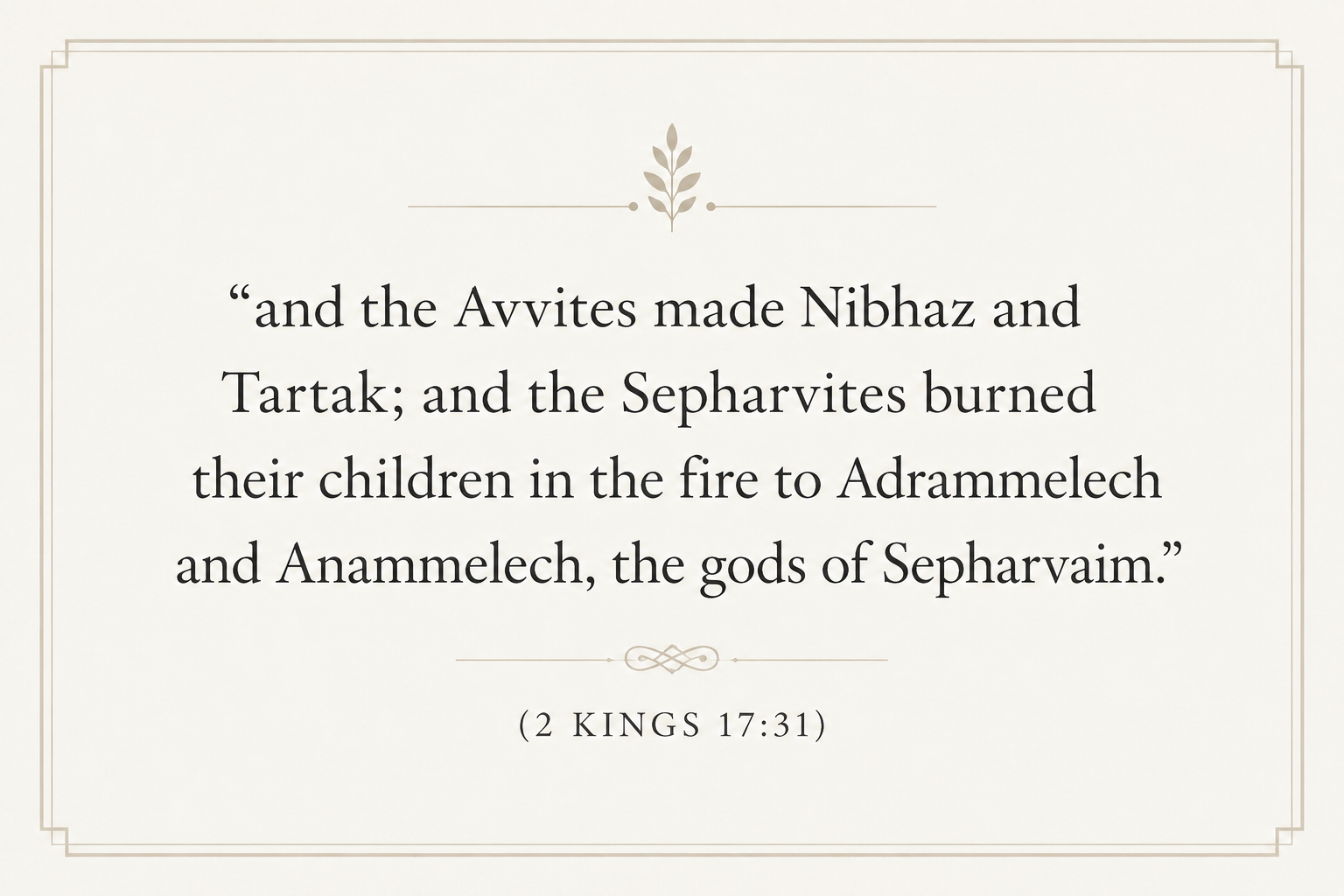
“and the Avvites made Nibhaz and Tartak; and the Sepharvites burned their children in the fire to Adrammelech and Anammelech, the gods of Sepharvaim.” (2 Kings 17:31)
Here Adrammelek appears in a list of named deities associated with particular groups. The verse places Adrammelek alongside “Anammelech,” identifying both as “the gods of Sepharvaim,” and it connects their worship with an extreme ritual: “the Sepharvites burned their children in the fire to Adrammelech and Anammelech.” In the narrative flow of the sentence, Adrammelek functions as the recipient of this offering (“to Adrammelech”), marking a cultic object of devotion. The name stands as a proper, specific designation rather than a general category—one element in a catalog of worship that is presented through concrete acts (“made,” “burned”) and local affiliations (“Avvites,” “Sepharvites,” “Sepharvaim”).
“As he was worshiping in the house of Nisroch his god, Adrammelech and Sharezer struck him with the sword; and they escaped into the land of Ararat. Esar Haddon his son reigned in his place.” (2 Kings 19:37)
In this verse Adrammelek is not an idol but a person, paired with “Sharezer” as an agent of violence: “Adrammelech and Sharezer struck him with the sword.” The setting is explicitly religious—“worshiping in the house of Nisroch his god”—so the name appears in a scene where temple worship and political upheaval collide. Adrammelek is presented as acting decisively within the sanctuary context: the killing is carried out while the victim is engaged in worship. The verse then traces immediate consequences: the assailants “escaped into the land of Ararat,” and a succession follows (“Esar Haddon his son reigned in his place”). Adrammelek’s placement at the front of the paired names gives him a clear role in the act and in the transition of power that the sentence records.
“As he was worshiping in the house of Nisroch his god, Adrammelech and Sharezer his sons struck him with the sword; and they escaped into the land of Ararat. Esar Haddon his son reigned in his place.” (Isaiah 37:38)
This occurrence closely matches the wording of the account in Kings, again situating the action in “the house of Nisroch his god” and describing the killing with the same terse phrase: “struck him with the sword.” Isaiah adds an explicit relationship: “Adrammelech and Sharezer his sons,” making clear that Adrammelek is one of the king’s sons. As in the parallel line, Adrammelek is a named participant in an assassination that takes place during worship and is followed by flight (“they escaped into the land of Ararat”) and dynastic replacement (“Esar Haddon his son reigned in his place”). In this form, the name carries family proximity—son against father—inside a sacred space, joining domestic betrayal to temple ritual and political succession in a single sentence.

Sense and Usage
The name Adrammelek spans two sharply different referents within the same canon: an Assyrian idol (2 Kings 17:31) and a son of Sennacherib (2 Kings 19:37; Isaiah 37:38). In the first setting, Adrammelek is introduced among other named gods, tied to a specific people and place (“the gods of Sepharvaim”) and invoked as the object toward whom a ritual action is directed (“burned their children in the fire to Adrammelech”). The verse’s grammar keeps Adrammelek within the orbit of cultic devotion: the name is part of a set of deities distinguished by proper names, with worship described as tangible manufacturing (“made”) and sacrificial burning (“burned”).
In the latter setting, Adrammelek is a human bearer of the same name, acting within a temple scene. Both narratives place the victim in the act of worship: “As he was worshiping in the house of Nisroch his god.” Against that backdrop, Adrammelek is named as an executor of judgment by the sword, followed by escape and a change of reign. The texts thus juxtapose two kinds of “religious space” associated with Assyria: in one, a foreign deity receives offerings; in the other, a foreign god’s temple becomes the backdrop for political violence and succession. Adrammelek, whether as idol or assassin, is anchored to scenes involving worship—either as the recipient of ritual, or as a participant in an event occurring during ritual.
The duplication of the name across these referents also highlights how proper names can carry different functions without changing form. In Kings 17, Adrammelek’s identity is defined by being a “god” of a named locale; in Kings 19 and Isaiah 37, Adrammelek’s identity is defined by action (“struck him with the sword”) and, in Isaiah’s phrasing, by kinship (“his sons”). The two usages are not blended: each passage signals which referent is intended by the immediate frame—either “the gods of Sepharvaim” or “Sharezer…his sons.” The name thereby serves as a marker of specificity in two domains: cultic devotion and royal household politics.
Imagery in Context
The three passages attach Adrammelek to stark images. In 2 Kings 17:31, the name stands at the end of a line describing children “burned…in the fire,” an image of worship expressed through destruction. In 2 Kings 19:37 and Isaiah 37:38, the image is equally concrete: a king “worshiping in the house” of his god, struck “with the sword,” with the killers fleeing to another land and a new ruler taking the throne. Across these scenes, Adrammelek is repeatedly heard in the vicinity of sanctuaries, offerings, and acts that decisively end life, so that the name evokes worship settings marked by violent outcomes.
Sources: Lexical data from Strong’s Exhaustive Concordance and the Open Scriptures Hebrew Lexicon. Occurrence data from the Westminster Leningrad Codex with STEPBible reference data (CC BY). Scripture quotations from the World English Bible (public domain).