What Does Eder Mean in Hebrew?
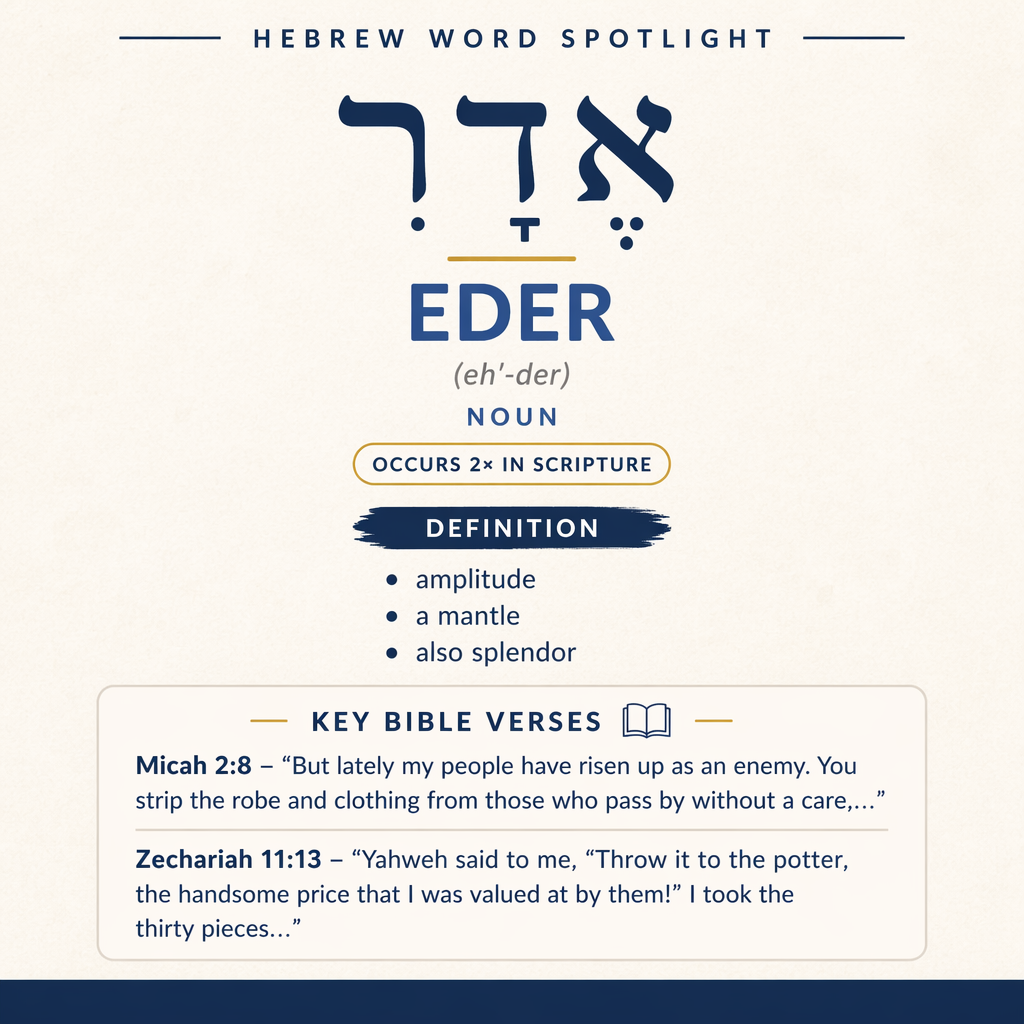
אֶדֶר (eder) means amplitude, a mantle, or splendor, and appears in Micah 2:8 and Zechariah 11:13.
Scripture Locations
This word occurs 2 times in Scripture: Micah 2:8 and Zechariah 11:13.
Learn More →Context Snapshots
In Micah 2:8, it appears in a context of stripping the robe and clothing. In Zechariah 11:13, it appears amid the thirty pieces of silver and the potter.
Learn More →אֶדֶר (eder) carries the sense of “amplitude; a mantle; also splendor.” It appears in two prophetic contexts, one describing the stripping of clothing from passersby and the other describing the casting away of a “handsome price” in Yahweh’s house.
Occurrences
“But lately my people have risen up as an enemy. You strip the robe and clothing from those who pass by without a care, returning from battle.” (Micah 2:8)
In Micah 2:8, eder belongs to an accusation framed as a reversal of proper social relations: “my people have risen up as an enemy.” The concrete action that displays this hostility is the stripping away of dress: “You strip the robe and clothing from those who pass by without a care.” Within the verse’s paired terms—“robe” alongside “clothing”—eder contributes to the picture of a substantial outer covering, something that ought to remain with the wearer but is forcibly removed. The people targeted are described as those who “pass by without a care,” and as “returning from battle,” which intensifies the sense of vulnerability and violation: the act is not ordinary loss but deliberate taking, and the garment imagery serves as the visible sign of aggression. In this setting, eder functions as part of the language of dispossession: an outer covering that can be stripped becomes the emblem of a wider turning of neighborliness into enmity.
“Yahweh said to me, “Throw it to the potter, the handsome price that I was valued at by them!” I took the thirty pieces of silver, and threw them to the potter, in Yahweh’s house.” (Zechariah 11:13)
In Zechariah 11:13, the scene is set by a direct word from Yahweh and a commanded action. The focus is on valuation and contempt: a “handsome price” is named as the price at which Yahweh says he “was valued at by them,” and the prophet enacts rejection by taking “the thirty pieces of silver” and throwing them “to the potter, in Yahweh’s house.” Eder here aligns with the evaluative language—“handsome”—that frames the silver not merely as currency but as a kind of outwardly impressive assessment. The text’s irony sits in the contrast between the adjective of attractiveness (“handsome”) and the instructed disposal (“Throw it to the potter”), performed within the solemn location “in Yahweh’s house.” In this occurrence, eder participates in the rhetoric of appearance and worth: it marks what is presented as splendid or impressive, even as the narrative action treats that supposed splendor as something to be cast away.

Sense and Usage
The definition of eder spans two closely linked domains: a tangible garment (“a mantle”) and the quality that can attach to such an object (“amplitude” and “splendor”). The two passages together show how prophetic speech can move between material signs and evaluative language without leaving the concrete world of actions and objects.
Micah’s accusation operates at the level of bodily exposure and theft. A mantle is not a small accessory; it is a meaningful outer layer, and the verse places it alongside “robe and clothing,” creating a small cluster of dress terms that emphasize completeness: the victims are not lightly inconvenienced but stripped. The definition’s “amplitude” fits the way such a covering functions in everyday life: it is something broad enough to be taken away and noticed, and its removal makes the act of hostility visible. The verse does not describe the garment’s beauty; instead, eder’s value is implied by the wrongness of seizing it from those who “pass by without a care.” Thus, eder’s garment-sense underlines the ethical indictment: what should have covered and protected is turned into spoil.
Zechariah, by contrast, places eder within a verbal evaluation: “the handsome price.” Here the word’s association with “splendor” comes to the foreground, because the issue is how something is appraised—how it looks and what it seems to signify. The silver is counted (“thirty pieces”), and the price is declared “handsome,” a term that resonates with splendor as a perceived or claimed impressiveness. Yet the enacted gesture—throwing the silver away—exposes the instability of that appearance. The passage demonstrates that “splendor” can be attributed to an object or amount in speech while being repudiated in practice. In other words, eder can mark what is outwardly presented as fine or expansive in value, even when the surrounding action judges that presentation as unworthy.
Taken together, the two uses show eder’s capacity to connect the world of clothing with the world of valuation. A mantle is a visible outer layer; splendor is also a kind of “outer” quality, an impressiveness that can cling to people, objects, or prices in the public eye. In Micah, the outer layer is literally removed; in Zechariah, the “handsome” assessment is symbolically stripped of its legitimacy by being thrown away. The prophetic force in both scenes depends on that outwardness: what can be seen—garment removed, silver flung—is made to carry moral and relational meaning.
Imagery
These passages employ eder to sharpen prophetic confrontation through concrete, public acts. Micah’s imagery is harshly physical: the taking of robe and clothing makes enmity tangible and immediate. Zechariah’s imagery is ceremonial and spatial: the silver is handled and thrown “in Yahweh’s house,” so that a “handsome price” becomes a visible token of how Yahweh has been “valued.” In both, eder helps bind the abstract evaluation of relationships—enemy behavior, true worth—to objects that can be seized, measured, and cast away.
Sources: Lexical data from Strong’s Exhaustive Concordance and the Open Scriptures Hebrew Lexicon. Occurrence data from the Westminster Leningrad Codex with STEPBible reference data (CC BY). Scripture quotations from the World English Bible (public domain).