Discovering the Meaning of ‘eden in Hebrew
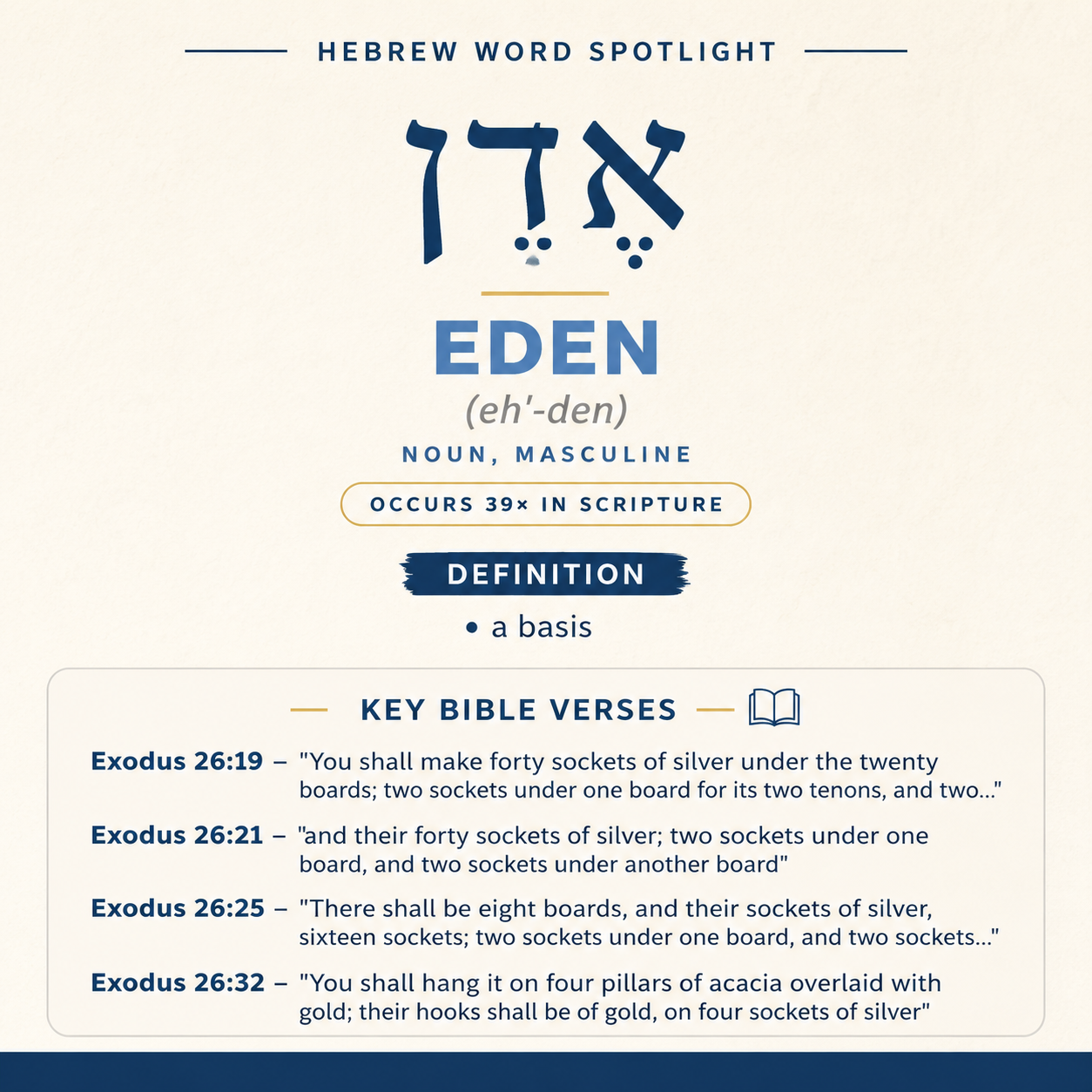
אֶדֶן (eden) means “a basis” and appears 39 times in Scripture, including Exodus 26–27 in tabernacle construction instructions.
Exodus Usage
In Exodus 26:19–37 and 27:10–12, אֶדֶן appears in instructions about sockets for boards and pillars.
Learn More →אֶדֶן (eden) means “a basis.” In the passages where it occurs here, it belongs to the detailed instructions for the tabernacle and its court, where structural elements repeatedly require a stable “basis” to support boards and pillars.

Occurrences
Exodus 26:19: “You shall make forty sockets of silver under the twenty boards; two sockets under one board for its two tenons, and two sockets under another board for its two tenons.”
Here אֶדֶן names the “sockets of silver” placed “under the twenty boards.” The verse itself explains the practical function of this basis by pairing each board with two sockets that correspond to its “two tenons,” so the lower supports match the board’s joining points.
Exodus 26:21: “and their forty sockets of silver; two sockets under one board, and two sockets under another board.”
This line continues the same construction pattern: each board has a double basis beneath it. The repetition of “two sockets under one board” underscores that the basis is not occasional hardware but the standard way the boards stand and hold position.
Exodus 26:25: “There shall be eight boards, and their sockets of silver, sixteen sockets; two sockets under one board, and two sockets under another board.”
Again the basis is counted and matched: eight boards correspond to “sixteen sockets,” preserving the two-per-board pattern. In this scene, the basis is measured as carefully as the boards themselves, showing that stability is built into the plan through an exact, repeated allocation.
Exodus 26:32: “You shall hang it on four pillars of acacia overlaid with gold; their hooks shall be of gold, on four sockets of silver.”
The basis now supports “four pillars,” which carry hanging elements (“You shall hang it”) and include “hooks.” The “four sockets of silver” provide the pillars’ base in a setting where weight and tension (from what is hung) would make a secure foundation necessary.
Exodus 26:37: “You shall make for the screen five pillars of acacia, and overlay them with gold. Their hooks shall be of gold. You shall cast five sockets of bronze for them.”
In this occurrence the basis is still a “socket,” but the material is specified as “bronze” rather than “silver.” The bases are “cast,” emphasizing manufacture and durability; each of the “five pillars” for the “screen” receives its own corresponding basis.
Exodus 27:10: “Its pillars shall be twenty, and their sockets twenty, of bronze. The hooks of the pillars and their fillets shall be of silver.”
The scene shifts to the enclosure of the court: “pillars” line its perimeter. The basis is counted one-for-one (“pillars shall be twenty, and their sockets twenty”), and the material division is clear within the verse—bases are “of bronze,” while other fittings (“hooks” and “fillets”) are “of silver.”
Exodus 27:11: “Likewise for the length of the north side, there shall be hangings one hundred cubits long, and its pillars twenty, and their sockets twenty, of bronze; the hooks of the pillars, and their fillets, of silver.”
Here the basis is integrated into the dimensions of a side of the court: “hangings” run “one hundred cubits long,” and beneath their support line are “pillars twenty” with “sockets twenty.” The basis serves a long stretch of structure, maintaining an orderly correspondence between the hanging length and the evenly repeated supports set into bronze bases.
Exodus 27:12: “For the width of the court on the west side shall be hangings of fifty cubits; their pillars ten, and their sockets ten.”
The west side’s reduced width (“fifty cubits”) is mirrored by a reduced count of supports (“pillars ten”) and therefore a reduced number of bases (“sockets ten”). The basis functions as part of a proportional design: as the span changes, the number of bases changes in step to keep the structure consistent.
Exodus 27:14: “The hangings for the one side of the gate shall be fifteen cubits; their pillars three, and their sockets three.”
Near the gate, the basis appears in a smaller unit: a short run of “hangings” (“fifteen cubits”) uses “pillars three” and “sockets three.” The basis is not reserved for major walls; even at the gate’s side sections the pillars stand on their own bases.
Exodus 27:15: “For the other side shall be hangings of fifteen cubits; their pillars three, and their sockets three.”
The matching “other side” repeats the same counts, showing symmetry in the entrance arrangement. The basis is part of that symmetry: equal hangings, equal pillars, equal bases.
Exodus 27:16: “For the gate of the court shall be a screen of twenty cubits, of blue, and purple, and scarlet, and fine twined linen, the work of the embroiderer; their pillars four, and their sockets four.”
At the gate itself, a richly described “screen” is supported by “pillars four,” each with its own basis (“sockets four”). The verse’s emphasis on textile materials and craftsmanship (“the work of the embroiderer”) sits alongside the simpler but necessary engineering detail: the decorative screen still depends on a stable basis beneath its supporting posts.
Exodus 27:17: “All the pillars of the court around shall be filleted with silver; their hooks of silver, and their sockets of bronze.”
This concluding statement about the court’s pillars gathers the fittings into a single description. Within that summary, the basis is again set apart by its material: “sockets of bronze.” The result is a consistent picture in which the bases are a standard, durable element under the perimeter pillars, distinguished from the silver used for the upper attachments.
Sense and Usage
Across these instructions, “a basis” is expressed concretely as the “socket” placed beneath a board or pillar. The word’s sense is not abstract in these contexts; it marks the physical component that allows something upright—boards in the tabernacle structure or pillars for hangings and screens—to stand in place. The recurring pattern of counting (“forty sockets,” “sixteen sockets,” “sockets twenty,” “sockets ten,” “sockets three,” “sockets four”) shows that a basis is treated as a planned unit in the overall design, not an improvised support.
The passages also show that a basis can be made from different metals depending on location and use: sockets are repeatedly “of silver” in the board-and-pillar setting of Exodus 26, while sockets are “of bronze” for the screen’s pillars in Exodus 26:37 and for the court’s pillars in Exodus 27. Without adding details beyond the verses, the text itself connects the basis to the load-bearing function of pillars and boards, and it consistently presents the basis as the lower element paired with visible upper fittings like “hooks” and “fillets.” In that way, אֶדֶן contributes the idea of grounded support: the hangings, screens, and structural boards are described as carefully crafted, but they remain dependent on their bases beneath them.
Imagery
The repeated mention of bases beneath boards and pillars gives these instructions a grounded, architectural feel. The eye is drawn downward in the description—under boards, under pillars—so that the tabernacle and its court are pictured not as floating textiles and gilded wood, but as a constructed space that stands because each upright element rests on its appointed basis.
Sources: Lexical data from Strong’s Exhaustive Concordance and the Open Scriptures Hebrew Lexicon. Occurrence data from the Westminster Leningrad Codex with STEPBible reference data (CC BY). Scripture quotations from the World English Bible (public domain).