
Discovering the Meaning of ‘Adowrayim in Hebrew
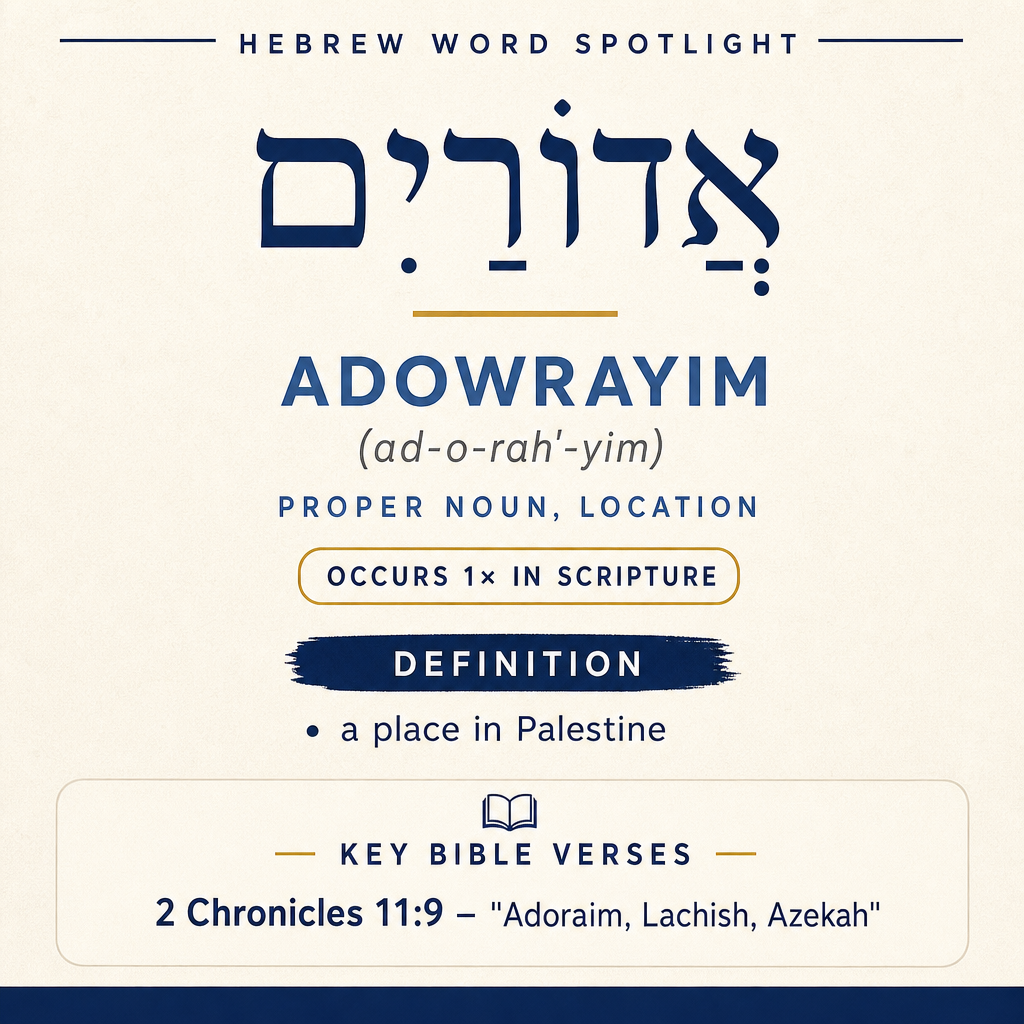
אֲדוֹרַיִם (Adowrayim) means a place in Palestine and appears once in Scripture in 2 Chronicles 11:9.
אֲדוֹרַיִם (Adowrayim) refers to a place in Palestine and appears in a single biblical list of locations. In that setting it functions as one named point among others, contributing to the sense of a defined landscape of towns.
Occurrences
2 Chronicles 11:9
“Adoraim, Lachish, Azekah,” (2 Chronicles 11:9)
Here אֲדוֹרַיִם is presented as a bare place-name within a concise sequence: “Adoraim, Lachish, Azekah,”. The verse gives no descriptive clauses for any of the three; instead, the rhetorical force comes from the accumulation of names. In such a catalog-like line, אֲדוֹרַיִם contributes as one discrete location that helps populate the geographic frame the narrator is setting. Its placement at the head of the brief excerpt makes it the initial marker in this segment of the list, after which two other localities follow in apposition-like succession, each separated by commas.
The form in the English verse reflects the transliteration of a specific settlement rather than a general category. Because it is embedded in a row of similarly treated place-names, the word functions primarily as an identifier: it anchors the reader in a network of named sites rather than in an abstract description. The verse’s compact style—simply naming places without verbs or qualifiers in the snippet quoted—lets the name stand on its own as a label for a point on the map of “a place in Palestine.”

Sense and Usage
As a proper noun for a location, אֲדוֹרַיִם operates the way place-names typically do in biblical narrative and administrative prose: it identifies a specific settlement, allowing the text to indicate scope and concreteness without pausing for explanation. In 2 Chronicles 11:9 the word is not used to convey qualities of the site, its inhabitants, or its features; its communicative value lies in naming.
The immediate context is a list-like presentation that strings together multiple toponyms. In that environment, each name carries weight through its membership in the series: the text constructs an impression of territorial arrangement by enumeration. The meaning “a place in Palestine” is realized not through description but through coordination with other places, as the verse pairs it with “Lachish” and “Azekah.” The reader is expected to receive the reference as a real, locatable town within the land, and the narrative’s economy presumes that naming is sufficient to establish it as part of the region’s settled geography.
Because the occurrence is a simple mention rather than an event involving the place, the word’s usage centers on designation rather than action. It is the kind of term that supplies structure to a passage by marking out distinct nodes within a larger territorial picture. The lack of modifiers in the verse excerpt—no directional markers, no adjectives, no narrative verbs—highlights a common feature of such lists: the semantic work is done by selection and sequence. אֲדוֹרַיִם thus contributes by being one selected element within a curated set of town names.
Within the phrasing of the verse, the name also participates in a pattern of parallelism-by-listing: each item is syntactically equal. That equality reinforces the idea that the text is not privileging one site by description in this line but presenting several as part of the same conceptual group. In practical terms, the place-name anchors one point in that group, allowing the overall list to suggest coverage and organization. The definition “a place in Palestine” is therefore expressed in a documentary way: the word is used to locate the reader within a concrete land by naming a specific settlement among others.
Imagery
Although 2 Chronicles 11:9 offers no visual details of אֲדוֹרַיִם itself, the verse’s style evokes the imagery of a landscape marked by towns that can be named in sequence. The line “Adoraim, Lachish, Azekah,” suggests a mental map formed by successive place-names—separate inhabited points set within the same land—so that the image is not of a single feature but of a network of settled locations, each established simply by being spoken aloud in a list.
Sources: Lexical data from Strong’s Exhaustive Concordance and the Open Scriptures Hebrew Lexicon. Occurrence data from the Westminster Leningrad Codex with STEPBible reference data (CC BY). Scripture quotations from the World English Bible (public domain).





