Discovering the Meaning of ‘Adb@’el in Hebrew
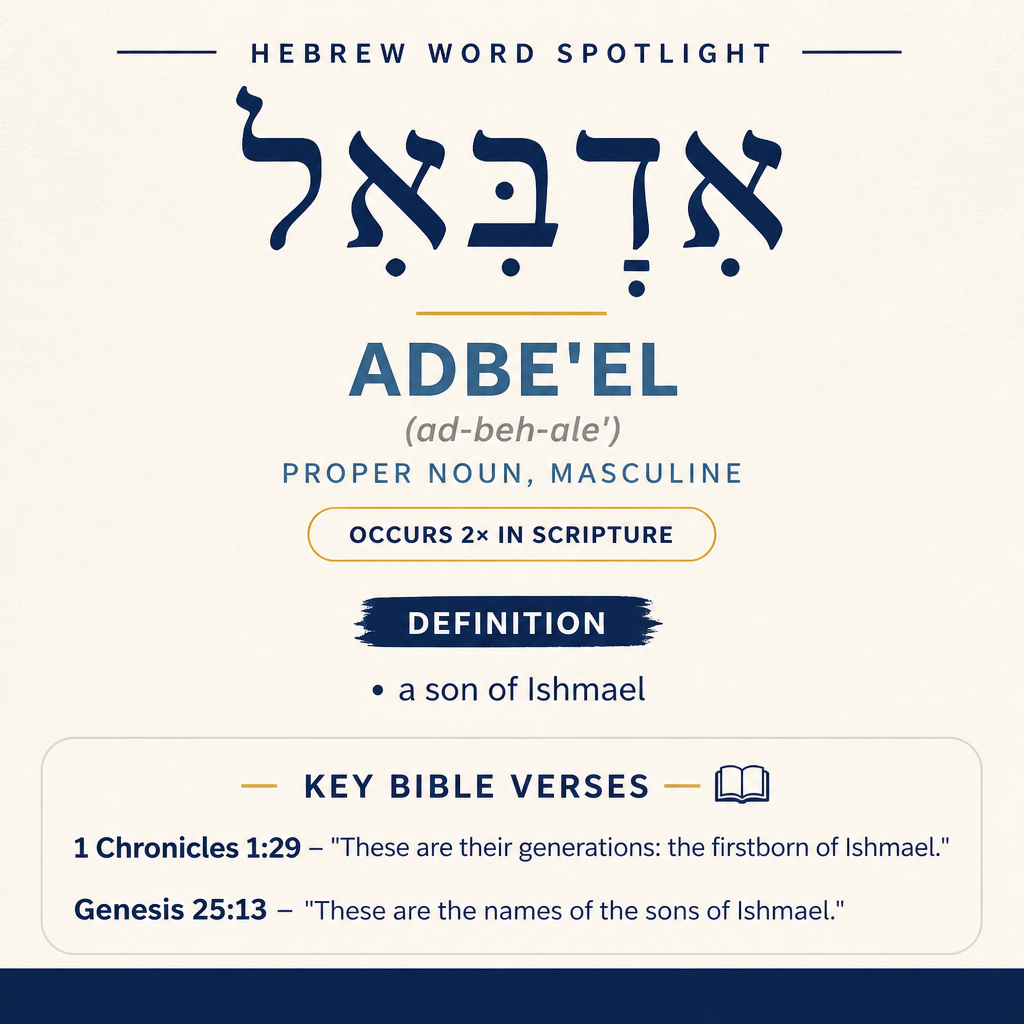
Adbe'el means “a son of Ishmael” and appears in Genesis 25:13 and 1 Chronicles 1:29.
Scripture Occurrences
Adbe'el occurs 2 times in Scripture, in Genesis 25:13 and 1 Chronicles 1:29.
Learn More →Genealogical Context
In 1 Chronicles 1:29, Adbe'el is listed among Ishmael’s sons after Kedar and before Mibsam.
Learn More →Adbe’el refers to a son of Ishmael and appears in two genealogical listings that name Ishmael’s sons in birth order. In both passages, the name functions within a sequence of brothers, anchoring a specific place within Ishmael’s family line.
Occurrences
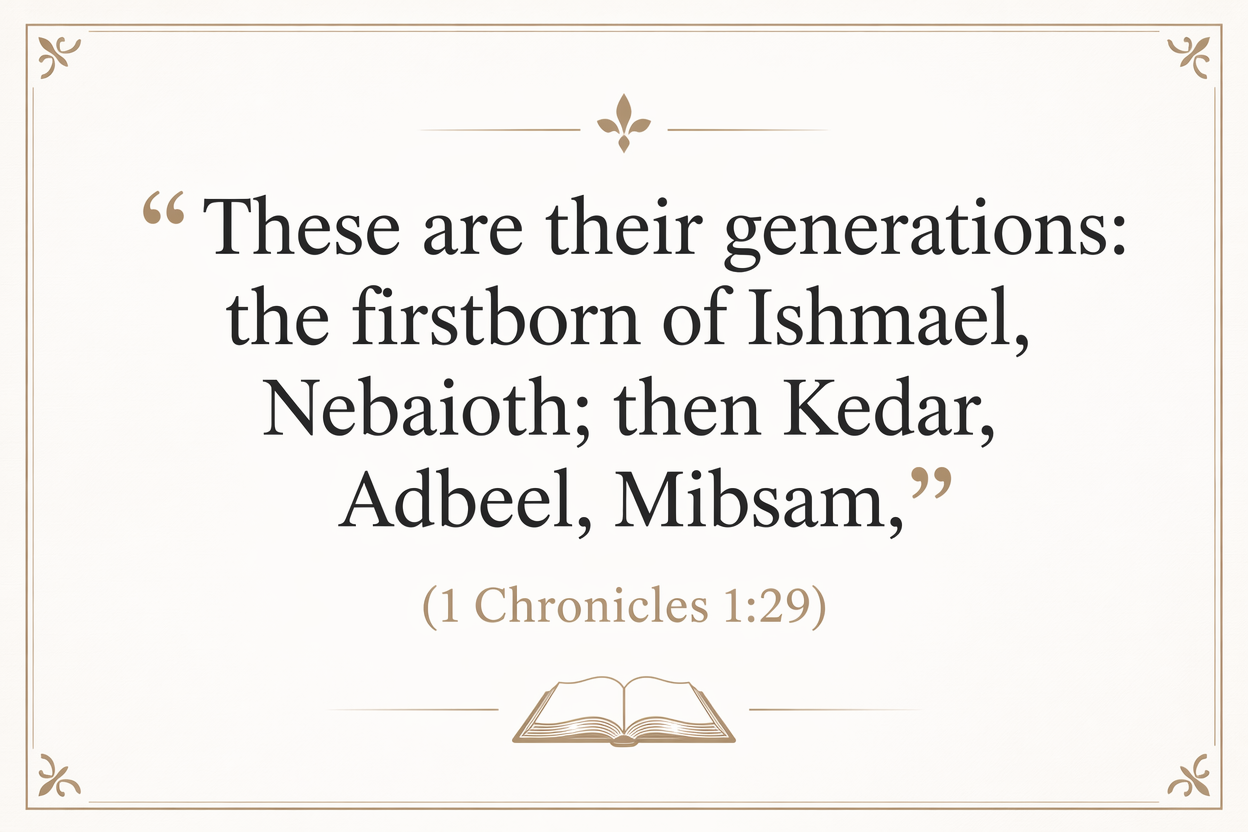
“These are their generations: the firstborn of Ishmael, Nebaioth; then Kedar, Adbeel, Mibsam,” (1 Chronicles 1:29)
Here Adbe’el is introduced as part of “their generations,” a formula that frames the list as lineage and succession. The verse begins by identifying Ishmael’s “firstborn,” Nebaioth, and then continues with a chain of names. Adbe’el appears after Kedar and before Mibsam, occupying a fixed position in the series that marks him as one distinct son within a larger family. The wording “then” keeps the emphasis on ordered descent: Adbe’el is not presented with narrative detail, but as a named bearer of Ishmael’s continuing line.
“These are the names of the sons of Ishmael, by their names, according to the order of their birth: the firstborn of Ishmael, Nebaioth, then Kedar, Adbeel, Mibsam,” (Genesis 25:13)
This occurrence explicitly highlights naming and order: “These are the names… by their names, according to the order of their birth.” Within that purpose statement, Adbe’el serves as one entry in a carefully arranged register. The verse again begins with the firstborn, Nebaioth, and then places Adbe’el after Kedar and before Mibsam. The immediate context stresses identification (“the names”) and sequence (“order of their birth”), so Adbe’el’s contribution is to specify a particular son within Ishmael’s household in a way meant to be remembered and distinguishable from his brothers.

Sense and Usage
Across both passages, Adbe’el functions as a personal name whose sense is bound to kinship: he is presented as a son of Ishmael within a list of brothers. The definition “a son of Ishmael” is not developed by narrative scenes or personal actions in either context; instead, it is expressed by placement within an ordered genealogy. The name’s role is therefore relational and classificatory: Adbe’el is identified through his father and through his position among siblings.
Both occurrences share a similar shape: an introductory line that announces a genealogical aim (“generations” in 1 Chronicles; “names… according to the order of their birth” in Genesis), followed by the sequence beginning with Ishmael’s firstborn. Adbe’el appears in the same segment of that sequence, consistently located between Kedar and Mibsam. That repeated ordering shows that, in these texts, Adbe’el is not merely one name among many but a stable element in a recognized list. The emphasis is not on what Adbe’el did, where he lived, or what became of him; the emphasis is on the preservation of Ishmael’s line through named sons, where each son’s name establishes a discrete branch within the family structure.
The immediate phrasing in Genesis gives the most explicit clue to how the name is meant to function: “by their names” suggests an interest in the names themselves as identifiers, and “according to the order of their birth” frames the list as more than a random catalog. In that setting, Adbe’el is part of a patterned presentation in which birth order is treated as meaningful for organizing family memory. In 1 Chronicles, the corresponding list is introduced as “their generations,” which likewise treats the names as markers of descent. Adbe’el’s sense in use is thus tied to lineage documentation: he is one named son within the recorded continuation of Ishmael’s descendants.
Genealogical Imagery
The imagery attached to Adbe’el in these passages is the imagery of a recited family register: names spoken in sequence, framed by statements about “generations” and “order of their birth.” Adbe’el stands as a fixed point within that ordered recitation—one of the sons named after Ishmael’s firstborn—so that the reader hears his identity through the rhythm of lineage and succession rather than through narrative portraiture.
Sources: Lexical data from Strong’s Exhaustive Concordance and the Open Scriptures Hebrew Lexicon. Occurrence data from the Westminster Leningrad Codex with STEPBible reference data (CC BY). Scripture quotations from the World English Bible (public domain).