Discovering the Meaning of ‘Agagiy in Hebrew
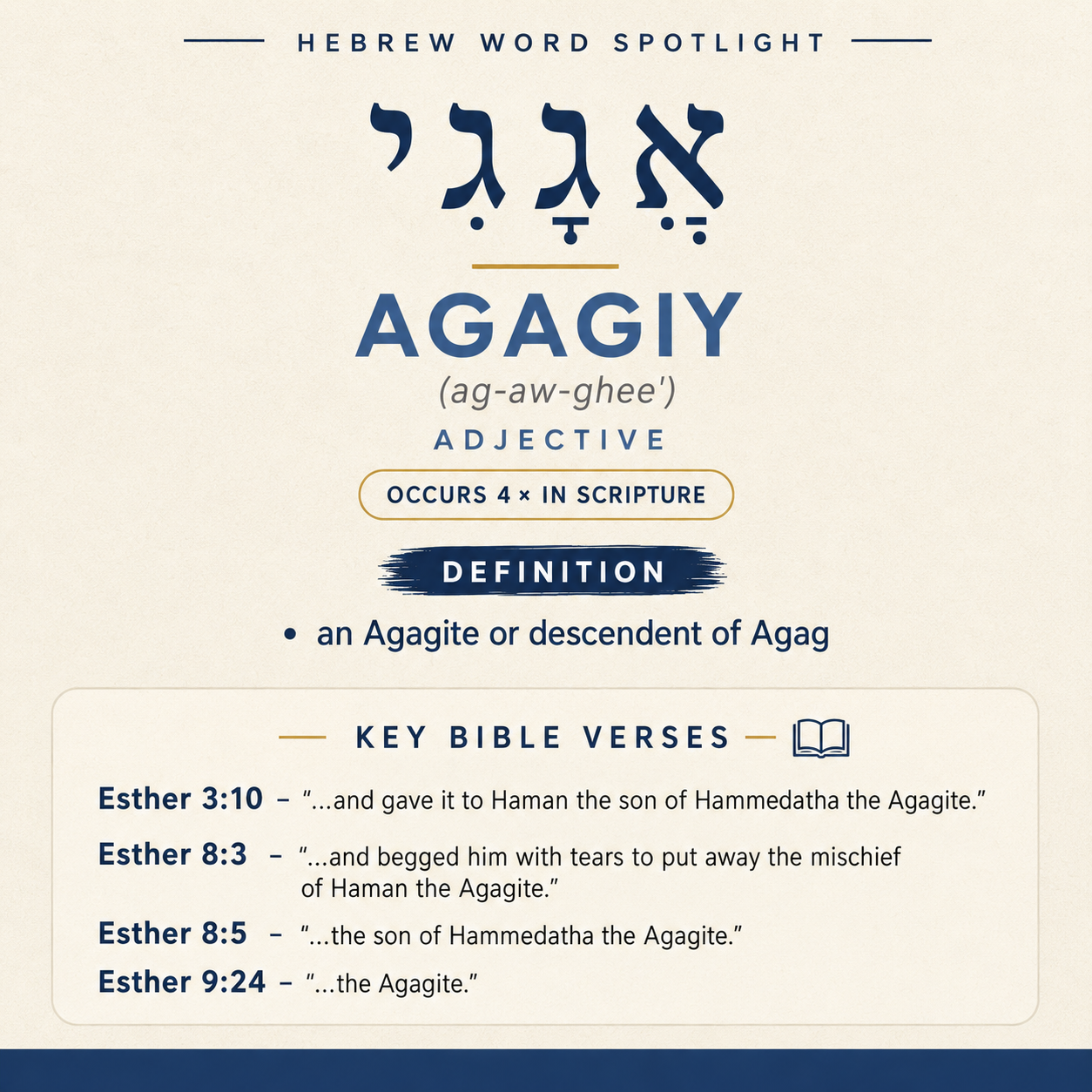
אֲגָגִי (Agagiy) means “an Agagite or descendent of Agag” and appears four times in Scripture, all in the book of Esther.
Esther Context
In Esther 3:10 and 9:24, Haman is identified as “the Agagite” and called the Jews’ enemy.
Learn More →אֲגָגִי (Agagiy) designates “an Agagite or descendent of Agag.” In Scripture it functions as a fixed descriptor for Haman in the book of Esther, where it repeatedly identifies him in connection with his hostility and plans against the Jews.
Occurrences
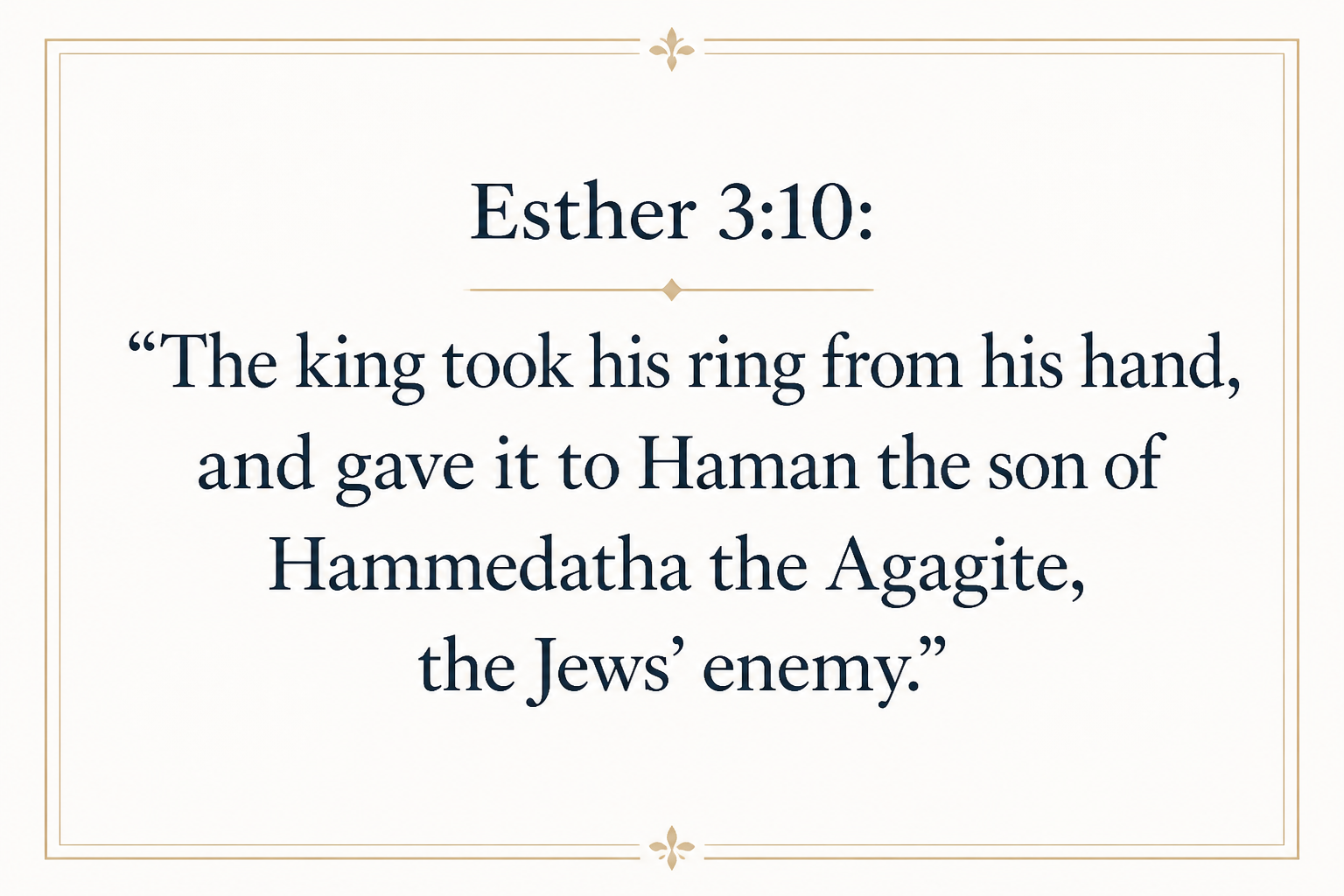
Esther 3:10: “The king took his ring from his hand, and gave it to Haman the son of Hammedatha the Agagite, the Jews’ enemy.”
Here אֲגָגִי is part of Haman’s formal identification: “Haman the son of Hammedatha the Agagite.” The word works like a lineage-marker attached to his name, placing him within a defined descent (“descendent of Agag”) while the sentence simultaneously characterizes him by role: “the Jews’ enemy.” In this scene the descriptor stands at the moment when royal authority is transferred—symbolized by the king’s ring—into Haman’s hand. The title “the Agagite” therefore appears precisely where Haman is empowered to act, tying his identity to the antagonistic posture named in the same line.
Esther 8:3: “Esther spoke yet again before the king, and fell down at his feet, and begged him with tears to put away the mischief of Haman the Agagite, and his plan that he had planned against the Jews.”
In Esther’s appeal, אֲגָגִי again follows “Haman,” but the narrative emphasis is not ancestry for its own sake; it is ancestry linked to threat. Esther pleads about “the mischief of Haman the Agagite” and immediately appends “his plan that he had planned against the Jews.” The word helps keep the focus on the same adversary previously elevated by royal favor, now named as the source of “mischief” and an organized “plan.” In the posture of Esther’s supplication—falling at the king’s feet, begging “with tears”—the descriptor functions as part of the legal and personal identification of the one whose actions must be “put away.”
Esther 8:5: “She said, “If it pleases the king, and if I have found favor in his sight, and the thing seem right to the king, and I am pleasing in his eyes, let it be written to reverse the letters devised by Haman, the son of Hammedatha the Agagite, which he wrote to destroy the Jews who are in all the king’s provinces.”
This occurrence embeds אֲגָגִי inside a longer, official description: “Haman, the son of Hammedatha the Agagite.” The setting is administrative and documentary: Esther requests that something “be written” to “reverse the letters devised by” Haman, specifying that these are letters “which he wrote to destroy the Jews who are in all the king’s provinces.” The descriptor supports precision: it anchors the culpable author of the letters within a recognizable personal identity, with both patronymic (“son of Hammedatha”) and descent label (“the Agagite”). In a scene concerned with counter-edicts and the reversal of written orders, the word contributes to the careful naming of the party whose written initiative must be undone.
Esther 9:24: “because Haman the son of Hammedatha, the Agagite, the enemy of all the Jews, had plotted against the Jews to destroy them, and had cast “Pur”, that is the lot, to consume them, and to destroy them;”
In this retrospective explanation, אֲגָגִי appears once more as part of Haman’s full designation: “Haman the son of Hammedatha, the Agagite.” The sentence intensifies the characterization begun earlier by explicitly naming him “the enemy of all the Jews” and then rehearsing the content of his actions: he “had plotted against the Jews to destroy them,” and he “had cast “Pur”, that is the lot,” in order “to consume them, and to destroy them.” Within this catalogue of hostility and intention, “the Agagite” remains a stable identifier attached to Haman’s name. It functions as a continuing label that binds together the narrative memory of who he was—by descent—and what he did—by plotting and casting lots for destruction.

Sense and Usage
Across these four contexts, אֲגָגִי operates as a designation of descent (“an Agagite or descendent of Agag”) that is consistently attached to a single figure: Haman. Rather than standing alone, it regularly appears within a formula of identification: sometimes simply “Haman … the Agagite,” and sometimes expanded to “Haman the son of Hammedatha the Agagite.” This makes the word function like an inherited label—one that marks a person by lineage and, in these scenes, helps keep that person’s identity unambiguous within court proceedings, petitions, and official writing.
The repetition is significant in the flow of events visible in the quotations. In Esther 3:10 the “Agagite” designation is present at the transfer of authority (“The king took his ring … and gave it to Haman … the Agagite”), so the title accompanies the moment when Haman’s capacity to act is secured. In Esther 8:3 and 8:5, the word sits within Esther’s appeal to overturn “mischief” and reverse “letters devised by” the same man; in other words, the label travels from empowerment to accusation. In Esther 9:24 it occurs in an explanatory summary that restates Haman’s identity while recounting the scope of his hostility (“the enemy of all the Jews”) and the mechanisms of his attempted destruction (“plotted,” “cast ‘Pur’”). Thus the word’s force in Esther is not that it supplies a new action or emotion; rather, it tags the central antagonist with a stable genealogical descriptor at each key legal and narrative turn: empowerment, petition, reversal of documents, and later explanation.
In these passages, descent language also works alongside other kinds of naming. The text pairs “the Agagite” with patronymic (“son of Hammedatha”) and with moral-political characterization (“the Jews’ enemy,” “the enemy of all the Jews”). The effect is cumulative. The descent label identifies who Haman is in terms of origin, while the accompanying descriptors identify how he functions in the story: an enemy whose schemes are expressed as “mischief,” “plan,” “letters … to destroy,” and a “plot” advanced by casting lots. The word therefore participates in a pattern where ancestry terminology and narrative role-description reinforce one another within formal, court-centered speech.
Imagery and Association
The repeated attachment of אֲגָגִי to Haman’s name gives the term a strong association with the machinery of threat in Esther’s court setting: the king’s ring handed over, official letters drafted and reversed, and an explanation that recalls both a plotted destruction and the casting of “Pur,” “the lot.” In these quotations, “the Agagite” is the fixed label that accompanies the movement from royal authorization to the attempt to “destroy the Jews,” and then to the effort to undo that attempt through counter-writing and public remembrance of what had been planned.
Sources: Lexical data from Strong’s Exhaustive Concordance and the Open Scriptures Hebrew Lexicon. Occurrence data from the Westminster Leningrad Codex with STEPBible reference data (CC BY). Scripture quotations from the World English Bible (public domain).