
Discovering the Meaning of ‘Abiyno`am’ in Hebrew
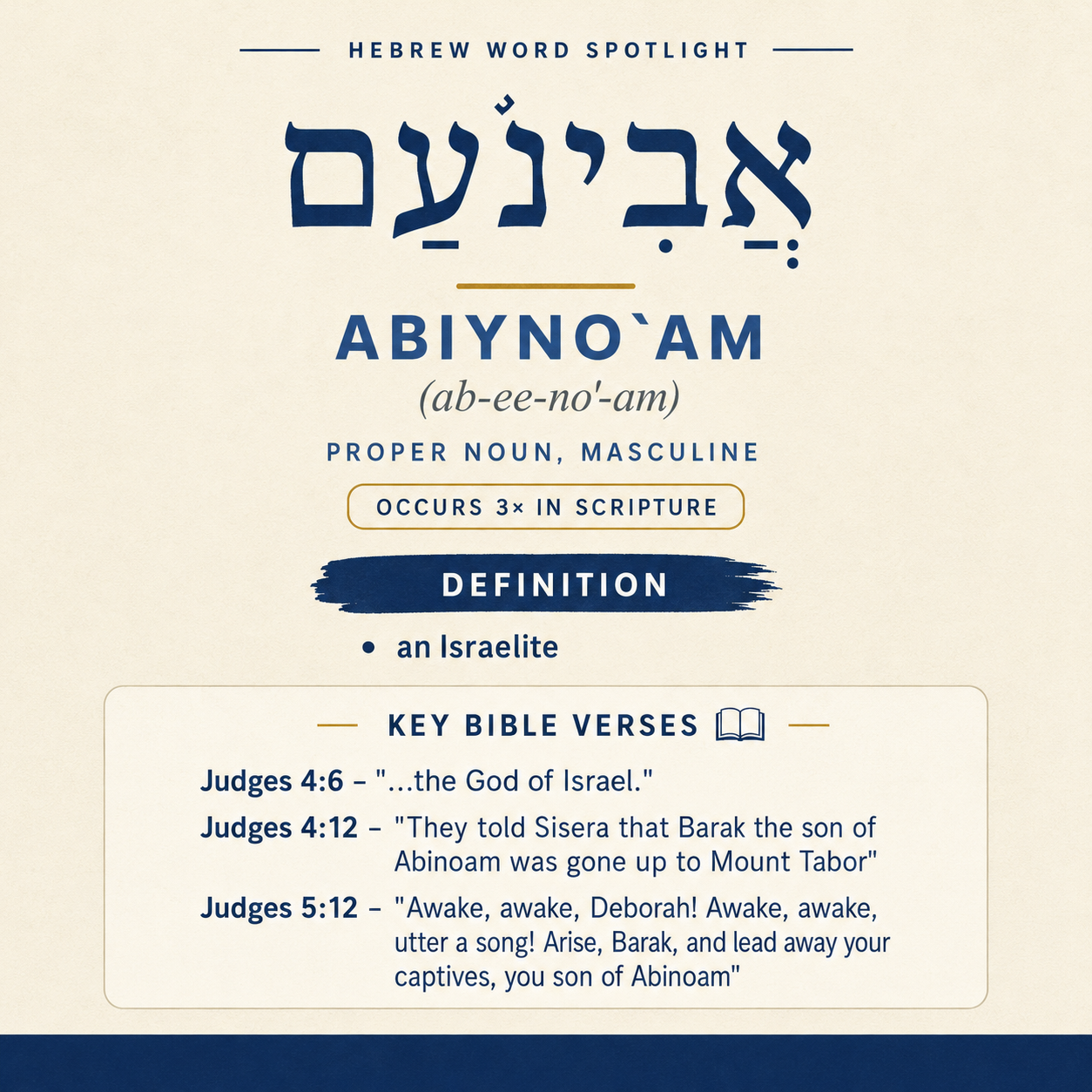
אֲבִינֹעַם (Abiyno`am) means an Israelite and appears three times in Judges 4:6, 4:12, and 5:12.
אֲבִינֹעַם (Abiyno`am) is a masculine personal name describing “an Israelite.” It appears in Judges 4–5 in close connection with Barak, whose identity is repeatedly given through his relationship to Abinoam.
Occurrences
Judges 4:6: “She sent and called Barak the son of Abinoam out of Kedesh Naphtali, and said to him, “Hasn’t Yahweh, the God of Israel, commanded, ‘Go and lead the way to Mount Tabor, and take with you ten thousand men of the children of Naphtali and of the children of Zebulun?”
Here Abinoam functions as the identifying anchor in a formal introduction: Barak is brought onstage as “the son of Abinoam.” The scene is administrative and directive—Deborah “sent and called” him, locating him “out of Kedesh Naphtali,” and addressing him in the context of a divine command. Within this summons, Abinoam’s name does not carry action of its own; it supplies lineage as part of Barak’s public identity, the kind of designation suitable for the transfer of orders and the mustering of a force (“take with you ten thousand men”). The naming also helps the reader distinguish this Barak from any other by attaching him to an Israelite household through his father’s name, as the command moves from Deborah’s message to concrete military mobilization.
Judges 4:12: “They told Sisera that Barak the son of Abinoam was gone up to Mount Tabor.”
In this report, the same identifying formula is repeated, now in the mouth of unnamed informants addressing Sisera. Abinoam’s name again appears as part of Barak’s full designation, but the narrative setting has shifted from commissioning to surveillance and response: “They told Sisera” what Barak had done, namely that he “was gone up to Mount Tabor.” The mention of Abinoam in this context shows that Barak is a known figure whose movements can be tracked and communicated to an opponent. The paternal identification makes the report specific and actionable—this is not a vague rumor about “Barak,” but about “Barak the son of Abinoam,” the same man previously summoned to lead. The name thus participates in the tension of the scene: information is being passed to Sisera about a particular Israelite leader’s strategic positioning.
Judges 5:12: “‘Awake, awake, Deborah! Awake, awake, utter a song! Arise, Barak, and lead away your captives, you son of Abinoam.’”
In the poetic voice of Judges 5, Abinoam’s name is retained but placed in a heightened rhetorical frame. The line addresses Deborah with urgent repetition (“Awake, awake”) and then turns directly to Barak with a command suited to victory: “Arise, Barak, and lead away your captives.” Calling him “you son of Abinoam” in this setting does more than identify; it punctuates the exhortation with a personal, familial designation embedded in public acclaim. The phrase functions like a formal address within song, tying the celebrated leader back to his Israelite lineage even as he is summoned to act as a conqueror who conducts captives. Abinoam’s name therefore stands at the intersection of ancestry and achievement: Barak’s triumph is narrated as the deed of a son within a named household.

Sense and Usage
Across these passages, Abinoam is an Israelite whose significance in the text is relational: he is consistently presented as Barak’s father. The name appears in a stable construction (“son of Abinoam”) that works as a narrative identifier in prose (Judges 4:6; 4:12) and as a form of address in poetry (Judges 5:12). This consistency shows the practical function of the name in these scenes: it secures Barak’s identity when he is summoned, reported upon, and celebrated.
The settings in which the designation occurs show how an Israelite name can operate in different registers without changing its basic role. In Judges 4:6, the lineage label accompanies a call to obedience and leadership under the command of “Yahweh, the God of Israel,” and it sits amid geographical and tribal markers (“Kedesh Naphtali,” “children of Naphtali,” “children of Zebulun”). In Judges 4:12, the same label appears in a military intelligence report to Sisera, where specificity matters because the information concerns movement to a strategic location (“gone up to Mount Tabor”). In Judges 5:12, the label becomes part of the cadence of a song, where direct address and repeated imperatives propel the hearer toward action and celebration. In each case, Abinoam’s name functions as a stable genealogical tag that keeps Barak’s personhood and public role connected to a particular Israelite household.
The repeated phrasing also shapes how the story’s leadership is framed. Barak is never introduced here as an isolated hero; his identity is consistently mediated through sonship. The text does not present Abinoam speaking or acting, yet the father’s name remains attached to the son at decisive narrative points: when the divine command is conveyed, when the opposing commander is informed, and when the victory-song calls for captives to be led. The usage therefore underscores continuity and recognized identity within Israel, as Barak’s actions are narrated as those of “the son of Abinoam” from summons to ascent to triumphal command.
Imagery
Although Abinoam himself is not depicted performing an action, the name is carried through vivid moments: a summons from Deborah that gathers “ten thousand men,” news that a leader “was gone up to Mount Tabor,” and a poetic call to “lead away your captives.” In these scenes the repeated “son of Abinoam” binds the battlefield movement and the victory-song back to a named Israelite lineage, giving the narrative a sense of rooted identity amid commands, reports, and celebratory imperatives.
Sources: Lexical data from Strong’s Exhaustive Concordance and the Open Scriptures Hebrew Lexicon. Occurrence data from the Westminster Leningrad Codex with STEPBible reference data (CC BY). Scripture quotations from the World English Bible (public domain).





