Discovering the Meaning of ‘Abiynadab in Hebrew
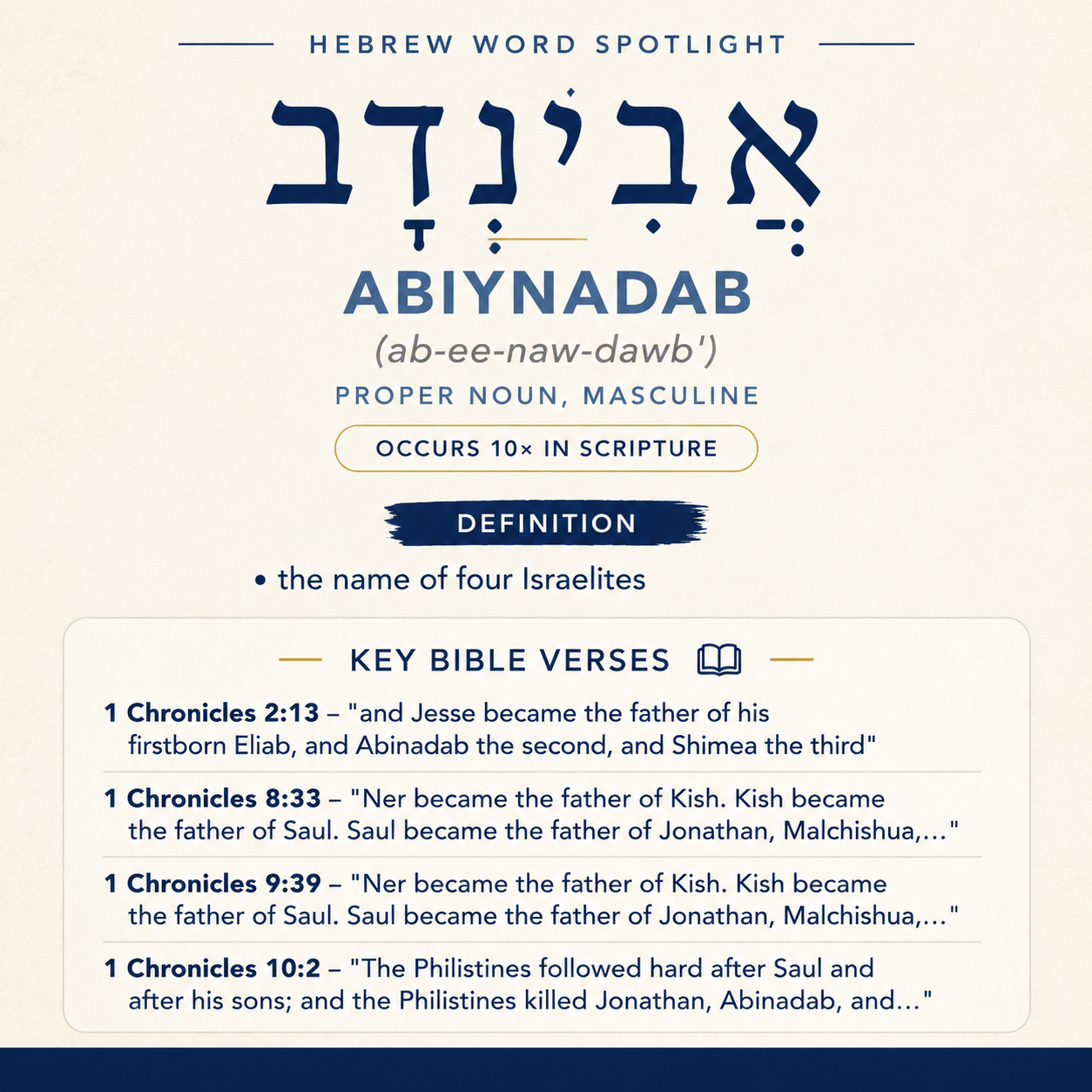
אֲבִינָדָב (Abiynadab) is the name of four Israelites, occurring 10 times in Scripture including 1 Samuel and 1 Chronicles.
Meaning Overview
אֲבִינָדָב is used as the name of four Israelites. It appears across narratives and genealogies.
Learn More →Jesse’s Son
Abinadab is listed as Jesse’s second son (1 Chronicles 2:13). He also passes before Samuel and is not chosen (1 Samuel 16:8).
Learn More →Saul’s Son
Abinadab is named among Saul’s sons (1 Chronicles 8:33; 9:39). He is killed with Jonathan and Malchishua (1 Chronicles 10:2; 1 Samuel 31:2).
Learn More →אֲבִינָדָב appears as a personal name borne by four Israelites, used in narratives and genealogies that locate individuals within family lines and key events. Across its attestations, the name functions to identify sons in a household, a member of Saul’s family, and the household from which God’s ark was brought on a cart.
Occurrences
1 Chronicles 2:13: “and Jesse became the father of his firstborn Eliab, and Abinadab the second, and Shimea the third,”
Here Abinadab marks Jesse’s second son, positioned between Eliab and Shimea in a list that orders siblings by birth. The name serves the genealogical purpose of placing Abinadab within Jesse’s immediate family, establishing his relation to his brothers in a concise sequence.

1 Chronicles 8:33: “Ner became the father of Kish. Kish became the father of Saul. Saul became the father of Jonathan, Malchishua, Abinadab, and Eshbaal.”
In this genealogical line, Abinadab is named among Saul’s sons alongside Jonathan, Malchishua, and Eshbaal. The name contributes to the record of Saul’s household, tying Abinadab to the royal line through the repeated “became the father of” structure that anchors him in an unbroken chain of descent.
1 Chronicles 9:39: “Ner became the father of Kish. Kish became the father of Saul. Saul became the father of Jonathan, Malchishua, Abinadab, and Eshbaal.”
This verse repeats the same familial placement: Abinadab is one of Saul’s sons. In context, the repetition reinforces the stability of the genealogical identification; Abinadab is not introduced through action here but through his fixed relation within the family list.
1 Chronicles 10:2: “The Philistines followed hard after Saul and after his sons; and the Philistines killed Jonathan, Abinadab, and Malchishua, the sons of Saul.”
Abinadab is named as one of Saul’s sons who died in battle. The name functions in the terse report of pursuit and death: the Philistines “followed hard,” and Abinadab is included in the list of those killed, with the added clarification that they were “the sons of Saul.”
1 Chronicles 13:7: “They carried God’s ark on a new cart, and brought it out of Abinadab’s house; and Uzza and Ahio drove the cart.”
Here Abinadab identifies the household associated with the location of the ark. The verse presents Abinadab not as an actor in the movement of the ark, but as the named owner of the “house” from which the ark was brought; the action is carried out by others (“Uzza and Ahio drove the cart”). The name therefore anchors the scene geographically and domestically: the ark is brought “out of Abinadab’s house.”
1 Samuel 16:8: “Then Jesse called Abinadab, and made him pass before Samuel. He said, “Yahweh has not chosen this one, either.””
Abinadab appears as one of Jesse’s sons presented before Samuel. The narrative role of the name is specific and immediate: Jesse “called Abinadab,” and Abinadab’s passing before Samuel is met with a decisive evaluation, “Yahweh has not chosen this one, either.” The name thus identifies the individual in a sequence of candidates and marks him as personally involved in the moment, even though the verdict is negative.
1 Samuel 17:13: “The three oldest sons of Jesse had gone after Saul to the battle: and the names of his three sons who went to the battle were Eliab the firstborn, and next to him Abinadab, and the third Shammah.”
Abinadab is again Jesse’s son, now placed in a military setting: he is among “the three oldest” who “had gone after Saul to the battle.” The verse orders the brothers and situates Abinadab as the middle of the three named participants—“next to him Abinadab”—showing him as part of the family contingent aligned with Saul in the conflict.
1 Samuel 31:2: “The Philistines overtook Saul and on his sons; and the Philistines killed Jonathan, Abinadab, and Malchishua, the sons of Saul.”
This account parallels the report in Chronicles: Abinadab is named among Saul’s sons killed by the Philistines. The name contributes to the identification of the fallen by naming each son, and the phrase “the sons of Saul” frames Abinadab’s death within the larger downfall of Saul’s household in that battle.
2 Samuel 6:3: “They set God’s ark on a new cart, and brought it out of Abinadab’s house that was on the hill; and Uzzah and Ahio, the sons of Abinadab, drove the new cart.”
Abinadab here is associated with a particular residence: “Abinadab’s house that was on the hill.” The name anchors the ark’s point of departure and also identifies Uzzah and Ahio by kinship: they are “the sons of Abinadab.” In this scene Abinadab’s role is conveyed through possession and relationship—his house is the staging place, and his sons are the drivers of the cart.
2 Samuel 6:4: “They brought it out of Abinadab’s house, which was in the hill, with God’s ark; and Ahio went before the ark.”
The name again specifies the ark’s origin point: “Abinadab’s house, which was in the hill.” The verse focuses on motion and procession—bringing the ark out, and Ahio going before it—while Abinadab remains the fixed reference for the location. The repetition of the house-language keeps the reader oriented: the ark’s movement begins from a named household in a particular setting.

Sense and Usage
Across these passages, Abinadab functions as a personal name that distinguishes individuals who otherwise could be confused by shared family roles (sons, brothers) and by repeated narrative patterns (genealogies and battle reports). The name’s usage falls into three main settings.
First, Abinadab identifies a son of Jesse in both genealogical ordering and narrative action. In the genealogical listing, Abinadab is “the second” after Eliab (1 Chronicles 2:13), while in the narrative of selection he is presented directly before Samuel and explicitly not chosen (1 Samuel 16:8). In the battle setting, the same name marks a family member who goes with Saul to war as one of “the three oldest sons of Jesse” (1 Samuel 17:13). Taken together, these contexts show how the name can serve both to index a family position and to pinpoint a participant in a specific event.
Second, Abinadab identifies a son of Saul in multiple genealogical notices and in two accounts of battlefield death. The genealogies list Abinadab among Saul’s sons (1 Chronicles 8:33; 1 Chronicles 9:39), while the battle reports name him among those killed by the Philistines (1 Chronicles 10:2; 1 Samuel 31:2). In the death notices, the naming of Abinadab alongside Jonathan and Malchishua personalizes the report and clarifies which members of Saul’s family are included, with “the sons of Saul” providing the family frame for the list.
Third, Abinadab serves as a household-name tied to the movement of God’s ark. In 1 Chronicles 13:7 and 2 Samuel 6:3–4, the ark is “brought… out of Abinadab’s house,” and the house is further described as being “on the hill” / “in the hill” in Samuel. In 2 Samuel 6:3, the name also provides patronymic identification: “Uzzah and Ahio, the sons of Abinadab.” This use shows Abinadab functioning as a reference point for both place and family connection, giving the narrative a concrete starting location and identifying the men responsible for driving the cart by their relation to the householder.
Because the name belongs to four Israelites, these passages also illustrate how a single name can attach to distinct persons in different lines and settings: one in Jesse’s household, one in Saul’s household, and one associated with the house from which the ark is brought. The texts themselves keep these figures distinct by immediate context—father’s name (Jesse; Saul), sibling groupings (Eliab and Shimea/Shammah; Jonathan and Malchishua), and the domestic location tied to the ark (“Abinadab’s house”).
Imagery
The strongest visual setting linked to Abinadab in these verses is the departure of the ark from a named house “on the hill,” placed “on a new cart” and driven forward with attendants in motion (1 Chronicles 13:7; 2 Samuel 6:3–4). In those lines, Abinadab’s name stands at the threshold between a private household and a public procession: the ark is brought out from a specific home into the road, with the family of the householder directly involved in leading it onward.
Sources: Lexical data from Strong’s Exhaustive Concordance and the Open Scriptures Hebrew Lexicon. Occurrence data from the Westminster Leningrad Codex with STEPBible reference data (CC BY). Scripture quotations from the World English Bible (public domain).