
Unraveling the Meaning of ‘Abiytal in Hebrew
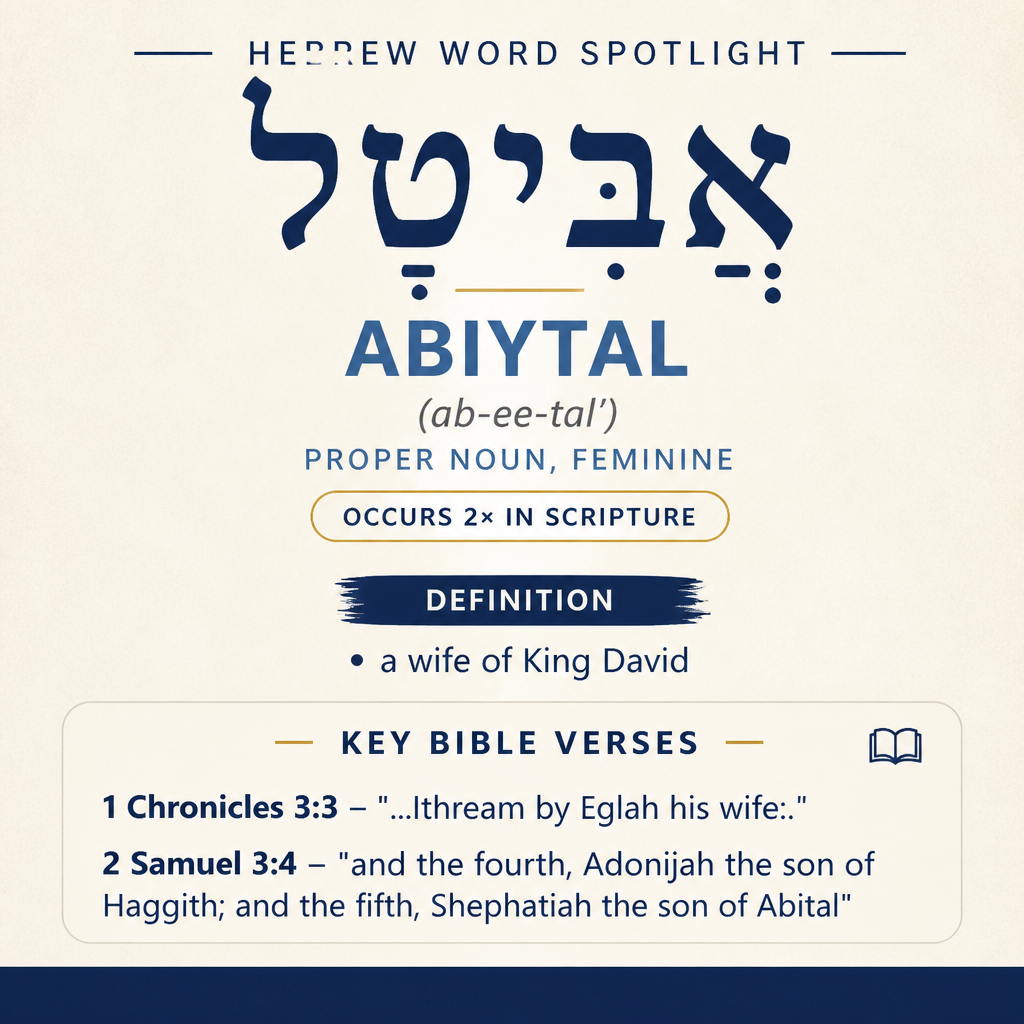
אֲבִיטָל (Abiytal) names a wife of King David, appearing in 2 Samuel 3:4 and 1 Chronicles 3:3.
Scripture Occurrences
The name occurs 2 times in Scripture: 2 Samuel 3:4 and 1 Chronicles 3:3.
Learn More →Narrative Context
In 2 Samuel 3:4, Shephatiah is called the son of Abital. In 1 Chronicles 3:3, Shephatiah is listed as of Abital.
Learn More →אֲבִיטָל (Abiytal) refers to a wife of King David and appears in two genealogical contexts that identify David’s sons through their mothers. In both passages the name functions to anchor a son within David’s household by naming the woman through whom he was born.
Occurrences
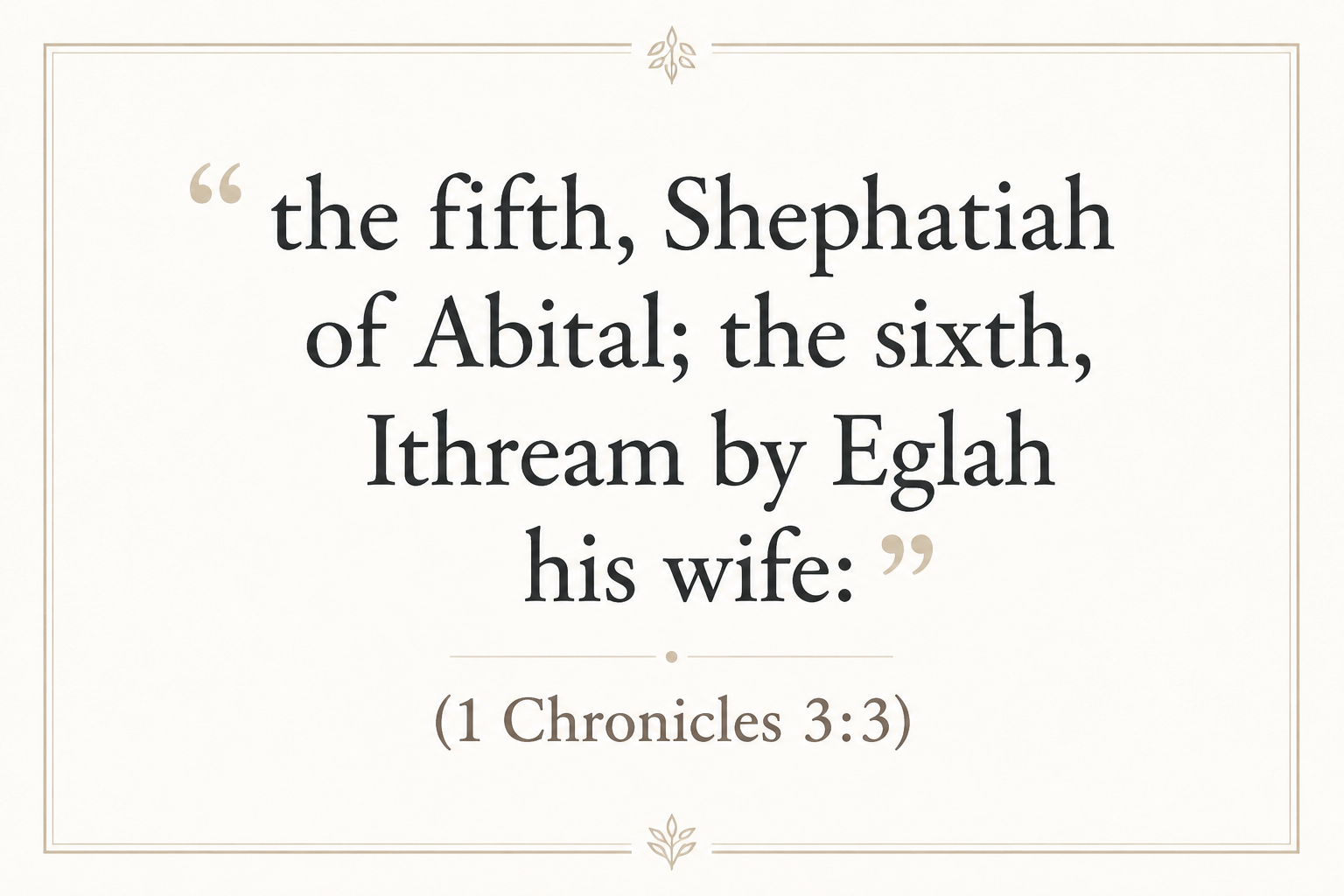
“the fifth, Shephatiah of Abital; the sixth, Ithream by Eglah his wife:” (1 Chronicles 3:3)
Here Abital appears within a list that orders David’s sons (“the fifth … the sixth”) and distinguishes them by maternal connection. The phrasing “Shephatiah of Abital” uses Abital’s name as the identifying marker for Shephatiah’s maternal line, placing him among his brothers in a sequence of births. Within the same verse the next child is described “by Eglah his wife,” so Abital’s name participates in the same kind of household mapping: sons are not only counted but also located within the structure of David’s marriages. Abital’s role in the line is therefore relational and classificatory—she is the mother by whom Shephatiah is recognized in the record.
“and the fourth, Adonijah the son of Haggith; and the fifth, Shephatiah the son of Abital;” (2 Samuel 3:4)
In this listing Abital’s name again serves as a maternal identifier, set parallel to other mothers named in the same style (“Adonijah the son of Haggith … Shephatiah the son of Abital”). The wording “the son of Abital” explicitly places Abital in the position of mother and uses her name to distinguish Shephatiah among other sons who are similarly tied to their mothers. The sequence “the fourth … the fifth” shows that Abital’s mention is part of an ordered register of David’s offspring, not a narrative scene with actions or speech; the name’s contribution is to make the genealogy precise by attaching Shephatiah to his mother within David’s family.

Sense and Usage
Across these occurrences Abital functions as a personal name whose primary significance is relational: she is named because she is one of David’s wives and because her motherhood identifies a particular son. Both verses are concerned with enumeration (“the fourth … the fifth … the sixth”) and differentiation—sons are listed in sequence and their maternal connections are supplied so that each son’s place in the royal household is clear. In this way Abital’s name is not presented for its own narrative development but for its ability to mark lineage.
The two passages also show slightly different but closely aligned formulations. In 1 Chronicles 3:3 the construction “Shephatiah of Abital” links the son to his mother with a concise expression that sits alongside another maternal notice in the same verse (“Ithream by Eglah his wife”). In 2 Samuel 3:4 the more explicit “Shephatiah the son of Abital” makes the maternal relationship unmistakable and sets Abital in parallel with Haggith, another mother named for the same purpose. Taken together, these uses depict Abital’s place within David’s domestic sphere as one element in a larger list of wives and sons, where the mother’s name serves as a stable point of reference for the identity of the child.
Because Abital appears only in these listing contexts, the sense carried by the name in Scripture is tightly focused: it designates the woman as David’s wife in the capacity that matters for these texts—her motherhood in the royal genealogy. The name functions as a node in a network of family relations: David as father, the sons in birth order, and the mothers who distinguish those sons within the same father’s household.
Family Listing Imagery
The imagery surrounding Abital in these passages is the imagery of record-keeping: an ordered sequence of sons and the mothers who locate them within the king’s family. Abital is remembered in the concise, formal way genealogies preserve names—by attaching her to “Shephatiah,” so that his identity is read not only in relation to David but also through the household of the wife who bore him.
Sources: Lexical data from Strong’s Exhaustive Concordance and the Open Scriptures Hebrew Lexicon. Occurrence data from the Westminster Leningrad Codex with STEPBible reference data (CC BY). Scripture quotations from the World English Bible (public domain).





