Unlocking the Meaning of ‘Abiytuwb in Hebrew
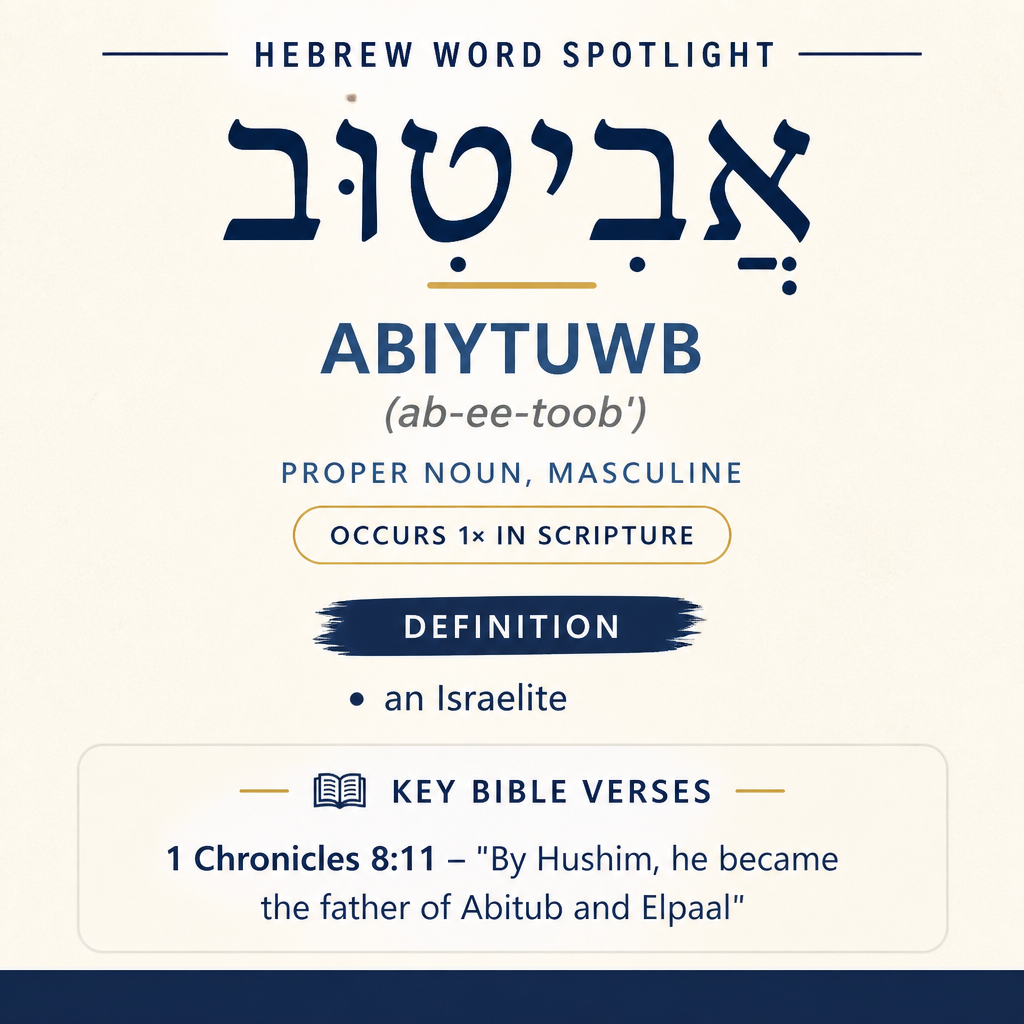
אֲבִיטוּב (Abiytuwb) means “an Israelite” and appears once in Scripture in 1 Chronicles 8:11.
Biblical Occurrence
This name occurs 1 time in Scripture. It is found in 1 Chronicles 8:11.
Learn More →Genealogical Context
In 1 Chronicles 8:11, Hushim became the father of Abitub and Elpaal.
Learn More →אֲבִיטוּב (Abiytuwb) refers to an Israelite individual named in a genealogical notice. It appears in 1 Chronicles 8:11 within a statement of fatherhood and descent.
Occurrences
1 Chronicles 8:11
“By Hushim, he became the father of Abitub and Elpaal.” (1 Chronicles 8:11)
Here אֲבִיטוּב functions as a personal name set within a compact record of lineage: the verse frames Abitub as one of two sons (“Abitub and Elpaal”) attributed to Hushim (“By Hushim, he became the father of…”). The wording places Abitub inside a chain of kinship rather than in a narrative action; the name’s role is to identify a member of Israel in a family line and to anchor relationships between named individuals. Because the verse pairs the name with another son, it also locates Abitub within a sibling grouping, showing how the genealogical record preserves multiple branches from a single father.
The verse’s brief, formulaic syntax gives the name its primary function: it is a fixed point in a structured list, helping the reader track descent and family connection. In this setting, the significance of the name lies less in an event and more in its placement within an ordered account of who fathered whom.

Sense and Usage
As a proper name for “an Israelite,” אֲבִיטוּב is used to label a specific person within Israel rather than to describe an action, trait, or object. In 1 Chronicles 8:11, the term contributes to the way the genealogy establishes identity through parentage: Abitub is known by being named as Hushim’s son and by being placed beside Elpaal in the same paternal statement. The verse’s structure shows that this kind of name functions as a link in a relational network—one node among others—so that family lines can be traced through named individuals.
The immediate context highlights a common feature of genealogical writing: individuals are presented in relation to other individuals. The phrase “he became the father of” gives the name a defined social and familial location. Thus, the sense of the word as an Israelite is expressed not by a label like “Israelite” in the sentence itself, but by its inclusion in an Israelite genealogical register where the defining information is descent. The name stands as a marker of belonging within that register: Abitub is a person counted within Israel’s recorded families, and the verse preserves his place by stating his father and his brother.
Because the verse is narrowly focused—one father, two sons—אֲבִיטוּב carries no additional semantic range in this attestation beyond personal identification. The name’s usage is therefore precise and referential: it points to one Israelite individual in a lineage statement, and its meaning in context is conveyed through kinship placement rather than through description.
Genealogical Imagery
The imagery surrounding אֲבִיטוּב in 1 Chronicles 8:11 is the imagery of family continuity: a father named, sons named, and a relationship stated in a single line. The verse evokes the quiet, documentary picture of a household line being recorded—one generation giving rise to the next—so that Abitub’s identity is preserved through the simple but weighty act of naming within a family record.
Sources: Lexical data from Strong’s Exhaustive Concordance and the Open Scriptures Hebrew Lexicon. Occurrence data from the Westminster Leningrad Codex with STEPBible reference data (CC BY). Scripture quotations from the World English Bible (public domain).