Discovering the Meaning of ‘Abiyda in Hebrew
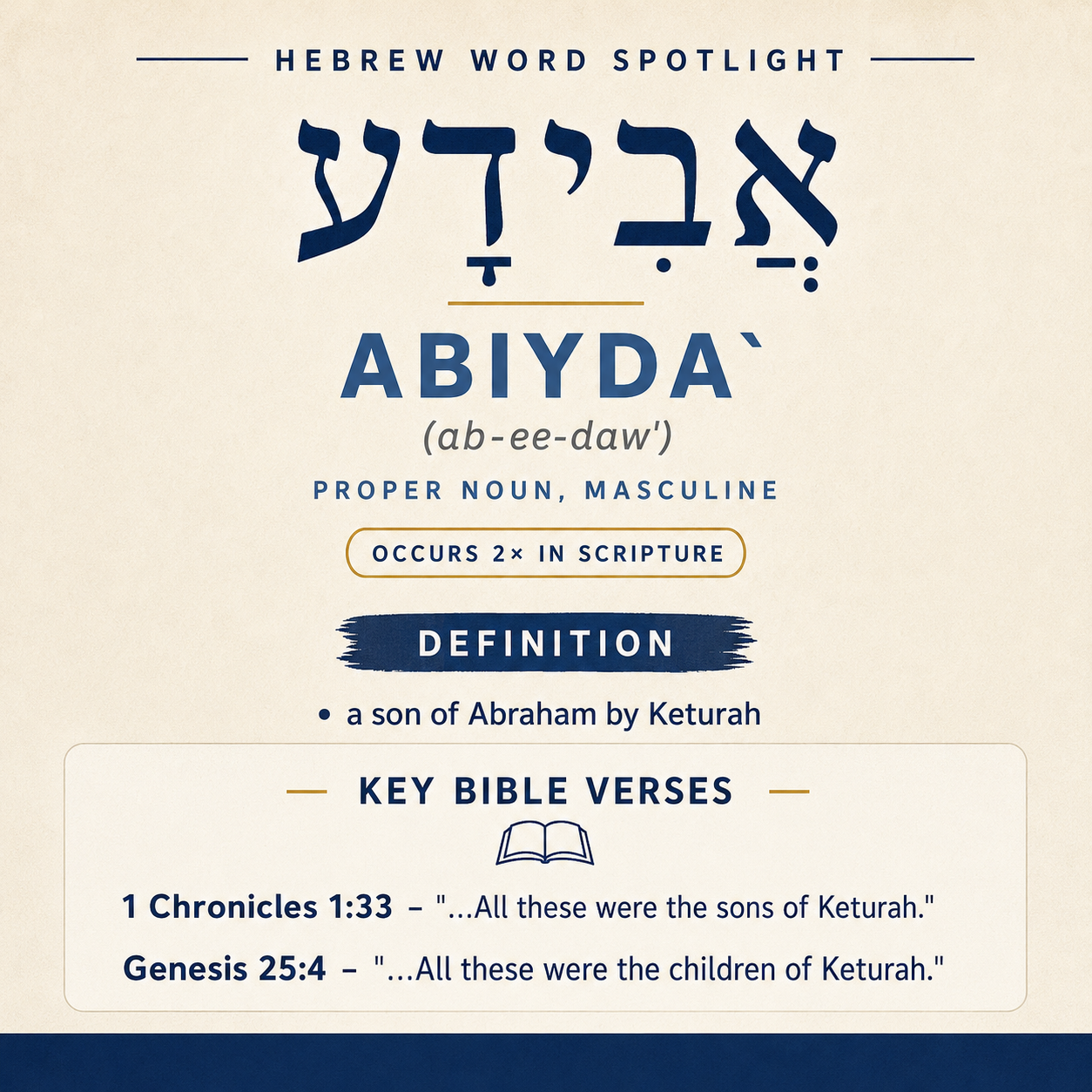
אֲבִידָע (Abiyda`) names a son of Abraham by Keturah, appearing in Genesis 25:4 and 1 Chronicles 1:33.
Scripture Occurrences
The name occurs 2 times in Scripture. It appears in Genesis 25:4 and 1 Chronicles 1:33.
Learn More →Family Listing
Both verses list Abida among the sons of Midian: Ephah, Epher, Hanoch, Abida, and Eldaah. Each passage identifies them as children of Keturah.
Learn More →אֲבִידָע (Abiyda`) is the name of a son of Abraham by Keturah. The name appears in two genealogical listings that identify Abida among the sons of Midian.
Occurrences
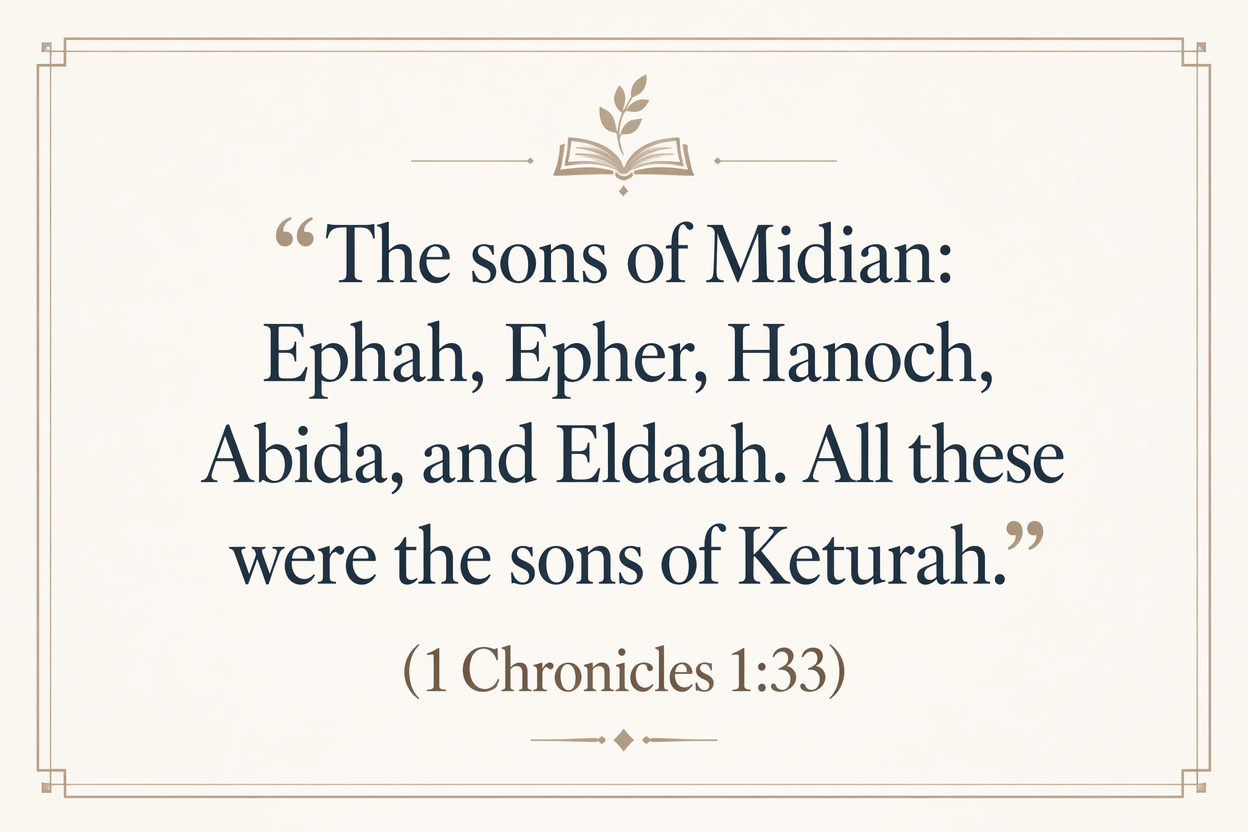
“The sons of Midian: Ephah, Epher, Hanoch, Abida, and Eldaah. All these were the sons of Keturah.” (1 Chronicles 1:33)
Here Abida is presented within a compact lineage statement that moves from Midian to a list of his sons. The wording places Abida in a coordinated series (“Ephah, Epher, Hanoch, Abida, and Eldaah”), indicating that his identity in this verse is defined by familial position: he is one of Midian’s sons. The closing sentence, “All these were the sons of Keturah,” then anchors the entire list back one generation further, locating Abida within the broader household of Abraham through Keturah. In this scene the name functions as a genealogical marker: it helps enumerate and distinguish the individual descendants connected to Keturah, and it contributes to the structure of the record by making the list complete and specific rather than generic.
“The sons of Midian were Ephah, Epher, Hanoch, Abida, and Eldaah. All these were the children of Keturah.” (Genesis 25:4)
In Genesis the name again appears as one item in the listing of Midian’s sons, with the same grouping and the same ordering of names. The verse identifies Abida through the same immediate relationship—sonship to Midian—then closes with a summary line that ties those named descendants to Keturah: “All these were the children of Keturah.” The term “children” broadens the perspective slightly beyond the preceding “sons of Midian,” emphasizing that the listed individuals, including Abida, belong within Keturah’s line. Abida’s contribution to this verse is therefore not descriptive (no additional trait or action is narrated) but identificatory: the name serves to locate a particular person within a stated family framework and to differentiate him from his brothers named in the same sentence.

Sense and Usage
Across both occurrences, Abiyda` operates strictly as a personal name used for lineage accounting: it designates a son of Abraham by Keturah, named in the immediate context as one of the sons of Midian. The two passages employ nearly the same genealogical formula—first identifying Midian’s sons by name, then summarizing them as belonging to Keturah—so the usage is stable and tightly bounded. In each case Abida is not introduced as an independent character with speech, actions, or a narrated role; instead, the name’s function is to preserve individual identity within a list, where each named figure represents a distinct branch within the family line.
The repeated sequence of names (“Ephah, Epher, Hanoch, Abida, and Eldaah”) creates a fixed set in which Abida is one of five brothers, and his placement among them is part of the literary shape of the genealogy. Genealogical lists in these verses are not merely incidental: they are constructed with explicit relationships (“sons of Midian,” “sons/children of Keturah”) that define how the named individuals should be understood. Within that framework, Abida is identified indirectly through the layered wording: Midian is the immediate father named in the verse, and Keturah is the mother identified in the concluding statement. The definition “a son of Abraham by Keturah” is thus expressed in the text by combining the explicit connection to Keturah with the acknowledged fact that Keturah is the mother of this line; the verses focus especially on the segment of the family tree that passes through Midian.
Because both verses end with an “all these” clause, Abida also participates in a collective summary. That summary statement (“All these were the sons of Keturah” / “All these were the children of Keturah”) frames the list as a coherent unit and makes clear that the names are not random but belong to a single maternal line. Abida’s role, then, is representative as well as individual: his name is one of the elements that compose the “all these,” helping define the scope of the group being summarized. The name’s sense in these contexts is therefore relational—its significance is carried by the network of kinship terms around it rather than by any lexical description of character or occupation.
In terms of form and presentation, Abiyda` is used in a straightforward naming slot in both texts, appearing as a bare proper noun within a comma-separated list. It is not accompanied by a patronymic phrase (“son of…”) attached directly to the name, because the relationship is established once for the whole set (“The sons of Midian…”). This shows how the name is integrated into a syntactic pattern where the genealogy’s introductory label carries the explanatory burden, and each personal name then fills in the members of that labeled category.
Genealogical Imagery
The imagery attached to Abiyda` in these passages is the imagery of enumeration and family continuity: a brief line of text that gathers multiple names into a single family unit. In both verses, Abida stands among brothers under a single heading (“The sons of Midian”), and the concluding line gathers the entire set under Keturah. The result is a picture of descent described by ordered naming—an arrangement in which each name, including Abida, serves as a distinct point within a larger family structure.
Sources: Lexical data from Strong’s Exhaustive Concordance and the Open Scriptures Hebrew Lexicon. Occurrence data from the Westminster Leningrad Codex with STEPBible reference data (CC BY). Scripture quotations from the World English Bible (public domain).