
Discovering the Meaning of ‘Abowy in Hebrew
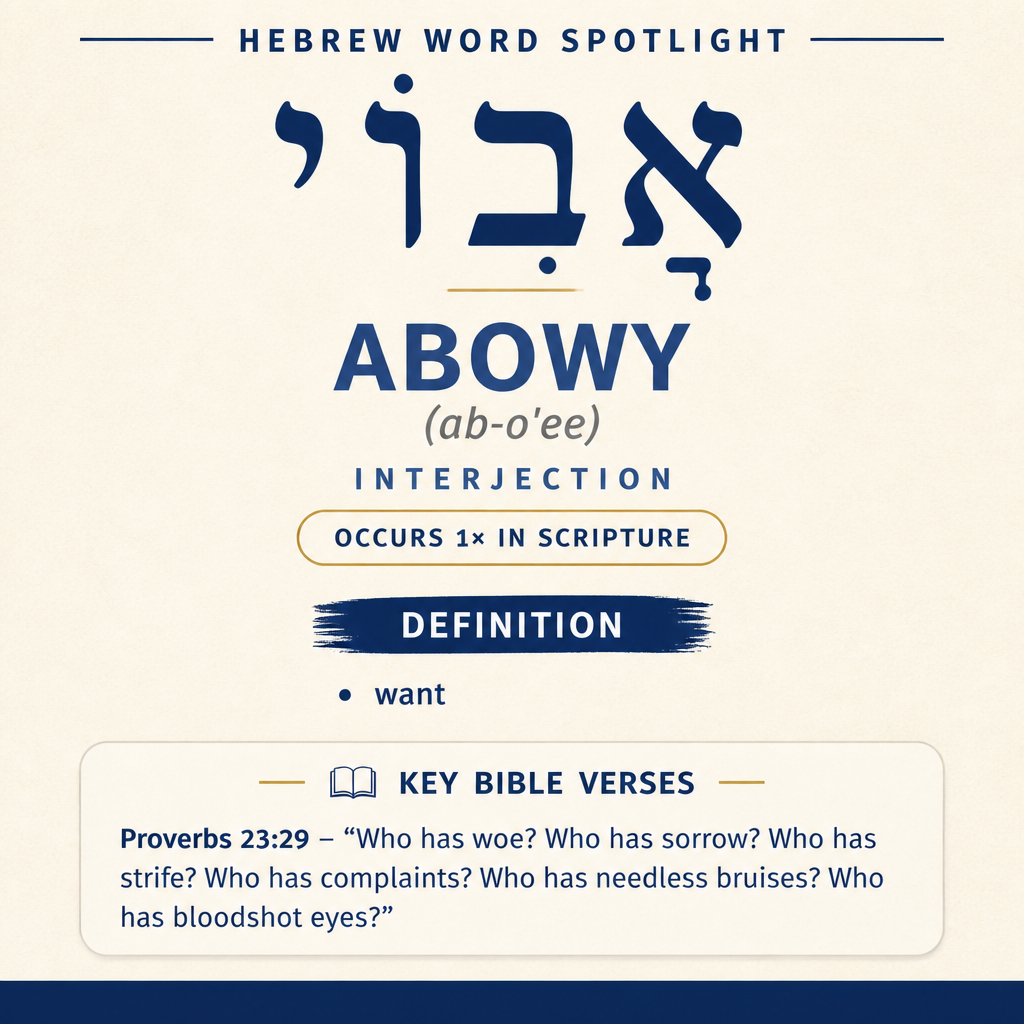
אֲבוֹי (abowy) means “want” and appears once in Scripture, in Proverbs 23:29.
Verse Context
In Proverbs 23:29 it appears amid questions about woe, sorrow, strife, complaints, bruises, and bloodshot eyes.
Learn More →אֲבוֹי expresses “want,” and it appears in a single line of Proverbs that frames a searching set of questions about human misery. In that context it functions as an exclamation that gives voice to need and lack amid visible, bodily and social trouble.
Occurrences
“Who has woe? Who has sorrow? Who has strife? Who has complaints? Who has needless bruises? Who has bloodshot eyes?” (Proverbs 23:29)
In Proverbs 23:29, אֲבוֹי is situated within a rapid sequence of questions that catalogue distress from multiple angles. The verse is not a calm description but a probing interrogation: “Who has woe? Who has sorrow? Who has strife? Who has complaints?” The piling up of nouns forces the reader to linger over the breadth of trouble, moving from inward pain (“sorrow”) to outward conflict (“strife”) and ongoing verbal friction (“complaints”). Within this scene, “want” functions as the cry embedded in the speaker’s search—an audible marker of lack that matches the list’s tone of urgent diagnosis.
The final pair of questions ties the emotional and relational burdens to physical evidence: “Who has needless bruises? Who has bloodshot eyes?” The trouble described is not merely theoretical; it appears on the body and in the eyes. Here “want” fits the verse’s movement from general misery to concrete signs: need becomes something that can be recognized, traced, and named. The rhetorical form (“Who has…?” repeated) suggests that the exclamation of want belongs to a recognizable type of person—someone whose condition is marked by woe, sorrow, conflict, and visible harm.

Sense and Usage
As an interjection meaning “want,” אֲבוֹי conveys need in a compressed, emotive way—less like a measured statement and more like a spontaneous outburst. In Proverbs 23:29 it is not used to request an object or specify what is lacking; instead, it colors the whole portrait with the sound of need itself. The verse’s interrogative rhythm creates a kind of verbal spotlight, circling around the person who lives with a cluster of miseries. In that spotlight, “want” is not an abstract concept but the felt reality that accompanies woe and sorrow and that spills over into strife and complaint.
The way the questions are arranged also clarifies how “want” is heard. It stands alongside terms that cover (1) the emotional register (“woe,” “sorrow”), (2) the social register (“strife,” “complaints”), and (3) the physical register (“needless bruises,” “bloodshot eyes”). “Want” fits naturally because it can be experienced in each register at once: need can ache inwardly, provoke outward contention, and leave tangible traces. The verse does not isolate one dimension of hardship; it gathers them together, so that “want” becomes the kind of cry that can rise from a whole life bent under multiple pressures.
Because the verse uses repeated “Who has…?” questions rather than direct assertions, “want” also participates in a pedagogical strategy. The reader is invited to identify the person described, not merely to sympathize. The exclamation is therefore aligned with discernment: it is a sound of need that belongs to a pattern—sorrow that persists, conflict that erupts, complaints that multiply, and injuries that appear without good reason. In this setting, “want” does not function as a neutral label for shortage; it is the vocal edge of a life in disarray, recognizable by the signs enumerated in the questions.
The paired bodily images are especially pointed for the way they make “want” visible. “Needless bruises” implies harm that is not simply accidental or honorable; it is injury that does not have to be there. “Bloodshot eyes” evoke fatigue, impairment, or prolonged strain. In such a description, “want” is not merely the absence of something desirable; it is the experience of being reduced, diminished, or worn down. The interjection’s brevity matches the starkness of those signs: need is short to say, but heavy to carry.
At the level of sound and pacing, the verse’s clipped questions mirror the interjection’s abruptness. Each clause is short, and the repetition creates a drumbeat effect, as though the speaker is ticking off symptoms one by one. “Want,” as an interjection, belongs to that same register: it is not a long explanation but a short cry. In this way the word participates in the proverb’s style—compressed language designed to strike quickly and leave an impression.
Imagery
Proverbs 23:29 attaches “want” to a set of images that move from the inner life to the public sphere and finally to the body. The imagery is ordinary and unromantic—strife, complaints, bruises, reddened eyes—and that ordinariness is part of its force. “Want” is therefore heard not only as an emotion but as the audible accompaniment to a recognizable condition: a person whose troubles are numerous enough to be listed and plain enough to be seen.
Sources: Lexical data from Strong’s Exhaustive Concordance and the Open Scriptures Hebrew Lexicon. Occurrence data from the Westminster Leningrad Codex with STEPBible reference data (CC BY). Scripture quotations from the World English Bible (public domain).




