
Exploring the Meaning of Hairetikos in Greek
αἱρετικός (Hairetikos) means “schismatic” and appears once in Scripture, in Titus 3:10.
Verse Context
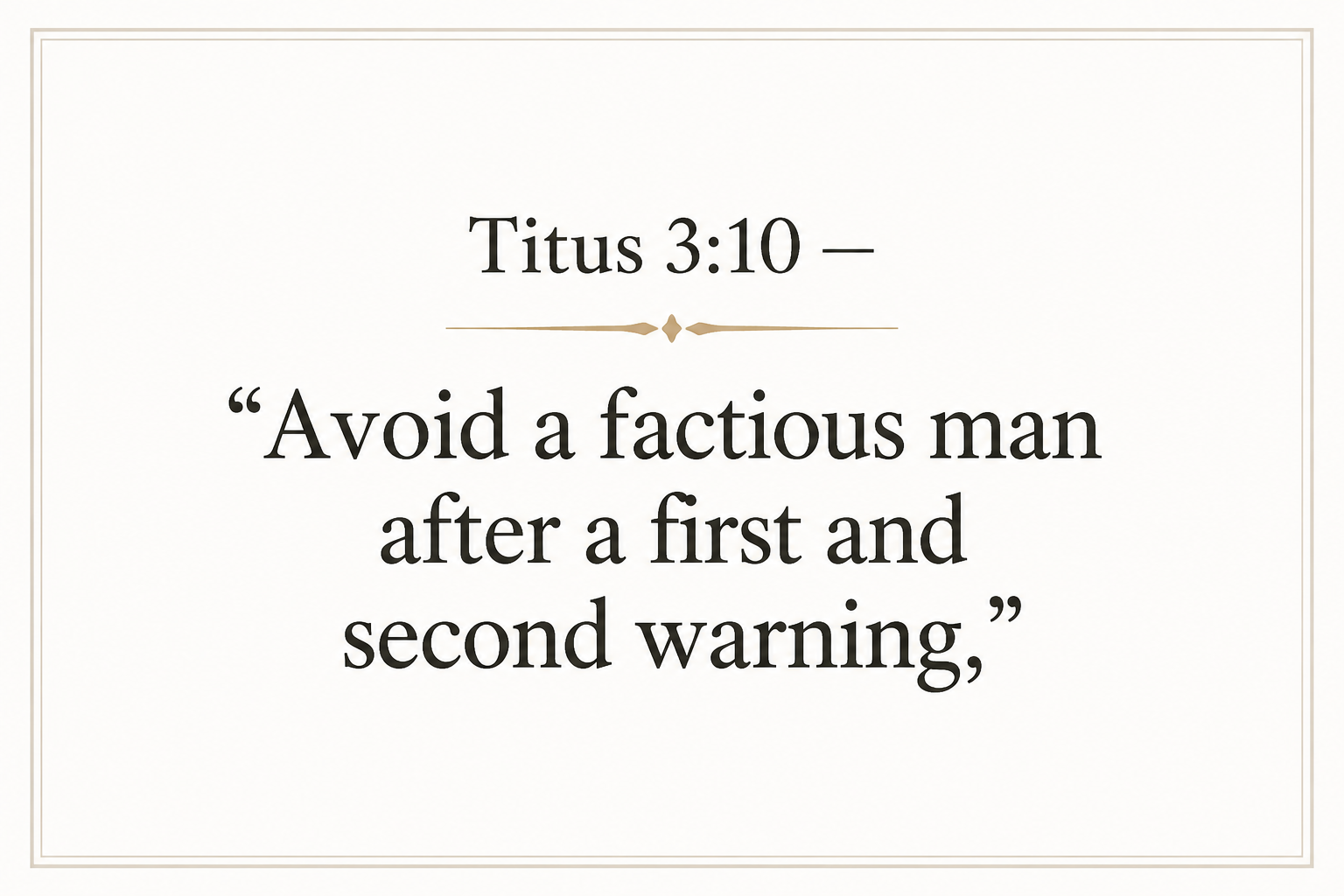
In Titus 3:10 it is used in the instruction: “Avoid a factious man after a first and second warning,”.
Learn More →αἱρετικός describes a “schismatic” person, and it appears once in the New Testament. Its single occurrence comes in a brief instruction about how to respond to a disruptive figure within the community.

Root and Related Words
αἱρετικός is connected with the verb hairetizo (αἱρετίζω), “to choose” (Strong’s G140). The relationship highlights the word-family background that stands behind the adjective’s use as a descriptor applied to a particular kind of person.

Occurrences
Titus 3:10 — “Avoid a factious man after a first and second warning,”
In this instruction, αἱρετικός functions as an identifying label for “a factious man” who is to be avoided after due process: “a first and second warning.” The adjective marks a person whose presence or conduct is treated as socially and spiritually destabilizing, the sort of figure for whom ordinary inclusion and engagement are no longer appropriate once warnings have been issued. The line balances two concerns held together in one sentence: (1) there is an initial willingness to address the person through repeated admonition, and (2) there is a clear endpoint at which continued interaction is no longer framed as constructive.
The immediate force of the word in this verse is practical and relational. The instruction does not describe an internal attitude to cultivate, but a concrete communal response: “Avoid.” The adjective therefore characterizes the individual as one whose schismatic quality bears directly on how others should treat him. Within the boundaries of the verse itself, αἱρετικός is not presented as a mere private difference of opinion; it is the kind of description that, once verified by the pattern of behavior addressed by warnings, warrants separation.
The phrase “after a first and second warning” sets the term in a context of measured action rather than reflex. The person is identified as αἱρετικός in connection with a staged response: the community is to attempt correction more than once before moving to avoidance. In this way the adjective is tethered to a recognizable situation in which the person has already been confronted and has continued in the same course. The warning sequence gives the label moral and communal weight: it is not simply a theoretical category, but a designation used when repeated counsel has not resolved the schismatic issue.
Sense and Usage
The definition “schismatic” signals a rupture-oriented posture—something that tends toward division rather than cohesion. In Titus 3:10, that sense is applied to a person and not to an abstract movement, and it operates as a trigger for community discipline once warnings have been delivered. The focus stays on the practical consequences of schismatic conduct: it damages the shared life enough that “avoid” becomes the fitting next step.
The verse also frames how the label is to be handled. The community’s response is neither unlimited tolerance nor immediate exclusion; it is a limited process with stated stages. The adjective therefore belongs to the sphere of discernment: someone becomes recognizable as αἱρετικός in a way that can be addressed verbally (“warning”) and then answered socially (“avoid”). By placing the command after “a first and second warning,” the verse portrays a schismatic person as one who persists despite correction, making the problem not only the presence of division but the resistance to repair.
Because αἱρετικός is used here as a descriptor for an individual (“a factious man”), the term’s usage is personal and concrete. It targets a kind of person—someone whose effect on the group requires boundaries. The action required is straightforward: avoidance. That avoids turning the term into a purely diagnostic label; instead, it is a word that guides decision-making and group health in a specific, managed scenario.
Within the contours of Titus 3:10, “schismatic” is not treated as a momentary slip but as a settled pattern serious enough to merit an altered relationship. The movement from warning to avoidance suggests escalation: words have been spent, opportunity has been granted, and now the community is instructed to withhold the ordinary forms of association. In that limited framework, αἱρετικός captures a relational threat that must be contained after attempts at correction.
Imagery
The imagery implied by Titus 3:10 is social rather than visual: repeated warnings followed by deliberate distance. The word αἱρετικός sits at the hinge between those two actions, naming the kind of person for whom conversation has been tried and for whom separation becomes the final safeguard.
Sources: Lexical data from Strong’s Exhaustive Concordance and the Translators Brief Lexicon of Extended Strongs for Greek (STEPBible, CC BY). Occurrence data from the Translators Amalgamated Greek New Testament (STEPBible, CC BY). Scripture quotations from the World English Bible (public domain).




