Understanding the Meaning of Agrammatos in Greek
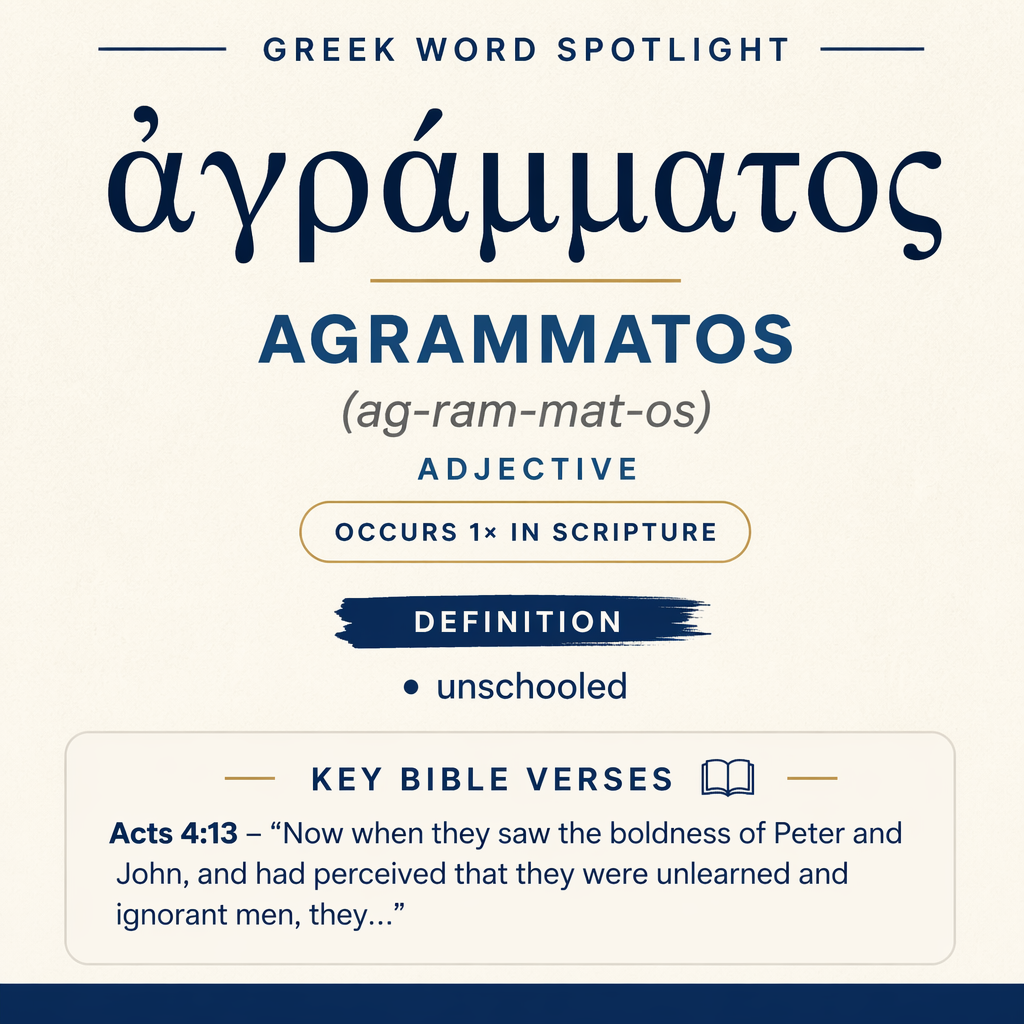
ἀγράμματος means “unschooled” and appears once in Scripture, in Acts 4:13.
Scripture Occurrence
This word occurs 1 time in Scripture. Its single occurrence is in Acts 4:13.
Learn More →Acts Context
In Acts 4:13, observers perceived Peter and John as “unlearned and ignorant men.” The verse connects this perception with their boldness.
Learn More →Agrammatos means “unschooled.” It appears once, in Acts 4:13, where observers interpret Peter and John’s boldness through the lens of their perceived lack of schooling.
Root and Related Words
Agrammatos is related to gramma (γράμμα), “something written.” Strong’s also connects it with A (α, Ἀλφα), “Alpha.”

Occurrences
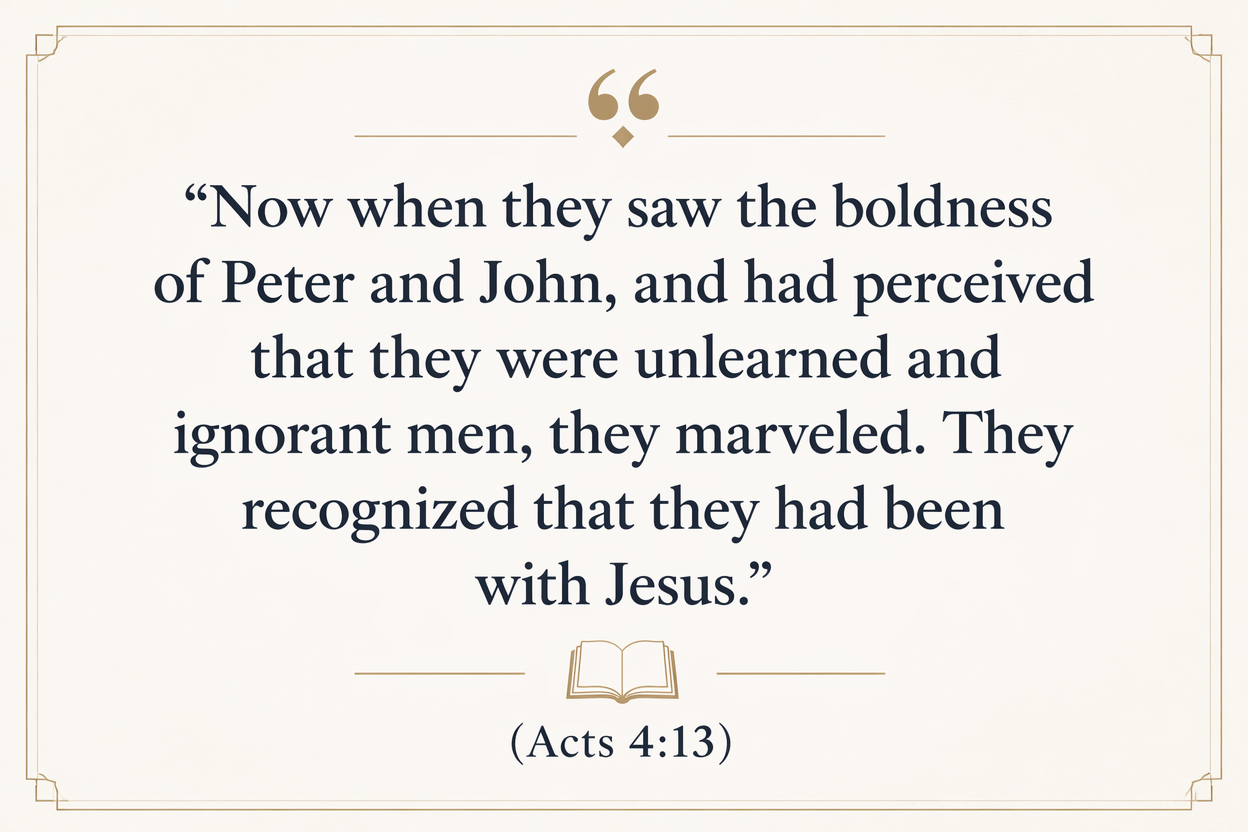
“Now when they saw the boldness of Peter and John, and had perceived that they were unlearned and ignorant men, they marveled. They recognized that they had been with Jesus.” (Acts 4:13)
Here agrammatos is part of the observers’ assessment of Peter and John. The verse portrays a sequence of perceptions: the crowd (or authorities) sees “the boldness of Peter and John,” then “had perceived that they were unlearned and ignorant men,” then “they marveled,” and finally “They recognized that they had been with Jesus.” In this chain, agrammatos contributes to the contrast between expectation and reality: bold speech and presence are set beside an evaluation that these men are not products of formal schooling.
The term functions socially in the scene. It is not used to describe a private deficiency or inner state; it is a label applied by onlookers who are weighing what they observe. The word sits within a paired description (“unlearned and ignorant”), which shows that their evaluation is not merely about what Peter and John said in that moment but about what kind of men the observers take them to be. Agrammatos thus helps explain why the onlookers “marveled”: the boldness does not fit their category for people they consider unschooled.
At the same time, Acts 4:13 places that label alongside another recognition: “They recognized that they had been with Jesus.” The verse does not present agrammatos as the last word about Peter and John; rather, it is one element in the observers’ attempt to account for what they are seeing. The narrative movement is from perceived lack of schooling to astonishment to identification of a formative association. Within this single sentence, agrammatos helps frame the observers’ reasoning: the men’s boldness is interpreted against their perceived educational standing, and then a different explanatory factor comes into view.
Sense and Usage
In Acts 4:13, “unschooled” operates as a public descriptor that marks a perceived absence of formal instruction. The point of the description is not to quantify learning in the abstract, but to locate Peter and John outside the expected class of trained speakers or credentialed teachers. Agrammatos is therefore a term of contrast: it gains its force from being juxtaposed with an observable quality—“boldness”—that the observers did not anticipate from men they categorize this way.
The verse also shows that the label is an inference (“had perceived”), not a measured report. That nuance matters for how the word works in context: it conveys the observers’ conclusion about Peter and John’s schooling status and sets up their astonishment. The narrative impact is that boldness is not treated as the natural outcome of formal education. By calling them “unschooled,” the observers signal that the boldness must have an explanation other than conventional training, and the verse immediately supplies the recognition that “they had been with Jesus.”
Because the word occurs here in a setting of evaluation and surprise, “unschooled” is not a neutral biographical note; it is a category with implications in the observers’ minds. It positions Peter and John as unlikely bearers of public boldness, and it makes their confident presence stand out. In this way, agrammatos contributes to the scene’s tension: it highlights a mismatch between perceived background and present speech, prompting marvel and reconsideration.
Imagery
The imagery tied to agrammatos in Acts 4:13 is the moment of scrutiny: observers watching two men speak boldly, then exchanging an assessment about their lack of schooling, and reacting with amazement as they connect that boldness with prior companionship “with Jesus.” The word evokes a social gaze that measures people by education and is startled when courage and clarity appear where formal training was not expected.
Sources: Lexical data from Strong’s Exhaustive Concordance and the Translators Brief Lexicon of Extended Strongs for Greek (STEPBible, CC BY). Occurrence data from the Translators Amalgamated Greek New Testament (STEPBible, CC BY). Scripture quotations from the World English Bible (public domain).