
Exploring the Meaning of Agrauleo in Greek
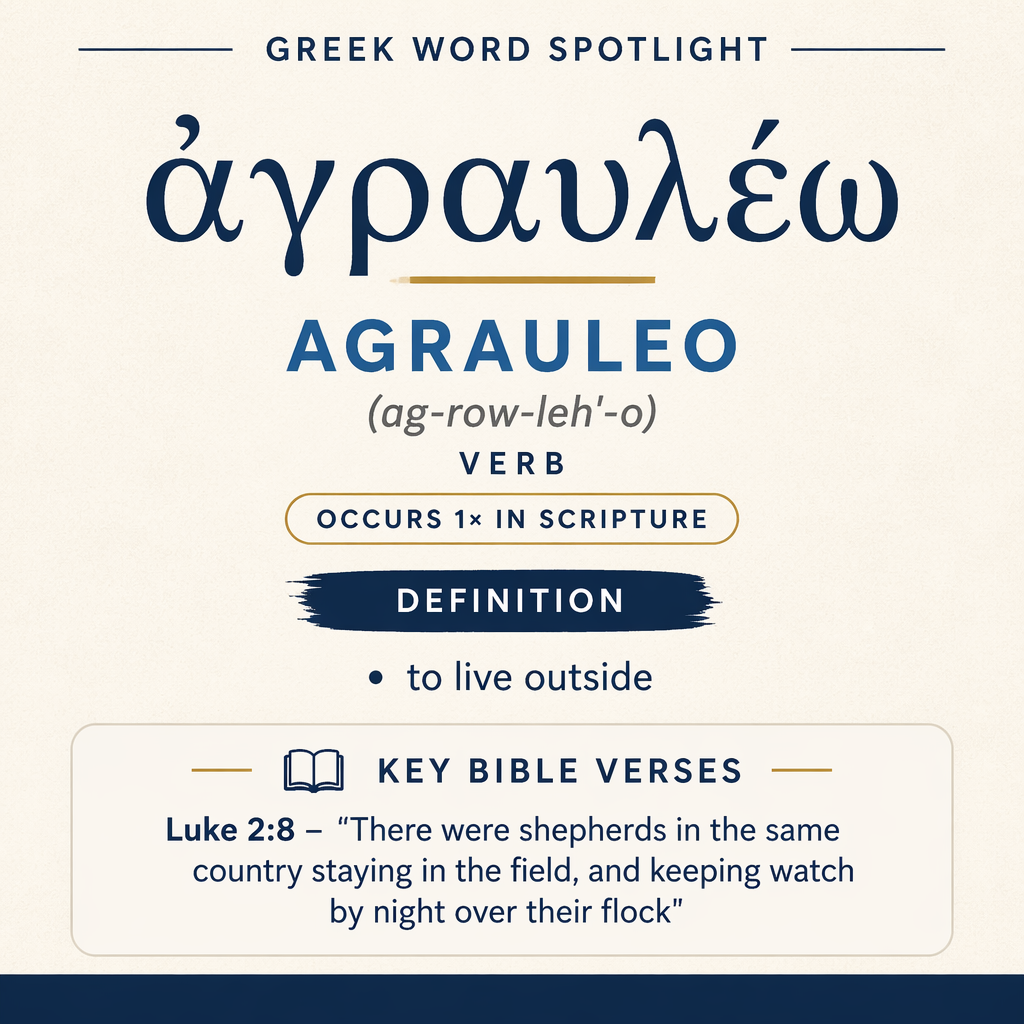
ἀγραυλέω means “to live outside” and appears once in Scripture, in Luke 2:8.
Scripture Occurrence
This word occurs 1 time in Scripture. Its single occurrence is in Luke 2:8.
Learn More →Verse Context
In Luke 2:8, shepherds were staying in the field and keeping watch at night over their flock.
Learn More →ἀγραυλέω appears in Luke’s infancy narrative to describe the shepherds’ way of life on the night the angelic announcement is about to come. In that single scene, it frames the setting as one of outdoor living rather than indoor lodging.
Root and Related Words
ἀγραυλέω (Agrauleo) is connected, by derivation, with ἀγρός (agros), “field” (Strong’s G68). It is also connected with αὐλέω (auleo), “to play the flute” (Strong’s G832), and with αὐλή (aule), “palace/courtyard” (Strong’s G833). These related forms place the verb’s idea in a landscape vocabulary that can point either to the open country (a field) or to a built environment associated with a courtyard.
Occurrences
“There were shepherds in the same country staying in the field, and keeping watch by night over their flock.” (Luke 2:8)
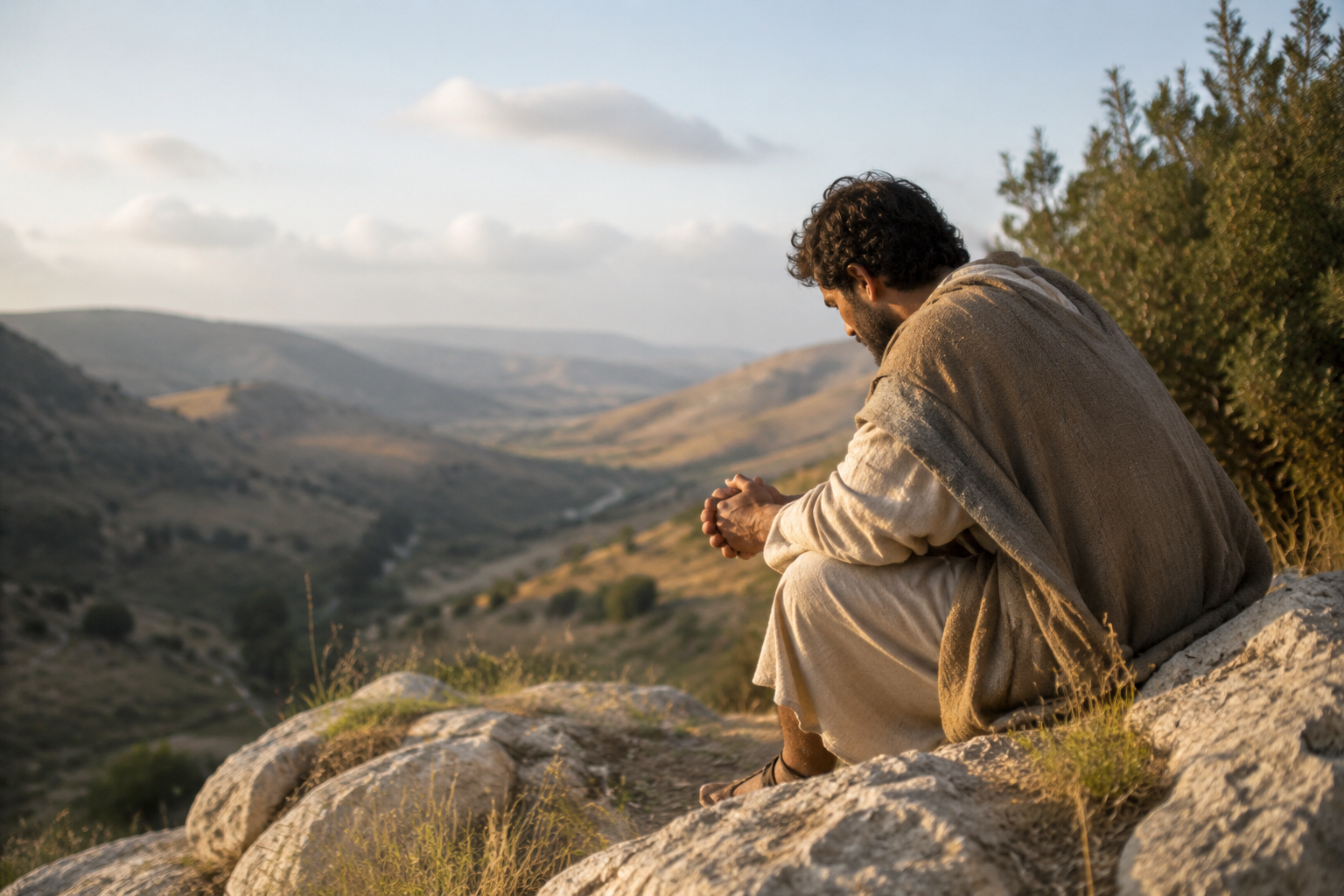
Here ἀγραυλέω marks the shepherds as spending their time outdoors, in the open country, rather than returning home at night. The verse sets a double rhythm: they are “staying in the field,” and they are “keeping watch by night.” The verb helps bind those two elements together into a single picture of nocturnal life outside—remaining where the flock is, through the dark hours, with vigilance as part of the same outdoor setting. Because the object of their attention is “their flock,” the outdoor staying is not presented as a recreational choice but as a practical pattern that matches the needs of animals in the field.
The location language in the verse is tight and concrete. “In the same country” places them in the region where the birth has just been narrated; “in the field” narrows that further to open ground rather than a village street or an interior space. ἀγραυλέω contributes to that narrowing by making “field” not only a point on a map but a place of continued habitation. Luke could have left the shepherds simply “in the field” for a moment; instead, the verb makes the field their night’s dwelling, which heightens the sense of exposure and attentiveness implied by “keeping watch by night.”
In this way the verb functions as part of the scene-setting. The shepherds are introduced not by name or rank but by their circumstances: outdoors, at night, responsible for living creatures. The word’s contribution is therefore narrative as much as descriptive; it prepares for what is about to happen by establishing a setting where quiet, darkness, and watchfulness are already in place.
Sense and Usage
The core idea—living outside—comes to expression in Luke 2:8 through a single, carefully sketched situation. “Outside” is not an abstract contrast with “inside” here; it is anchored to “the field” and to the practice of guarding a flock at night. The verb therefore presents outdoor living as sustained presence: remaining in an open place for the night, not merely passing through it.
Luke’s phrasing links outdoor staying with nighttime vigilance. The verse does not describe a brief glance at the animals or a visit to check on them; it depicts a settled night watch. That makes the verb especially fitting for a scene where time matters (“by night”) and where the shepherds’ task requires continuity. Outdoor living in this setting is inseparable from watchfulness: the field is not simply where the flock happens to be; it is where the shepherds remain so that they can keep watch.
Within the verse’s small compass, ἀγραυλέω also contributes to the atmosphere of openness. The shepherds are under the night sky, in the country, without the protective enclosure implied by a house or similar shelter. This open-air setting is part of what makes the subsequent interruption of ordinary night work plausible within the story’s flow: the shepherds are already awake, already alert, already positioned in the open where events in the surrounding environment would be noticed. The verb, by describing their living arrangement for the night, gives narrative weight to the scene’s plain details.
Imagery
Luke 2:8 pairs ἀγραυλέω with two images that reinforce each other: a field and a night watch. The result is a quiet tableau of ordinary labor carried out under darkness—shepherds outdoors, stationary enough to be described as “staying,” and attentive enough to be described as “keeping watch.” The word carries the texture of that tableau: outdoor living as a lived, embodied reality in the open country.
Sources: Lexical data from Strong’s Exhaustive Concordance and the Translators Brief Lexicon of Extended Strongs for Greek (STEPBible, CC BY). Occurrence data from the Translators Amalgamated Greek New Testament (STEPBible, CC BY). Scripture quotations from the World English Bible (public domain).





