
Exploring the Meaning of Agrielaios in Greek
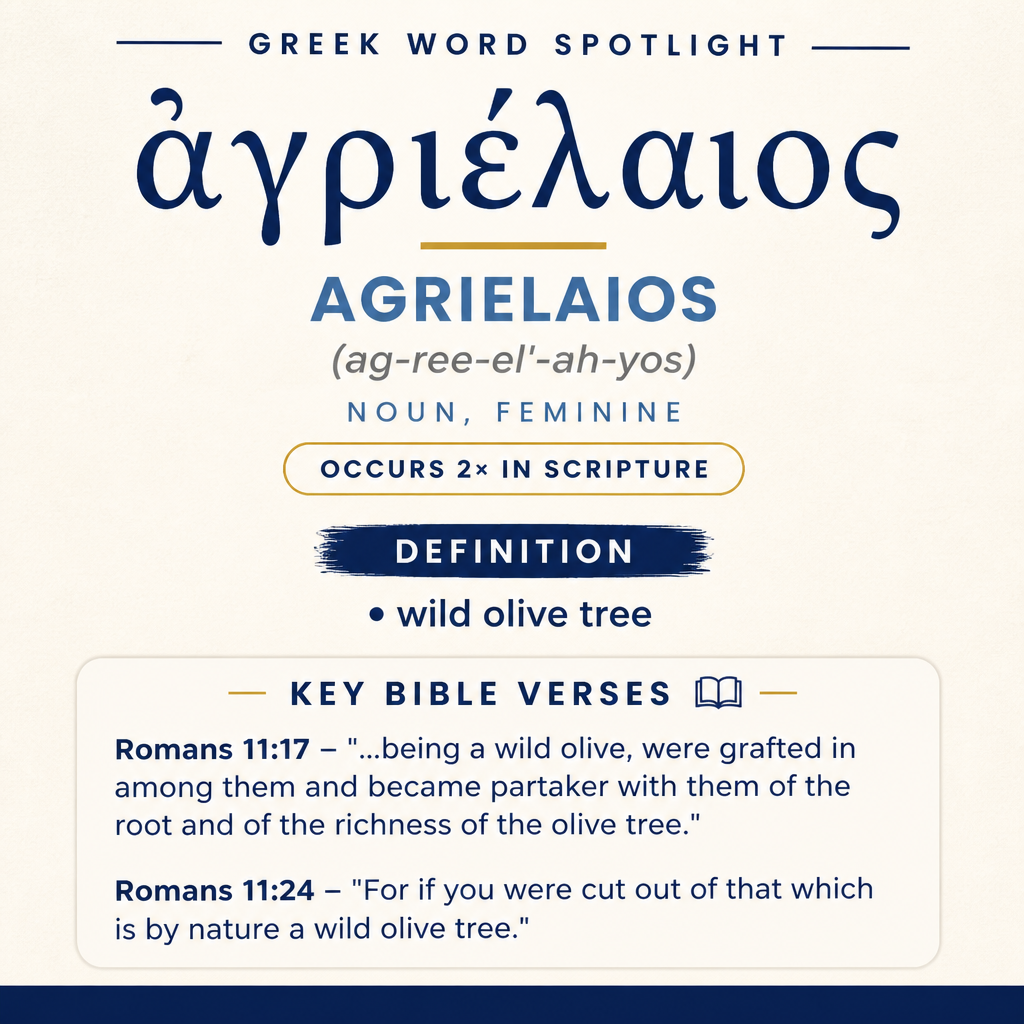
ἀγριέλαιος means “wild olive tree” and appears twice in Romans 11 (vv. 17, 24).
Romans Context
It occurs in Romans 11:17 in the image of a wild olive grafted in among branches. It occurs again in Romans 11:24 describing being cut from a wild olive tree and grafted into a good olive.
Learn More →Scripture Occurrences
ἀγριέλαιος appears 2 times in Scripture. Both occurrences are in Romans 11.
Learn More →ἀγριέλαιος refers to a “wild olive tree,” and it appears in Romans 11 within Paul’s extended olive-tree imagery about branches, root, and grafting. In both occurrences the term functions inside a single metaphor, contrasting what is “by nature” wild with the cultivated “good olive tree.”
Root and Related Words
ἀγριέλαιος is formed from two related Greek words: ἐλαία (elaia, “olive tree”; Strong’s G1636) and ἄγριος (agrios, “wild”; Strong’s G66). The compound draws on the ordinary agricultural distinction between what grows in an uncultivated state and what belongs to the managed, fruit-bearing olive tree.

Occurrences
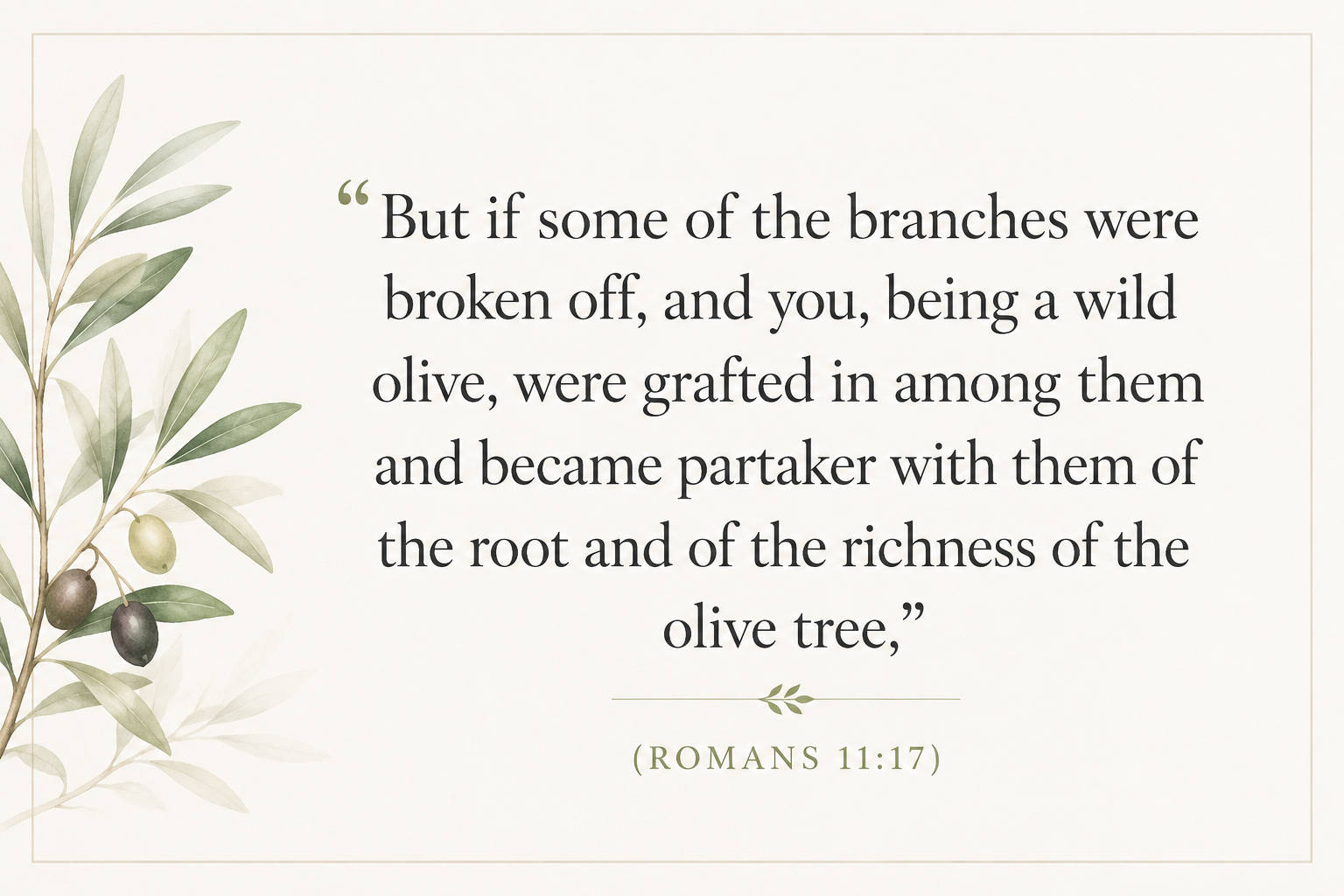
“But if some of the branches were broken off, and you, being a wild olive, were grafted in among them and became partaker with them of the root and of the richness of the olive tree,” (Romans 11:17)
Here ἀγριέλαιος is applied directly to “you,” placing the addressee inside the picture as something originally belonging to a wild olive. In the scene, “some of the branches were broken off,” creating space within the existing olive tree; the “wild olive” is then “grafted in among them.” The word therefore helps mark a contrast of origin: the newly inserted branch comes from a wild source, yet it is now located “among them” (among the remaining branches) in the shared tree. The result is not merely proximity but participation: the grafted-in “wild olive” “became partaker with them of the root and of the richness of the olive tree.” Within this sentence, ἀγριέλαιος highlights the surprising identity of the one who nevertheless shares in what flows from the “root” and the tree’s “richness.”
“For if you were cut out of that which is by nature a wild olive tree, and were grafted contrary to nature into a good olive tree, how much more will these, which are the natural branches, be grafted into their own olive tree?” (Romans 11:24)
In Romans 11:24 the term appears with explicit qualifiers that press the image further: “by nature a wild olive tree.” ἀγριέλαιος here names the stock from which the addressed “you” once belonged—something you were “cut out of.” The verse then stacks two movements: extraction (“cut out”) and insertion (“grafted”)—and it underscores the oddity of the second movement with the phrase “contrary to nature.” The “wild olive tree” is contrasted with “a good olive tree,” and the contrast serves the argument of the closing rhetorical question: if such a “contrary to nature” grafting has occurred, “how much more” can the “natural branches” be regrafted “into their own olive tree.” In this verse, ἀγριέλαιος anchors one side of a threefold set of categories: wild olive / good olive / natural branches. The term thereby contributes to a carefully structured comparison about what fits “by nature,” what happens “contrary to nature,” and what follows as the more expected outcome.
Sense and Usage
Across these two verses, ἀγριέλαιος functions as a precise label within a horticultural metaphor, marking the addressee’s starting point in terms of olive-tree identity. The meaning “wild olive tree” is not used to describe a landscape or a literal plant in view; rather, it is used to characterize a branch’s source in relation to a larger cultivated tree. In Romans 11:17 the emphasis falls on incorporation and shared nourishment: the one described as a wild olive becomes a “partaker” of “the root” and the “richness of the olive tree.” The term thus carries the sense of an origin that does not prevent real participation once grafting has taken place.
Romans 11:24 develops the same sense with added explicitness and contrast. “By nature” frames the wild olive as the fitting, native context from which one might expect the branch to remain; “contrary to nature” frames the grafting into “a good olive tree” as unexpected relative to that origin. ἀγριέλαιος is therefore not merely a botanical adjective but a marker for how the metaphor assigns identity and expectation: it defines what would normally correspond to a branch’s natural place. In the logic of the passage, that marked origin becomes the backdrop for a stronger claim about possibility—if the unexpected graft has occurred, then the regrafting of “natural branches” is portrayed as even more plausible.
The two contexts also show how the “wild” descriptor works in tandem with the broader olive-tree vocabulary in the sentences. In Romans 11:17, the wild olive is set alongside “the root” and “the richness of the olive tree,” which are presented as shared goods for those within the tree. In Romans 11:24, the wild olive is set opposite “a good olive tree,” while “natural branches” and “their own olive tree” introduce categories of belonging. ἀγριέλαιος, then, helps the metaphor speak about difference without dissolving the unity of the single tree imagery: branches can differ in origin (wild versus natural), yet the discussion centers on one olive tree into which branches are broken off, grafted in, and grafted back.
Imagery
ἀγριέλαιος evokes the tangible practice of grafting, with its implied cutting and joining of living wood. In these verses the “wild olive tree” is pictured as the source of a branch removed and inserted into a cultivated tree, so that nourishment from the “root” and the tree’s “richness” can be shared (Romans 11:17), and so that a “contrary to nature” graft can serve as a basis for expecting the restoration of “natural branches” to “their own olive tree” (Romans 11:24). The word’s imagery thus works by contrasting origins while keeping attention on what grafting accomplishes within a single olive-tree framework.
Sources: Lexical data from Strong’s Exhaustive Concordance and the Translators Brief Lexicon of Extended Strongs for Greek (STEPBible, CC BY). Occurrence data from the Translators Amalgamated Greek New Testament (STEPBible, CC BY). Scripture quotations from the World English Bible (public domain).





