Exploring the Meaning of Zeukteria in Greek
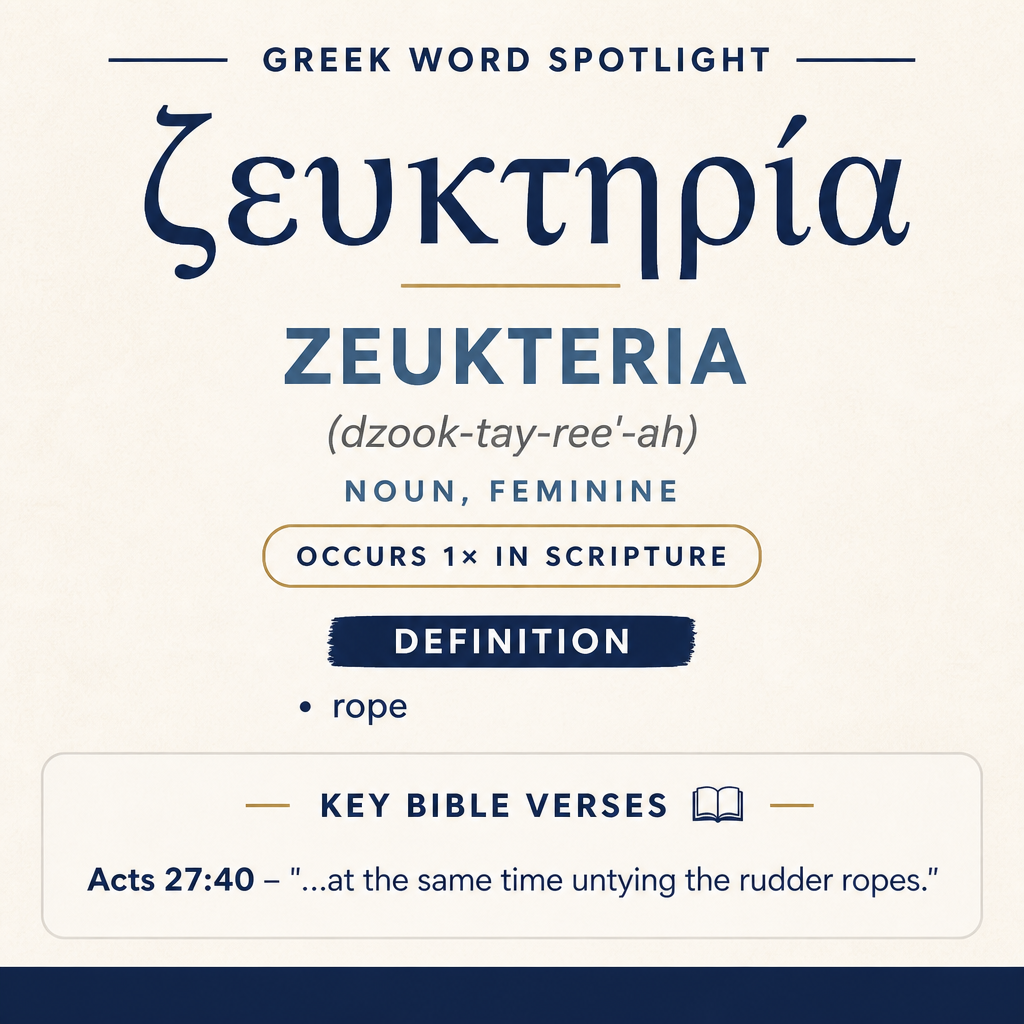
ζευκτηρία (Zeukteria) means “rope” and appears once in Scripture, in Acts 27:40.
Scripture Occurrence
ζευκτηρία occurs 1 time in Scripture. Its single occurrence is in Acts 27:40.
Learn More →ζευκτηρία means “rope” and appears in the nautical account of Acts 27, where a ship’s crew prepares to run for shore in dangerous conditions. In that scene it names one set of ropes that must be dealt with quickly as the sailors shift from riding out the storm to steering toward land.
Root and Related Words
ζευκτηρία is related to zygos (ζυγός), “yoke/scales” (Strong’s G2218). The relationship points to the broader idea of something that joins, restrains, or holds in coordinated tension—imagery that fits naturally with shipboard rigging and control lines.

Occurrences
“Casting off the anchors, they left them in the sea, at the same time untying the rudder ropes. Hoisting up the foresail to the wind, they made for the beach.” (Acts 27:40)
In Acts 27:40, ζευκτηρία belongs to a chain of brisk, practical actions taken almost simultaneously: anchors are released, rudder ropes are untied, a sail is raised, and the ship is aimed for the beach. Within the sentence, “rudder ropes” stands as one specific item among several pieces of equipment that must be adjusted to change the vessel’s situation. The anchors represent what had held the ship in place; once they are “left…in the sea,” the ship is no longer fixed. But drifting without control would be useless—so “at the same time” the crew unties the ropes connected with the rudders, preparing the steering apparatus for active guidance as they “made for the beach.”
The placement of “untying the rudder ropes” between anchor-release and sail-hoisting shows what ζευκτηρία contributes: it names the tangible, worked-with line whose tying and untying affects the ship’s responsiveness. The action is not merely cutting loose but deliberately loosening: the ropes are untied, implying they had been secured in a way suitable for holding rudders steady during a prior phase of the storm. When the crew shifts to a new goal—approaching land—these ropes must be freed so the rudders can serve that goal. In the verse’s compact description, ζευκτηρία is one of the small, concrete details that makes the sequence credible: seamanship involves not just large decisions (anchors or sails) but also management of ropes that connect human hands to the ship’s moving parts.
Sense and Usage
With the straightforward sense “rope,” ζευκτηρία functions as a technical yet ordinary term for a working line. Acts 27:40 uses it in a plural expression (“rudder ropes”), placing the word in the world of maritime hardware where multiple ropes serve different tasks at different moments. The verse highlights two complementary aspects of ropes: first, they can secure and stabilize—something tied is held; second, they can be released so that a mechanism can move. The sailors’ “untying” shows rope as an instrument of controlled restraint: it is not simply an object that exists on the ship but a tool whose knots and loosenings regulate motion.
The immediate context also clarifies how rope relates to direction and urgency. The crew’s aim is explicit: “they made for the beach.” In that push toward shore, rope is not background clutter but part of the means by which the ship can answer the wind and the helmsman. The rudders, as steering elements, must be able to function freely; ζευκτηρία names what had been holding them in a fixed position and what must be removed for steering to resume. Thus the word’s contribution is practical and kinetic: it evokes hands working knots, the moment of release, and the shift from passive survival measures to active maneuvering.
Even in a single occurrence, the verse’s coordinated verbs (“Casting off… leaving… untying… Hoisting up… made for…”) show ζευκτηρία as part of a timed, sequenced response. Rope is something acted upon; it is loosened at the right moment, alongside other actions, to enable a decisive move. In this usage, the noun takes on the feel of shipboard order: not chaos, but a disciplined set of tasks where a rope’s status—tied or untied—matters.
Imagery
Acts 27:40 gives ζευκτηρία a vivid, physical image: ropes at the stern being untied as the ship transitions from anchoring to running before the wind. The word carries the immediacy of wet rigging and hurried hands, set against the broader motion of a vessel turning toward a visible shoreline—an image of control regained through small, concrete actions.
Sources: Lexical data from Strong’s Exhaustive Concordance and the Translators Brief Lexicon of Extended Strongs for Greek (STEPBible, CC BY). Occurrence data from the Translators Amalgamated Greek New Testament (STEPBible, CC BY). Scripture quotations from the World English Bible (public domain).