Exploring the Meaning of Zetesis in Greek
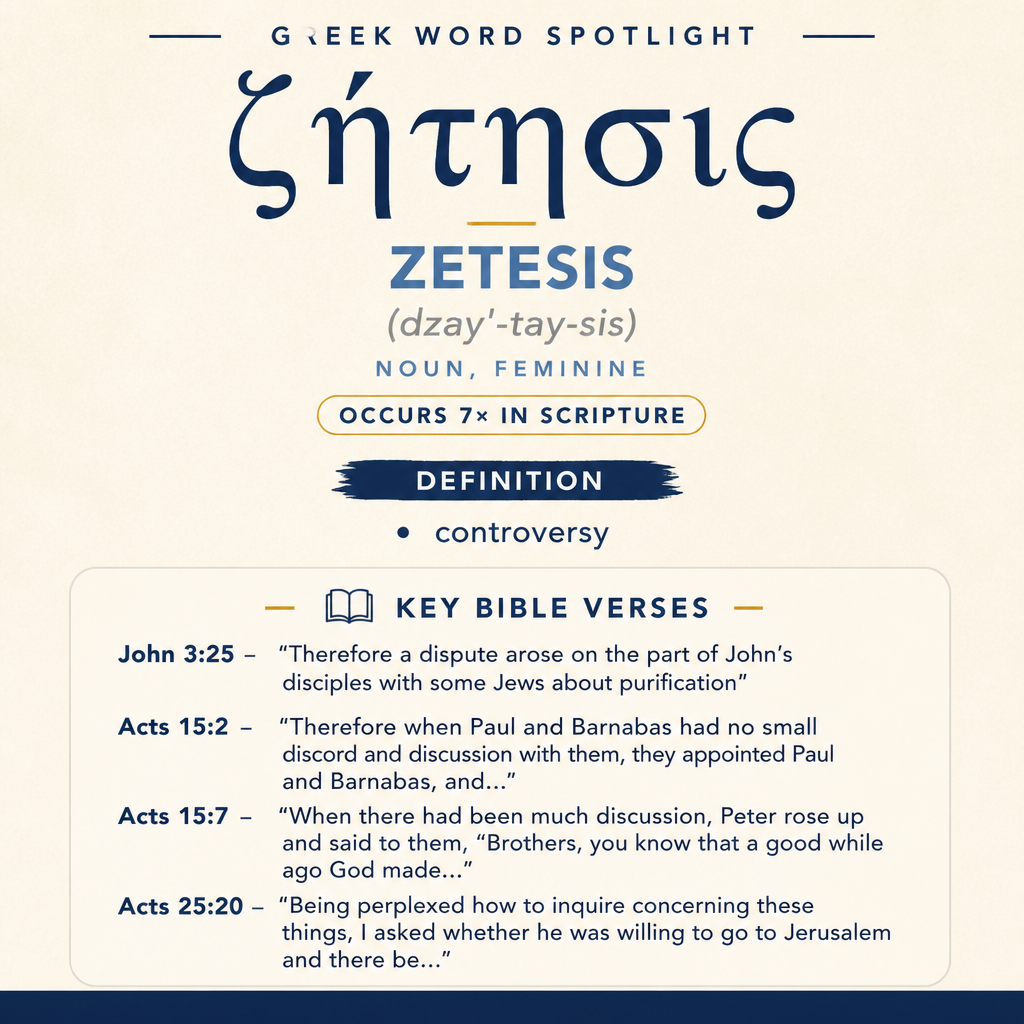
ζήτησις means “controversy” and occurs 7 times in Scripture, including John 3:25; Acts 15:2,7; Acts 25:20; 1 Timothy 6:4; 2 Timothy 2:23; Titus 3:9.
Core Meaning
ζήτησις is defined as “controversy.” In its listed occurrences, it appears in contexts of disputes, discussion, and questionings.
Learn More →Narrative Settings
It describes a dispute about purification (John 3:25) and much discussion in Jerusalem (Acts 15:2,7). It is also used for inquiry concerning a case (Acts 25:20).
Learn More →Pastoral Warnings
In 1 Timothy 6:4 it appears with arguments, disputes, and word battles. In 2 Timothy 2:23 and Titus 3:9 it is linked with foolish questionings and disputes about the law.
Learn More →ζήτησις names a kind of frictional exchange that surfaces as a live point of contention, rendered here as “controversy.” It appears in scenes ranging from a dispute over ritual practice to public and private hearings and to pastoral warnings about communal life.
Occurrences
John 3:25: “Therefore a dispute arose on the part of John’s disciples with some Jews about purification.”
Here ζήτησις is the spark of a concrete clash: it “arose” between identifiable groups (“John’s disciples” and “some Jews”) and it fastens onto a specific topic (“purification”). The wording frames the controversy not as a quiet difference of opinion but as an event that breaks out among people already engaged in religious practice, focusing attention on how purification should be understood or handled in that setting.
Acts 15:2: “Therefore when Paul and Barnabas had no small discord and discussion with them, they appointed Paul and Barnabas, and some others of them, to go up to Jerusalem to the apostles and elders about this question.”
ζήτησις appears as “this question,” the issue weighty enough to prompt an organized appeal to recognized leadership (“the apostles and elders”). The verse pairs the controversy with “no small discord and discussion,” showing how ζήτησις can press beyond mere talk into sustained contention that demands a formal process. The controversy functions as the stated agenda for travel and deliberation: it is what the delegation carries to Jerusalem.
Acts 15:7: “When there had been much discussion, Peter rose up and said to them, “Brothers, you know that a good while ago God made a choice among you that by my mouth the nations should hear the word of the Good News and believe.”
In this gathering, ζήτησις is heard as “much discussion,” a prolonged and possibly heated exchange that sets the stage for a decisive speech. The narrative movement—extended discussion followed by Peter rising—casts the controversy as something that can fill a room until a voice of testimony reframes the matter. The content of Peter’s address (“God made a choice… that… the nations should hear… and believe”) shows the controversy operating at the level of communal direction and mission, not simply at the level of personal preference.
Acts 25:20: “Being perplexed how to inquire concerning these things, I asked whether he was willing to go to Jerusalem and there be judged concerning these matters.”
ζήτησις enters a judicial-administrative scene as the problem of “how to inquire.” The speaker’s “perplexed” state highlights the complexity controversy can create for an official trying to conduct a proper examination. The controversy is not described as emotionally charged here so much as procedurally difficult: it raises “these matters” that require inquiry, venue, and judgment, and it pushes the question of where a case should be heard (“go to Jerusalem”).
1 Timothy 6:4: “he is conceited, knowing nothing, but obsessed with arguments, disputes, and word battles, from which come envy, strife, insulting, evil suspicions,”
ζήτησις is situated in a moral and relational diagnosis. It is listed among patterns of contentious engagement—“arguments, disputes, and word battles”—and the verse traces a chain of effects that flow out of such controversy: “envy, strife, insulting, evil suspicions.” In this depiction, ζήτησις is not an honest airing of concerns but an “obsession,” a fixation that corrodes a community’s emotional climate and interpersonal trust.
2 Timothy 2:23: “But refuse foolish and ignorant questionings, knowing that they generate strife.”
Here ζήτησις is pictured as “questionings” that are “foolish and ignorant,” and the focus falls on their predictable outcome: they “generate strife.” The verse treats controversy as something that can be selected or declined—“refuse”—suggesting that certain kinds of disputation are not neutral exercises. In this scene, ζήτησις functions like kindling: once entertained, it produces conflict rather than clarity.
Titus 3:9: “but shun foolish questionings, genealogies, strife, and disputes about the law; for they are unprofitable and vain.”
ζήτησις is again aligned with “foolish questionings,” now placed alongside “genealogies” and paired with “disputes about the law.” The instruction “shun” presents controversy as avoidable company that a community leader should keep at a distance. The evaluation “unprofitable and vain” marks such controversies as wasted effort: they consume energy without yielding constructive results, particularly when they orbit “about the law” and slide into recurrent, entrenched contention.

Sense and Usage
Across these passages, ζήτησις consistently signals a contested matter that draws people into argument and can reshape what happens next. In John 3:25 it is localized—an outbreak “about purification”—and the controversy is shown in its social geometry: identifiable parties, a defined topic, and a sudden emergence. In Acts 15 it becomes communal and directional: it provokes “no small discord,” requires representation, and is carried to a council of “apostles and elders.” The repeated emphasis on discussion (Acts 15:2, 15:7) portrays ζήτησις as something that can dominate a meeting until a key figure addresses it. Even without narrating every detail, the language implies that controversy has momentum: it gathers participants and demands response.
Acts 25:20 shows a different angle. Controversy is not only a quarrel between peers; it can become an administrative problem that tests an official’s ability to inquire “concerning these things.” The perplexity described there locates ζήτησις in the world of procedure—questions of inquiry, venue, and judgment. The controversy is still a contested matter, but the scene focuses on the difficulty of handling it fairly and coherently.
The Pastoral Epistles (1 Timothy 6:4; 2 Timothy 2:23; Titus 3:9) concentrate on the social and ethical fallout of ζήτησις. In 1 Timothy 6:4, controversy is embedded in a character portrait: the person is “conceited,” “knowing nothing,” and “obsessed.” ζήτησις here is less a single incident than a habitual mode of engagement, and the verse explicitly tracks its products in community life—“envy, strife, insulting, evil suspicions.” This list makes ζήτησις visible not merely as talk but as a generator of toxic relational outcomes.
In 2 Timothy 2:23 and Titus 3:9, ζήτησις is treated as avoidable because of its tendency to multiply conflict. The instruction to “refuse” or “shun” does not deny that questions can be asked, but it distinguishes a type of questioning that is “foolish and ignorant,” the kind that predictably “generate[s] strife” and proves “unprofitable and vain.” In Titus, the controversy is linked with “disputes about the law,” suggesting that ζήτησις can attach itself to interpretive or boundary-marking issues and then spiral into repeated contention. The consistent pragmatic assessment is that certain controversies do not simply reflect disagreement; they actively produce division and waste.
Read together, these occurrences show ζήτησις operating on a spectrum of settings: informal dispute among religious groups, formal deliberation in leadership councils, legal inquiry in governance, and internal congregational life where leaders must discern which controversies deserve engagement. The term’s force lies in its capacity to name the contested center of a conversation—the point around which people gather, clash, convene, or fracture.
Imagery
The passages paint ζήτησις with the imagery of a matter placed in the middle of a group: it “arose” (John 3:25), it fills time as “much discussion” (Acts 15:7), it can require escalation to appointed delegates and elders (Acts 15:2), and it can bog down an inquiry with perplexity (Acts 25:20). In the pastoral warnings, it resembles a contagion in speech—“arguments… disputes… word battles” (1 Timothy 6:4)—that spreads into “strife” (2 Timothy 2:23) and is judged “unprofitable and vain” (Titus 3:9).
Sources: Lexical data from Strong’s Exhaustive Concordance and the Translators Brief Lexicon of Extended Strongs for Greek (STEPBible, CC BY). Occurrence data from the Translators Amalgamated Greek New Testament (STEPBible, CC BY). Scripture quotations from the World English Bible (public domain).