
Exploring the Meaning of Zelos in Greek
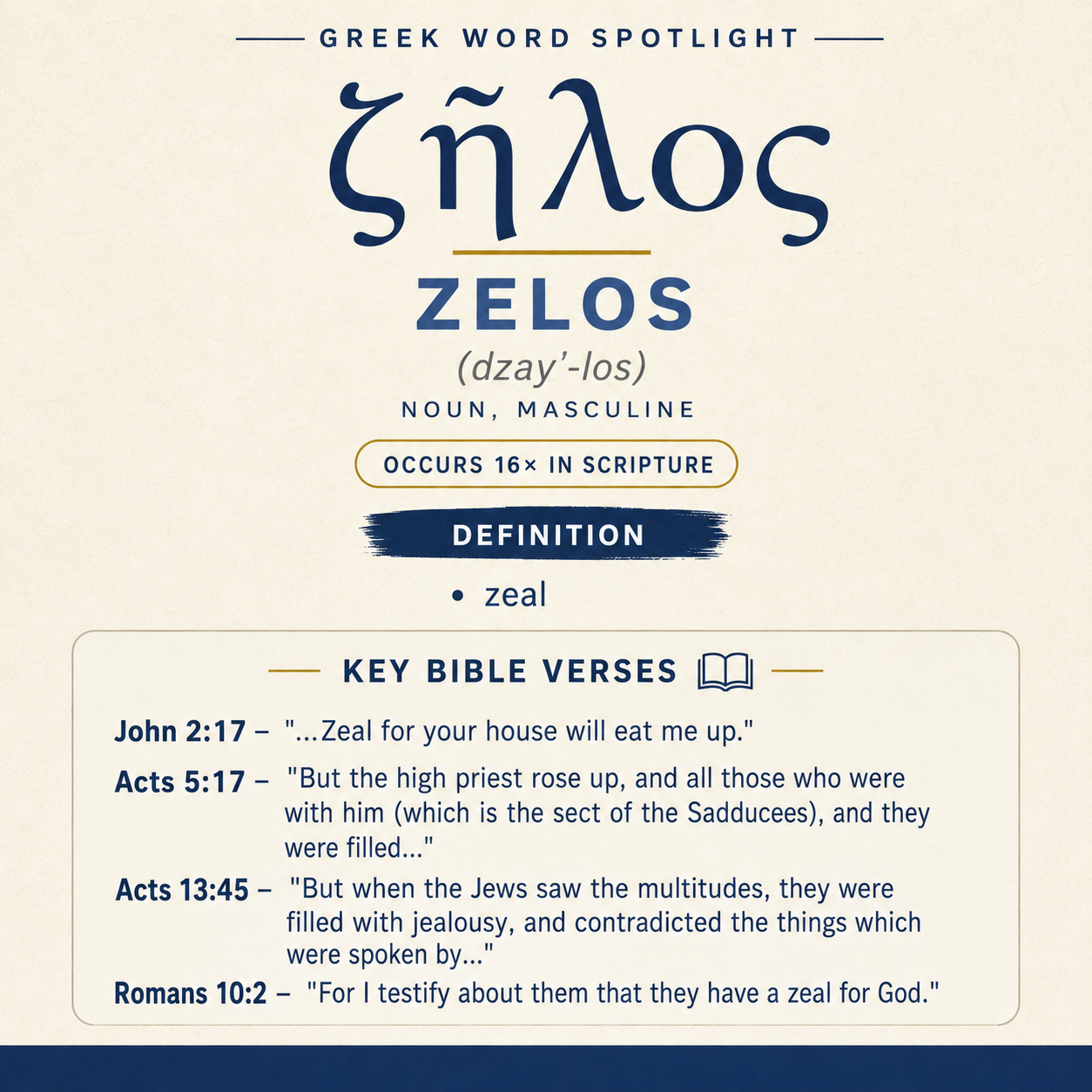
ζῆλος means “zeal” and occurs 16 times in Scripture, including John 2:17 and Romans 10:2.
Key Occurrences
It appears in John 2:17 (“Zeal for your house will eat me up”) and Romans 10:2 (“a zeal for God, but not according to knowledge”).
Learn More →Usage Examples
In Acts 13:45 it is rendered “jealousy,” and in 1 Corinthians 3:3 it appears alongside “jealousy, strife, and factions.”
Learn More →ζῆλος means “zeal,” appearing in scenes that range from worshipful devotion to contentious rivalry. Across the passages cited here, it names an intensity of concern that can be commended, misdirected, or condemned depending on its object and fruit.
Occurrences
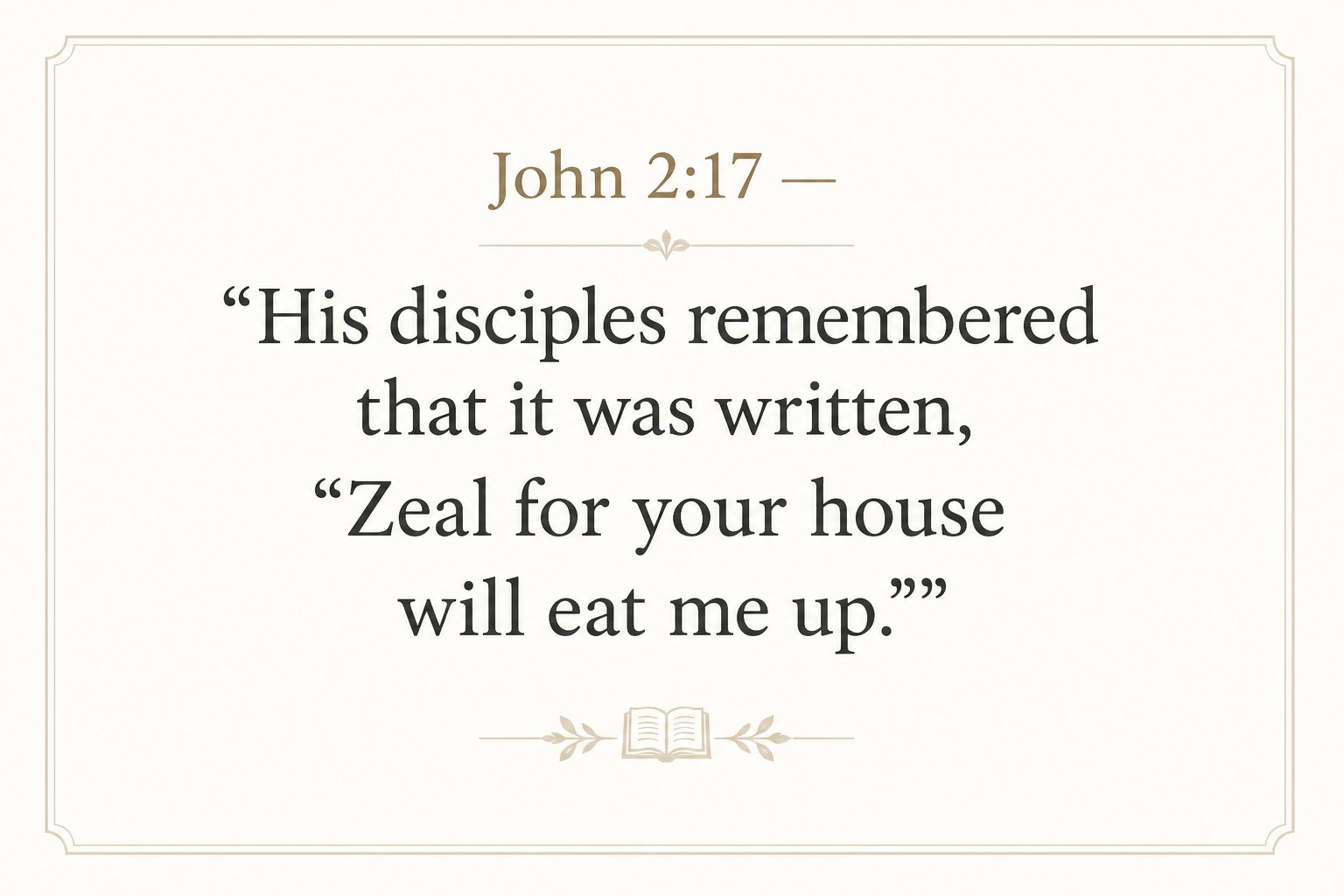
John 2:17 — “His disciples remembered that it was written, “Zeal for your house will eat me up.””
Here ζῆλος is focused on “your house,” a concrete object of devotion. The line frames zeal as consuming—so strong that it “will eat me up”—portraying an all-absorbing, costly intensity directed toward God’s dwelling and its honor.
Acts 5:17 — “But the high priest rose up, and all those who were with him (which is the sect of the Sadducees), and they were filled with jealousy”
In this conflict scene, ζῆλος is something that can “fill” a group, functioning like an inner force that motivates action. The subject is the high priest and his associates; the word characterizes their collective posture as they rise up, indicating an intense, driving response toward what is happening around them.
Acts 13:45 — “But when the Jews saw the multitudes, they were filled with jealousy, and contradicted the things which were spoken by Paul, and blasphemed.”
ζῆλος again “fills” people, but this time the text narrates its outward results: contradiction and blasphemy. The trigger is sight—“when the Jews saw the multitudes”—so zeal here is represented as a reactive intensity that turns speech combative and destructive in the moment.
Romans 10:2 — “For I testify about them that they have a zeal for God, but not according to knowledge.”
This occurrence assigns ζῆλος a stated object: “for God.” Yet it is evaluated by a standard alongside it: “according to knowledge.” The line recognizes real zeal while also describing a mismatch between intensity and understanding, showing that zeal can be genuine without being well-directed in thought.
Romans 13:13 — “Let’s walk properly, as in the day; not in reveling and drunkenness, not in sexual promiscuity and lustful acts, and not in strife and jealousy.”
ζῆλος is placed in a vice list as something inconsistent with walking “properly” in daylight. Paired with “strife,” it is treated as a social disorder that disrupts communal life. In this context, the word functions as a named behavior-pattern to be refused, not a virtue to be cultivated.
1 Corinthians 3:3 — “for you are still fleshly. For insofar as there is jealousy, strife, and factions among you, aren’t you fleshly, and don’t you walk in the ways of men?”
Here ζῆλος is evidence: its presence (“there is jealousy”) helps diagnose a community’s condition as “still fleshly.” The word is linked with “strife” and “factions,” so zeal is not merely an inner feeling but a communal dynamic that reveals itself in division and ordinary human patterns of rivalry.
2 Corinthians 7:7 — “and not by his coming only, but also by the comfort with which he was comforted in you while he told us of your longing, your mourning, and your zeal for me, so that I rejoiced still more.”
ζῆλος is personal and relational: “your zeal for me.” It is grouped with “longing” and “mourning,” suggesting a deep, earnest concern expressed toward a person rather than an abstract cause. The effect is reconciliation and joy—Paul “rejoiced still more”—so zeal here contributes positively as evidence of restored attachment and seriousness.
2 Corinthians 7:11 — “For behold, this same thing, that you were grieved in a godly way, what earnest care it worked in you. Yes, what defense, indignation, fear, longing, zeal, and vengeance! In everything you demonstrated yourselves to be pure in the matter.”
In a catalogue of responses produced by “grieved in a godly way,” ζῆλος stands among a cluster of vigorous reactions. The word contributes the idea of energetic concern that belongs to their active moral response. It is not isolated sentiment; it is part of a set of forces that result in demonstrated purity “in the matter.”
2 Corinthians 9:2 — “for I know your readiness, of which I boast on your behalf to those of Macedonia, that Achaia has been prepared for the past year. Your zeal has stirred up very many of them.”
ζῆλος is socially contagious: “has stirred up very many of them.” It accompanies “readiness” and long preparation, portraying zeal as an energizing public example that provokes others to action. The word’s contribution is motivational force—an intensity that spreads beyond its original community into others.
2 Corinthians 11:2 — “For I am jealous over you with a godly jealousy. For I married you to one husband, that I might present you as a pure virgin to Christ.”
ζῆλος is twice named, and qualified: “a godly jealousy.” The metaphor of betrothal and presentation (“married you to one husband… present you as a pure virgin to Christ”) frames zeal as protective and exclusive concern for fidelity. In this scene, zeal functions as guardianship—an intense vigilance aimed at preserving purity in a covenant-like relationship.
2 Corinthians 12:20 — “For I am afraid that by any means, when I come, I might find you not the way I want to, and that I might be found by you as you don’t desire, that by any means there would be strife, jealousy, outbursts of anger, factions, slander, whisperings, proud thoughts, or riots,”
Here ζῆλος appears in a feared cluster of community breakdowns. It is listed alongside escalating disorders (“outbursts of anger… riots”), implying that zeal, when turned sour, contributes to instability and relational damage. The word adds one ingredient to a volatile atmosphere Paul dreads encountering.
Galatians 5:20 — “idolatry, sorcery, hatred, strife, jealousies, outbursts of anger, rivalries, divisions, heresies,”
ζῆλος is pluralized (“jealousies”) and embedded in a list of competing, fragmenting forces. Its plural form presents zeal not as a single episode but as repeated expressions or patterns that belong among “rivalries” and “divisions,” intensities that pull a community apart rather than bind it together.

Sense and Usage
Across these passages, ζῆλος consistently names intensity—an energetic, heightened concern that presses toward expression. John 2:17 captures its consuming character with visceral imagery (“will eat me up”), showing zeal as an inward fire that can demand everything. In Romans 10:2, zeal is explicitly oriented (“for God”), yet assessed for alignment with understanding (“not according to knowledge”), so the value of zeal is not determined by its strength alone but by its fit with what is true.
The word also regularly appears as a communal force. In Acts 5:17 and Acts 13:45, zeal “fills” groups and then drives public opposition, shaping speech (“contradicted… blasphemed”). In the letters, ζῆλος is repeatedly paired with conflict terms—“strife,” “factions,” “divisions,” “riots”—so zeal can describe the heat of rivalry that escalates disputes and fractures fellowship (Romans 13:13; 1 Corinthians 3:3; 2 Corinthians 12:20; Galatians 5:20). In these contexts, the word’s intensity is not neutral; it is socially corrosive because it tends to express itself against others.
Yet the same intensity can function constructively when attached to a worthy aim and expressed through earnest action. In 2 Corinthians 7:7, zeal is bound up with relational repair (“your zeal for me”) and yields joy rather than strife. In 2 Corinthians 7:11, it belongs to a set of vigorous responses to godly grief, contributing to moral seriousness and a demonstrated clearing of guilt (“pure in the matter”). In 2 Corinthians 9:2, zeal becomes an example that motivates others (“stirred up very many of them”), showing its power to generate readiness and follow-through. Finally, 2 Corinthians 11:2 qualifies zeal as “godly,” portraying it as watchful devotion aimed at protecting loyalty and purity within a pledged relationship.
Read together, these uses show ζῆλος as a word for fervor whose moral shape is revealed by its object (“for your house,” “for God,” “for me,” “over you”) and by its outcomes (stirring others to readiness versus producing strife and division). The texts do not treat zeal as merely private emotion; it is depicted as something that fills, stirs, defends, divides, and consumes.
Imagery
Several passages give ζῆλος a vivid feel by pairing it with physical metaphors and observable effects. John’s line portrays zeal as consuming hunger (“will eat me up”), while Acts describes it as a fullness that takes hold of a group (“filled with jealousy”). In Corinth and Galatia it is heard in the noise of communities—“strife… whisperings… riots”—but in other moments it is felt as the steady heat behind “readiness” and as protective concern shaped by the goal of presenting someone “pure… to Christ.”
Sources: Lexical data from Strong’s Exhaustive Concordance and the Translators Brief Lexicon of Extended Strongs for Greek (STEPBible, CC BY). Occurrence data from the Translators Amalgamated Greek New Testament (STEPBible, CC BY). Scripture quotations from the World English Bible (public domain).





