
Who was Zuph in the bible?
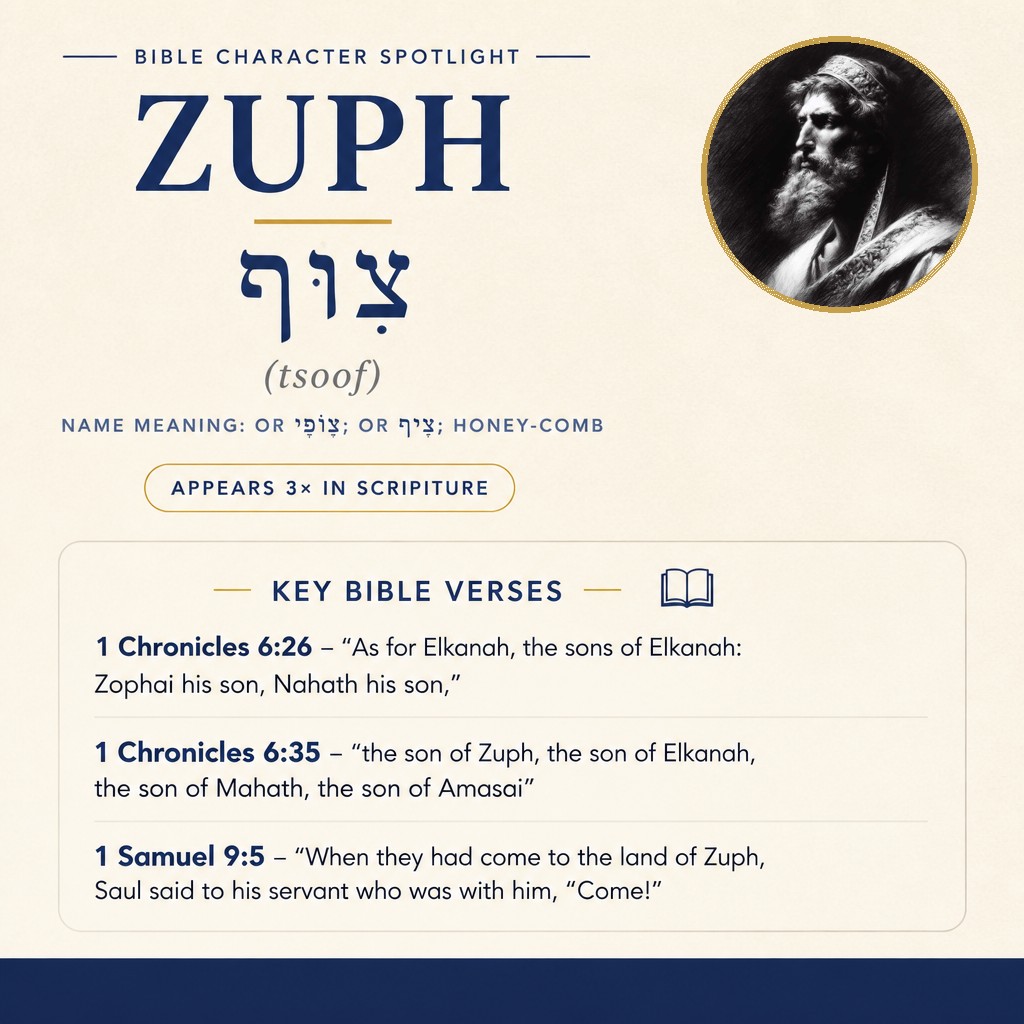
Zuph (also spelled Zophai/Tsophai/Tsiph) appears in 1 Chronicles 6:26, 6:35 as a named Israelite in a genealogy, and in 1 Samuel 9:5 as a place (“the land of Zuph”).

Genealogy References
1 Chronicles records “As for Elkanah, the sons of Elkanah: Zophai his son” (1 Chronicles 6:26). It also lists a line including “the son of Zuph, the son of Elkanah” (1 Chronicles 6:35).
Learn More →Name and Meaning
The lexicon gloss treats Zuph as the name of both “an Israelite and of a place in Palestine.” Its derivation is connected with “honey-comb” (from a term for dripping/comb).
Learn More →Zuph (also appearing as Zophai/Tsophai/Tsiph in related forms) is presented in Scripture as a name connected with (1) an Israelite in a genealogical line and (2) a place in Palestine, “the land of Zuph,” visited by Saul during a search for lost donkeys. Lexically, the name is associated with the idea of a honeycomb or dripping honey.
Zuph in Scripture
The name occurs in genealogical material in 1 Chronicles and in a geographical notice in 1 Samuel.
1) Zuph in a Levitical genealogy (1 Chronicles 6)
In the midst of a genealogy tied to the Kohathites, Zuph is named as an ancestor in a line that includes Elkanah and others. One portion reads:
“As for Elkanah, the sons of Elkanah: Zophai his son, Nahath his son,” (1 Chronicles 6:26, WEB)
In the same genealogical context, another line includes Zuph explicitly:
“the son of Zuph, the son of Elkanah, the son of Mahath, the son of Amasai,” (1 Chronicles 6:35, WEB)
These notices are surrounded by additional genealogical framing that locates the line within the Kohathites and ultimately within Levi. The context moves through successive “son of” statements and then anchors the line in Israel’s tribal structure:
“These are those who served, and their sons. Of the sons of the Kohathites: Heman the singer, the son of Joel, the son of Samuel,” (1 Chronicles 6:33, WEB)
“the son of Zuph, the son of Elkanah, the son of Mahath, the son of Amasai,” (1 Chronicles 6:35, WEB)
“the son of Izhar, the son of Kohath, the son of Levi, the son of Israel.” (1 Chronicles 6:38, WEB)
Within this flow, Zuph functions as a named link in a hereditary chain. The text does not pause to describe his actions or role, but it does place him in a lineage presented as part of those who “served,” and it situates that line among “the sons of the Kohathites” (1 Chronicles 6:33).
2) The land of Zuph in Saul’s search (1 Samuel 9)
Zuph also appears as a place-name in the narrative where Saul and a servant search for his father’s missing donkeys. The episode begins:
“The donkeys of Kish, Saul’s father, were lost. Kish said to Saul his son, “Now take one of the servants with you, and arise, go look for the donkeys.”” (1 Samuel 9:3, WEB)
The search ranges across multiple regions without success:
“He passed through the hill country of Ephraim, and passed through the land of Shalishah, but they didn’t find them. Then they passed through the land of Shaalim, and they weren’t there. Then he passed through the land of the Benjamites, but they didn’t find them.” (1 Samuel 9:4, WEB)
Eventually they reach a place identified with Zuph:
“When they had come to the land of Zuph, Saul said to his servant who was with him, “Come! Let’s return, lest my father stop caring about the donkeys, and be anxious for us.”” (1 Samuel 9:5, WEB)
At that point, Saul’s concern shifts from locating the animals to avoiding worry at home—“lest my father stop caring about the donkeys, and be anxious for us” (1 Samuel 9:5). The servant proposes another step, pointing them toward a “man of God” in a nearby city and expressing confidence in his reliability:
“The servant said to him, “Behold now, there is a man of God in this city, and he is a man who is held in honor. All that he says surely happens. Now let’s go there. Perhaps he can tell us which way to go.”” (1 Samuel 9:6, WEB)
Saul raises a practical question about what to bring, noting their provisions are depleted:
“Then Saul said to his servant, “But, behold, if we go, what should we bring the man? For the bread is spent in our sacks, and there is not a present to bring to the man of God. What do we have?”” (1 Samuel 9:7, WEB)
The servant answers by offering a small amount of silver as a gift in order “to tell us our way”:
“The servant answered Saul again, and said, “Behold, I have in my hand the fourth part of a shekel of silver. I will give that to the man of God, to tell us our way.”” (1 Samuel 9:8, WEB)
In this narrative, “the land of Zuph” is the point at which Saul is ready to turn back, and it becomes the setting for the decision to seek guidance from a respected “man of God” (1 Samuel 9:5–6).
Multiple bearers
The evidence presents two uses of the name: Zuph as an Israelite individual within a genealogical list (1 Chronicles 6:35) and Zuph as a place-name (“the land of Zuph,” 1 Samuel 9:5). In addition, 1 Chronicles 6:26 uses the form “Zophai,” which the lexical information associates with the same name-family, appearing as a related form in the genealogical line: “Zophai his son” (1 Chronicles 6:26).
Name and Meaning
The Hebrew script is צוּף, transliterated Tsuwph and pronounced “tsoof.” The lexical derivation connects the name to a root associated with a honey-comb and the idea of dripping, with a component sense of “comb of honey (from dripping).” The same lexicon entry also associates related forms (Tsuph/Tsophai/Tsiph) with both an Israelite name and a place in Palestine, which matches the two kinds of usage seen in 1 Chronicles 6 and 1 Samuel 9.
Observation
In the passages where it appears, Zuph marks a point of connection: in 1 Chronicles it links generations in a line traced to “Kohath” and “Levi” (1 Chronicles 6:35, 38), and in 1 Samuel it identifies a location where Saul’s search turns toward seeking direction—“Perhaps he can tell us which way to go” (1 Samuel 9:6).
Frequently Asked Questions
What does the name Zuph mean?
Zuph (also Tsuph/Tsophai/Tsiph) is linked to a term meaning “honey-comb.”
How many times does Zuph appear in the Bible?
Zuph appears 3 times.
Who was Zuph in the Bible?
Zuph is the name of an Israelite and also the name of a place in Palestine. In a genealogy, Zuph is listed as an ancestor of Elkanah (1 Chronicles 6:35).
What is the “land of Zuph” mentioned in the Bible?
It is a place called the land of Zuph, where Saul said to his servant, “Come! Let’s return…” (1 Samuel 9:5).
Explore Further
If you found this page about Zuph interesting and would like to discover more about other biblical characters, explore our comprehensive Encyclopedia of Biblical Characters. For those looking to delve deeper into the Greek origins of these names and terms, our Greek Lexicon is an invaluable resource.
Sources: Name and occurrence data from Strong’s Exhaustive Concordance and STEPBible reference data (CC BY). Scripture quotations from the World English Bible (public domain).




