
Who was Ziha in the bible?
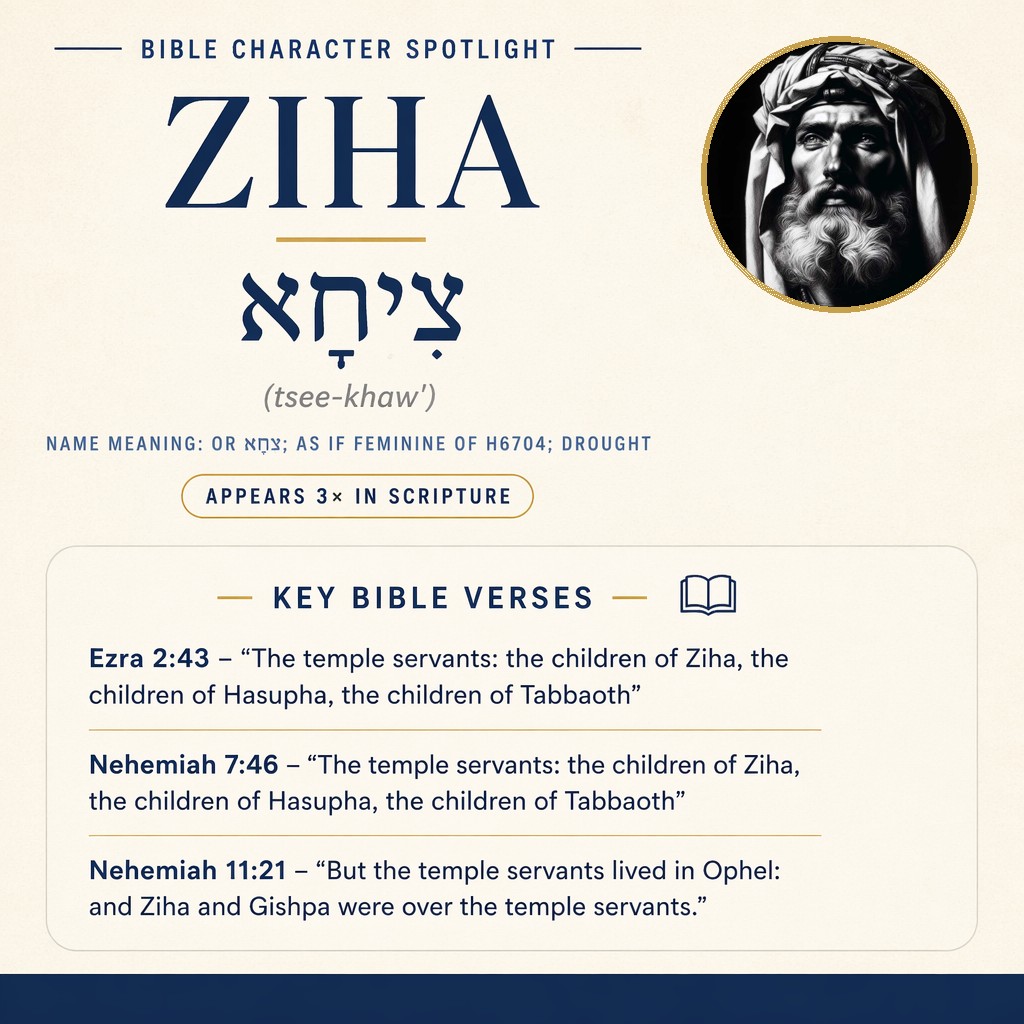
Ziha is a name borne by two Nethinim, appearing in temple-servant lists in Ezra 2:43 and Nehemiah 7:46, and as an overseer of temple servants in Nehemiah 11:21.
Where Mentioned
In the returnee lists, “The temple servants: the children of Ziha” appears in both Ezra 2:43 and Nehemiah 7:46. Later, “Ziha and Gishpa were over the temple servants” (Nehemiah 11:21).
Learn More →Name Meaning
Strong’s derives Ziha from a word sense “drought,” with a component meaning “parched.” The biblical text associates the name with temple servants (Ezra 2:43; Nehemiah 7:46; Nehemiah 11:21).
Learn More →Ziha (Tsiycha’, צִיחָא) is a biblical name connected with the “temple servants,” appearing as the ancestor-name of a family group and also as the name of an overseer set “over the temple servants.” The name is explained in lexicon tradition as being connected with the idea of drought or being parched.
Ziha in Scripture
Ziha first appears within a list that places “the temple servants” alongside other groups connected with worship and access to the temple. In Ezra’s register, the sequence moves from singers to gatekeepers and then to temple servants, where the family of Ziha is named.
“The singers: the children of Asaph, one hundred twenty-eight.” (Ezra 2:41)
“The children of the gatekeepers: the children of Shallum, the children of Ater, the children of Talmon, the children of Akkub, the children of Hatita, the children of Shobai, in all one hundred thirty-nine.” (Ezra 2:42)
“The temple servants: the children of Ziha, the children of Hasupha, the children of Tabbaoth,” (Ezra 2:43)
The list continues immediately with additional families of temple servants:
“the children of Keros, the children of Siaha, the children of Padon,” (Ezra 2:44)
“the children of Lebanah, the children of Hagabah, the children of Akkub,” (Ezra 2:45)
“the children of Hagab, the children of Shamlai, the children of Hanan,” (Ezra 2:46)
Nehemiah preserves a closely corresponding register. As in Ezra, Ziha appears as the head-name of one family among the temple servants, again placed after singers and gatekeepers.
“The singers: the children of Asaph: one hundred forty-eight.” (Nehemiah 7:44)
“The gatekeepers: the children of Shallum, the children of Ater, the children of Talmon, the children of Akkub, the children of Hatita, the children of Shobai: one hundred thirty-eight.” (Nehemiah 7:45)
“The temple servants: the children of Ziha, the children of Hasupha, the children of Tabbaoth,” (Nehemiah 7:46)
The listing continues with more temple-servant families:
“the children of Keros, the children of Sia, the children of Padon,” (Nehemiah 7:47)
“the children of Lebana, the children of Hagaba, the children of Salmai,” (Nehemiah 7:48)
“the children of Hanan, the children of Giddel, the children of Gahar,” (Nehemiah 7:49)
A third occurrence places Ziha not as an ancestral label (“children of Ziha”), but as a person holding responsibility among the temple servants. In Nehemiah’s description of the settled population in Jerusalem and Judah, various groups are mentioned: gatekeepers at the gates; the rest of Israel, priests, and Levites in Judah’s cities; and then the temple servants’ residence and oversight.
“Moreover the gatekeepers, Akkub, Talmon, and their brothers, who kept watch at the gates, were one hundred seventy-two.” (Nehemiah 11:19)
“The residue of Israel, of the priests, the Levites, were in all the cities of Judah, everyone in his inheritance.” (Nehemiah 11:20)
“But the temple servants lived in Ophel: and Ziha and Gishpa were over the temple servants.” (Nehemiah 11:21)
This brief notice situates the temple servants in a specific locale—“Ophel”—and assigns oversight to two named individuals: “Ziha and Gishpa.” The surrounding lines continue describing temple-related administration in Jerusalem:
“The overseer also of the Levites at Jerusalem was Uzzi the son of Bani, the son of Hashabiah, the son of Mattaniah, the son of Mica, of the sons of Asaph, the singers, over the business of God’s house.” (Nehemiah 11:22)
“For there was a commandment from the king concerning them, and a settled provision for the singers, as every day required.” (Nehemiah 11:23)
“Pethahiah the son of Meshezabel, of the children of Zerah the son of Judah, was at the king’s hand in all matters concerning the people.” (Nehemiah 11:24)
Within this cluster of statements, Ziha’s role is presented as part of an ordered community life in and around Jerusalem: gatekeepers “kept watch,” singers had “a settled provision,” the Levites had an “overseer,” and “Ziha and Gishpa were over the temple servants.”
Multiple Bearers
The verses identify Ziha in two distinct ways. First, “the children of Ziha” appear in the temple-servant lists of Ezra and Nehemiah:
“The temple servants: the children of Ziha, the children of Hasupha, the children of Tabbaoth,” (Ezra 2:43)
“The temple servants: the children of Ziha, the children of Hasupha, the children of Tabbaoth,” (Nehemiah 7:46)
Second, Ziha appears as an individual leader associated with the same group:
“But the temple servants lived in Ophel: and Ziha and Gishpa were over the temple servants.” (Nehemiah 11:21)
A lexicon gloss describes the name as belonging to “two Nethinim,” which aligns with the text’s presentation of (1) a temple-servant family identified by descent (“children of Ziha”) and (2) a temple-servant overseer named Ziha. The passages themselves do not explicitly state whether the overseer is the ancestor of the family or a different person with the same name; they simply attest both uses of the name within the sphere of temple servants.
Name and Meaning
The Hebrew form is צִיחָא, transliterated Tsiycha’ and pronounced tsee-khaw’. According to the name’s derivation in Strong’s lexicon tradition, it is associated with the idea of “drought,” and is connected with a component word צִחֶה (tsicheh) meaning “parched.”
Observation
Across the occurrences, Ziha is consistently tied to the community of “temple servants”—named among their families and also named among their leaders—so that the name is embedded in administrative lists describing ordered service: “the temple servants lived in Ophel: and Ziha and Gishpa were over the temple servants” (Nehemiah 11:21).
Frequently Asked Questions
What does the name Ziha mean?
Ziha is associated with the meaning “drought.”
How many times does Ziha appear in the Bible?
Ziha appears 3 times.
Who was Ziha?
Ziha is the name of two Nethinim (temple servants). Ezra 2:43 and Nehemiah 7:46 mention “the children of Ziha” among the temple servants.
What role did Ziha have over the temple servants?
Nehemiah 11:21 says, “Ziha and Gishpa were over the temple servants.”
Explore Further
If you found this page about Ziha interesting and would like to discover more about other biblical characters, explore our comprehensive Encyclopedia of Biblical Characters. For those looking to delve deeper into the Greek origins of these names and terms, our Greek Lexicon is an invaluable resource.
Sources: Name and occurrence data from Strong’s Exhaustive Concordance and STEPBible reference data (CC BY). Scripture quotations from the World English Bible (public domain).





