
Who was Zidon in the bible?
Zidon (Tsiydown) is named as Canaan’s firstborn and as a place referenced in Genesis, 1 Kings, 2 Samuel, 1 Chronicles, Isaiah, and Ezekiel.

Place References
Elijah was told, “go to Zarephath, which belongs to Sidon” (1 Kings 17:9). In a census journey, they came “around to Sidon” (2 Samuel 24:6).
Learn More →Prophetic Mentions
Isaiah addresses “the oppressed virgin daughter of Sidon” (Isaiah 23:12; cf. Isaiah 23:2,4). Ezekiel declares, “Behold, I am against you, Sidon” (Ezekiel 28:22; cf. Ezekiel 28:21).
Learn More →Zidon (also spelled Sidon in some passages) refers in Scripture to both a person and a place: the name is borne by “Sidon” the firstborn son of Canaan, and it is also used for Sidon, a coastal location associated with maritime trade and prophetic judgment.
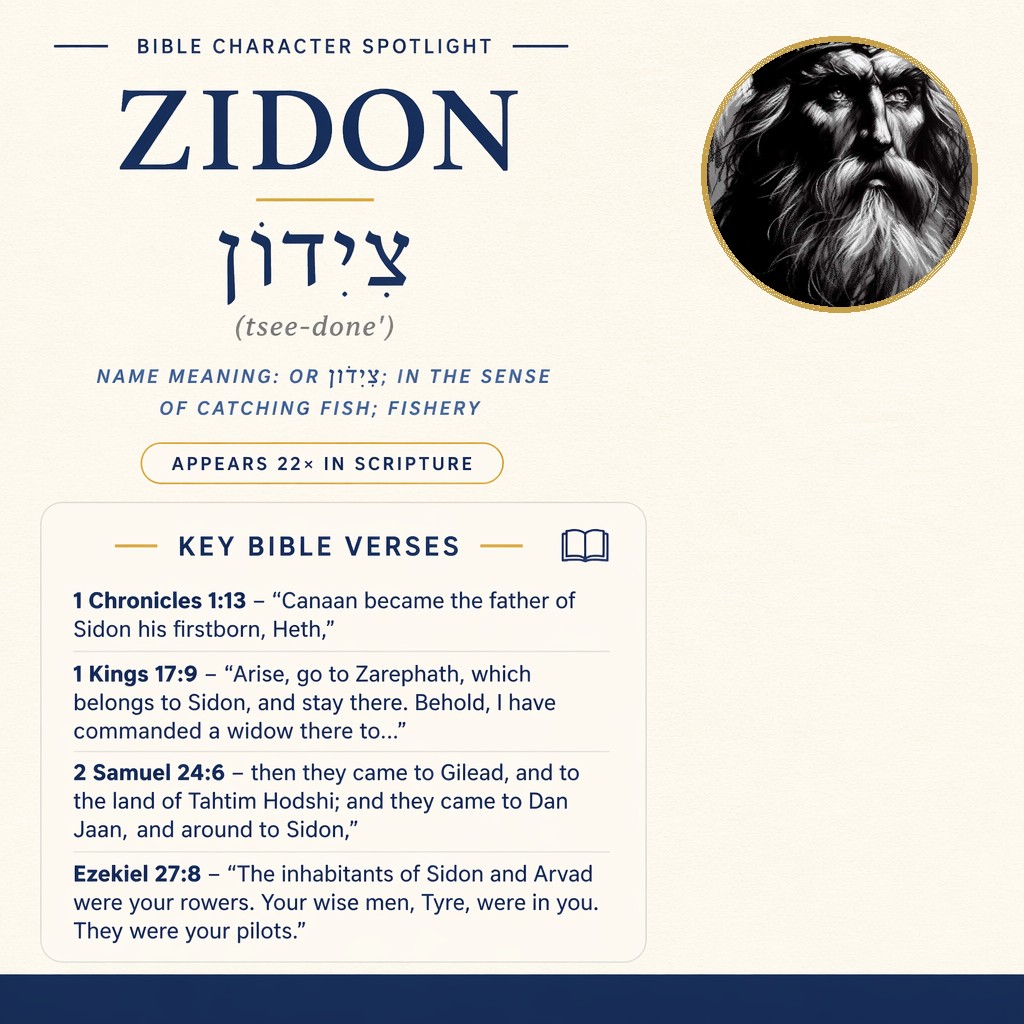
Zidon in Scripture
The earliest references identify Zidon as a person within the genealogical line of Canaan. Genesis and Chronicles state this plainly.
“Canaan became the father of Sidon (his firstborn), Heth,” (Genesis 10:15, WEB)
“Canaan became the father of Sidon his firstborn, Heth,” (1 Chronicles 1:13, WEB)
In Genesis’ description of Canaanite territory, Sidon appears as a geographic marker for the Canaanites’ border.
“The border of the Canaanites was from Sidon—as you go toward Gerar—to Gaza—as you go toward Sodom, Gomorrah, Admah, and Zeboiim—to Lasha.” (Genesis 10:19, WEB)
Later, in Jacob’s words over his sons, Sidon functions as a boundary point connected with Zebulun’s maritime setting.
“Zebulun will dwell at the haven of the sea. He will be for a haven of ships. His border will be on Sidon.” (Genesis 49:13, WEB)
Sidon also appears as a place reached in a circuit of land described in the account of David’s census.
“then they came to Gilead, and to the land of Tahtim Hodshi; and they came to Dan Jaan, and around to Sidon,” (2 Samuel 24:6, WEB)
In the narrative of Elijah, Sidon is mentioned as the region to which Zarephath belongs, and the place provides the setting for God’s provision through a widow.
“Arise, go to Zarephath, which belongs to Sidon, and stay there. Behold, I have commanded a widow there to sustain you.” (1 Kings 17:9, WEB)
Prophetic texts use Sidon as a known coastal people and city, connected with seafaring, commerce, and international contact. Ezekiel, in an oracle concerning Tyre, names Sidon’s inhabitants among those who served in maritime roles.
“The inhabitants of Sidon and Arvad were your rowers. Your wise men, Tyre, were in you. They were your pilots.” (Ezekiel 27:8, WEB)
In Ezekiel, Sidon is also directly addressed as the object of prophecy and divine judgment.
“Son of man, set your face toward Sidon, and prophesy against it,” (Ezekiel 28:21, WEB)
“and say, ‘The Lord Yahweh says: “Behold, I am against you, Sidon. I will be glorified among you. Then they will know that I am Yahweh, when I have executed judgments in her, and am sanctified in her.”’” (Ezekiel 28:22, WEB)
Isaiah 23 includes Sidon within a larger prophetic “burden” concerning Tyre. Within that chapter Sidon is portrayed as a maritime trading community and is personified in prophetic speech. The chapter opens by announcing Tyre’s devastation and its effects on seafaring commerce.
“The burden of Tyre. Howl, you ships of Tarshish! For it is laid waste, so that there is no house, no entering in. From the land of Kittim it is revealed to them.” (Isaiah 23:1, WEB)
Against this backdrop, Isaiah addresses coastal inhabitants and explicitly mentions Sidon’s merchants as suppliers, indicating Sidon’s role in sea-based trade.
“Be still, you inhabitants of the coast, you whom the merchants of Sidon that pass over the sea, have replenished.” (Isaiah 23:2, WEB)
The chapter continues by describing wealth and commerce across “great waters,” framing the setting as international trade and “the market of nations.”
“On great waters, the seed of the Shihor, the harvest of the Nile, was her revenue. She was the market of nations.” (Isaiah 23:3, WEB)
Sidon is then addressed directly in language of shame and bereavement, with the sea itself personified as speaking. The oracle expresses loss in terms of a city’s offspring and future.
“Be ashamed, Sidon; for the sea has spoken, the stronghold of the sea, saying, “I have not travailed, nor given birth, neither have I nourished young men, nor brought up virgins.”” (Isaiah 23:4, WEB)
The report of Tyre’s fall spreads outward, bringing anguish elsewhere, and calls are issued for maritime peoples to wail and pass to other places. In that movement of peoples and trade, Sidon is characterized as an “oppressed virgin daughter,” commanded to seek rest elsewhere but finding none.
“He said, “You shall rejoice no more, you oppressed virgin daughter of Sidon. Arise, pass over to Kittim. Even there you will have no rest.”” (Isaiah 23:12, WEB)
Isaiah 23 also explains the ultimate agency behind the downfall described: it is presented as a plan of Yahweh of Armies, directed toward humbling pride and bringing “the honorable of the earth” into contempt, with Yahweh’s hand stretched “over the sea.”
“Yahweh of Armies has planned it, to stain the pride of all glory, to bring into contempt all the honorable of the earth.” (Isaiah 23:9, WEB)
“He has stretched out his hand over the sea. He has shaken the kingdoms. Yahweh has ordered the destruction of Canaan’s strongholds.” (Isaiah 23:11, WEB)
The chapter proceeds to depict ongoing upheaval in maritime strongholds, with repeated calls for ships to howl, and it describes a period in which Tyre will be forgotten and later revisited, with its trade and merchandise ultimately described in terms of being set apart for Yahweh.
“Howl, you ships of Tarshish, for your stronghold is laid waste!” (Isaiah 23:14, WEB)
“It will happen after the end of seventy years that Yahweh will visit Tyre.” (Isaiah 23:17, WEB)
“Her merchandise and her wages will be holiness to Yahweh.” (Isaiah 23:18, WEB)
Within this full chapter, Sidon’s role is not to receive an extended separate narrative, but to be named as a maritime trading community (“the merchants of Sidon”) and to be directly addressed in the prophetic announcement of loss (“Be ashamed, Sidon”) and unrest (“you will have no rest”).
Multiple bearers
The name Zidon/Sidon belongs to more than one referent in the passages cited.
1) Sidon the person. He is identified only in genealogy as Canaan’s firstborn.
“Canaan became the father of Sidon (his firstborn), Heth,” (Genesis 10:15, WEB)
2) Sidon the place. Sidon appears as a territorial boundary (“The border of the Canaanites was from Sidon”), a maritime marker connected to Zebulun (“His border will be on Sidon”), a point reached in a geographic circuit (“around to Sidon”), the region to which Zarephath belongs (“which belongs to Sidon”), a source of maritime labor (“The inhabitants of Sidon… were your rowers”), and an object of prophecy (“set your face toward Sidon”).
Name and Meaning
In Hebrew the name is written צִידוֹן (also appearing as a closely related form), transliterated Tsiydown and pronounced tsee-done’. The lexicon notes that it is derived from a root connected with catching fish, conveying the sense of a fishery; it is linked with the component tsuwd (צוּד), “to lie alongside (i.e. in wait),” by implication. The same lexicon entry states that Tsidon is the name both of a son of Canaan and of a place in Palestine.
Observation
Across the cited texts, Sidon is consistently tied to coastal life and seafaring commerce—“the merchants of Sidon that pass over the sea” (Isaiah 23:2, WEB)—and is also explicitly placed under divine address and judgment: “Behold, I am against you, Sidon” (Ezekiel 28:22, WEB).
Frequently Asked Questions
What does the name Zidon mean?
Zidon means “fishery,” from a sense of catching fish.
How many times does Zidon appear in the Bible?
Zidon occurs 22 times.
Who was Zidon?
Zidon is the name of a son of Canaan and also the name of a place in Palestine (Genesis 10:15; 1 Chronicles 1:13).
What did God tell Elijah to do regarding Zidon?
God told Elijah to go to Zarephath, “which belongs to Sidon,” and stay there, saying He had commanded a widow there to sustain him (1 Kings 17:9).
Explore Further
If you found this page about Zidon interesting and would like to discover more about other biblical characters, explore our comprehensive Encyclopedia of Biblical Characters. For those looking to delve deeper into the Greek origins of these names and terms, our Greek Lexicon is an invaluable resource.
Sources: Name and occurrence data from Strong’s Exhaustive Concordance and STEPBible reference data (CC BY). Scripture quotations from the World English Bible (public domain).




