
Who was Zidkijah in the bible?
Zidkijah (Zedekiah) is a name borne by multiple Israelites, appearing in 1 Chronicles, 1–2 Kings, and 2 Chronicles.
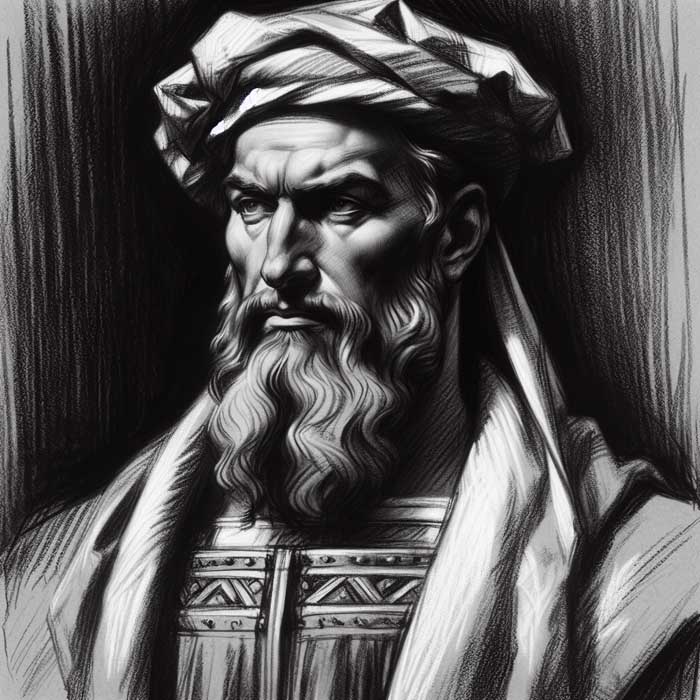
King in Judah
Another Zedekiah was made king by Babylon: “changed his name to Zedekiah” (2 Kings 24:17) and “he reigned eleven years in Jerusalem” (2 Kings 24:18; 2 Chronicles 36:11).
Learn More →Name Meaning
The name Tsidqiyah (Strong’s H6667) is derived from terms meaning “right” and “Jah,” and the gloss identifies it as the name of six Israelites.
Learn More →Zidkijah (more commonly spelled “Zedekiah” in the cited passages) is a Hebrew name that, according to the lexicon gloss, belonged to six Israelites. In the verses provided, the name refers to several distinct people, including royal figures in Judah and a man described as “the son of Chenaanah.”
Zidkijah in Scripture
The name appears in genealogical contexts in Chronicles. In a list of Josiah’s sons:
“The sons of Josiah: the firstborn Johanan, the second Jehoiakim, the third Zedekiah, and the fourth Shallum.” (1 Chronicles 3:15)
In the next generation, a Zedekiah is also named as a son of Jehoiakim:
“The sons of Jehoiakim: Jeconiah his son, and Zedekiah his son.” (1 Chronicles 3:16)
In Kings and Chronicles, another Zedekiah is identified as “the son of Chenaanah,” shown making a symbolic object and speaking in Yahweh’s name:
“Zedekiah the son of Chenaanah made himself horns of iron, and said, ‘Yahweh says, ‘With these you will push the Syrians, until they are consumed.’ ’ ” (1 Kings 22:11)
He is also depicted in conflict with Micaiah:
“Then Zedekiah the son of Chenaanah came near, and struck Micaiah on the cheek, and said, ‘Which way did Yahweh’s Spirit go from me to speak to you?’ ” (1 Kings 22:24)
Chronicles records the same actions in parallel language:
“Zedekiah the son of Chenaanah made himself horns of iron and said, ‘Yahweh says, ‘With these you shall push the Syrians, until they are consumed.’ ’ ” (2 Chronicles 18:10)
“Then Zedekiah the son of Chenaanah came near, and struck Micaiah on the cheek, and said, ‘Which way did Yahweh’s Spirit go from me to speak to you?’ ” (2 Chronicles 18:23)
The most extended narrative setting provided is 2 Kings 24, where Zedekiah is the king installed by Babylon after the capture and deportation of Jehoiachin. The chapter first situates events in the reign of Jehoiakim, describing Babylon’s advance and Judah’s distress as something Yahweh permitted in judgment:
“In his days Nebuchadnezzar king of Babylon came up, and Jehoiakim became his servant three years. Then he turned and rebelled against him.” (2 Kings 24:1)
“Yahweh sent against him bands of the Chaldeans, and bands of the Syrians, and bands of the Moabites, and bands of the children of Ammon, and sent them against Judah to destroy it, according to Yahweh’s word, which he spoke by his servants the prophets.” (2 Kings 24:2)
“Surely at the commandment of Yahweh this came on Judah, to remove them out of his sight, for the sins of Manasseh, according to all that he did,” (2 Kings 24:3)
“and also for the innocent blood that he shed; for he filled Jerusalem with innocent blood, and Yahweh would not pardon.” (2 Kings 24:4)
After Jehoiakim’s death, his son Jehoiachin briefly reigns, and the Babylonian siege tightens:
“So Jehoiakim slept with his fathers, and Jehoiachin his son reigned in his place.” (2 Kings 24:6)
“Jehoiachin was eighteen years old when he began to reign, and he reigned in Jerusalem three months. His mother’s name was Nehushta the daughter of Elnathan of Jerusalem.” (2 Kings 24:8)
“At that time the servants of Nebuchadnezzar king of Babylon came up to Jerusalem, and the city was besieged.” (2 Kings 24:10)
“Nebuchadnezzar king of Babylon came to the city while his servants were besieging it,” (2 Kings 24:11)
Jehoiachin surrenders and is captured:
“and Jehoiachin the king of Judah went out to the king of Babylon, he, and his mother, and his servants, and his princes, and his officers; and the king of Babylon captured him in the eighth year of his reign.” (2 Kings 24:12)
The account emphasizes extensive removal of temple and royal wealth, and a major deportation:
“He carried out from there all the treasures of Yahweh’s house, and the treasures of the king’s house, and cut in pieces all the vessels of gold, which Solomon king of Israel had made in Yahweh’s temple, as Yahweh had said.” (2 Kings 24:13)
“He carried away all Jerusalem, and all the princes, and all the mighty men of valor, even ten thousand captives, and all the craftsmen and the smiths. No one remained, except the poorest people of the land.” (2 Kings 24:14)
“He carried away Jehoiachin to Babylon, with the king’s mother, the king’s wives, his officers, and the chief men of the land. He carried them into captivity from Jerusalem to Babylon.” (2 Kings 24:15)
“All the men of might, even seven thousand, and the craftsmen and the smiths one thousand, all of them strong and fit for war, even them the king of Babylon brought captive to Babylon.” (2 Kings 24:16)
It is in this setting that Zedekiah becomes king, not by succession but by Babylonian appointment, along with a change of name:
“The king of Babylon made Mattaniah, Jehoiachin’s father’s brother, king in his place, and changed his name to Zedekiah.” (2 Kings 24:17)
His reign is described with age, duration, location, and maternal identification:
“Zedekiah was twenty-one years old when he began to reign, and he reigned eleven years in Jerusalem. His mother’s name was Hamutal the daughter of Jeremiah of Libnah.” (2 Kings 24:18)
His conduct is assessed briefly but decisively:
“He did that which was evil in Yahweh’s sight, according to all that Jehoiakim had done.” (2 Kings 24:19)
The chapter closes by interpreting these events as occurring “through the anger of Yahweh,” and it records Zedekiah’s political break with Babylon:
“For through the anger of Yahweh, this happened in Jerusalem and Judah, until he had cast them out from his presence. Then Zedekiah rebelled against the king of Babylon.” (2 Kings 24:20)
Two additional notices echo or extend this picture. Kings continues the siege timeline into the next chapter:
“So the city was besieged until the eleventh year of king Zedekiah.” (2 Kings 25:2)
Chronicles also records Babylon’s installation of Zedekiah in Judah and gives the same age and length of reign, framing it as part of the transfer of the king and temple goods to Babylon:
“At the return of the year, king Nebuchadnezzar sent and brought him to Babylon, with the valuable vessels of Yahweh’s house, and made Zedekiah his brother king over Judah and Jerusalem.” (2 Chronicles 36:10)
“Zedekiah was twenty-one years old when he began to reign, and he reigned eleven years in Jerusalem.” (2 Chronicles 36:11)
Multiple bearers
The verses provided identify several distinct bearers of the name.
(1) Zedekiah among Josiah’s sons: he appears in a list of “The sons of Josiah,” where he is named as “the third Zedekiah” (1 Chronicles 3:15).
(2) Zedekiah among Jehoiakim’s sons: a different genealogical notice states, “The sons of Jehoiakim: Jeconiah his son, and Zedekiah his son” (1 Chronicles 3:16).
(3) Zedekiah son of Chenaanah: he is explicitly called “Zedekiah the son of Chenaanah,” makes “horns of iron,” and declares, “Yahweh says” (1 Kings 22:11; 2 Chronicles 18:10). He also “struck Micaiah on the cheek” and challenged him about the Spirit of Yahweh (1 Kings 22:24; 2 Chronicles 18:23).
(4) Zedekiah king in Jerusalem: he is the man whose name was changed from Mattaniah when Babylon made him king: “changed his name to Zedekiah” (2 Kings 24:17). He “reigned eleven years in Jerusalem,” beginning at age twenty-one (2 Kings 24:18; 2 Chronicles 36:11), and he “rebelled against the king of Babylon” (2 Kings 24:20). The siege is dated to “the eleventh year of king Zedekiah” (2 Kings 25:2).
Name and Meaning
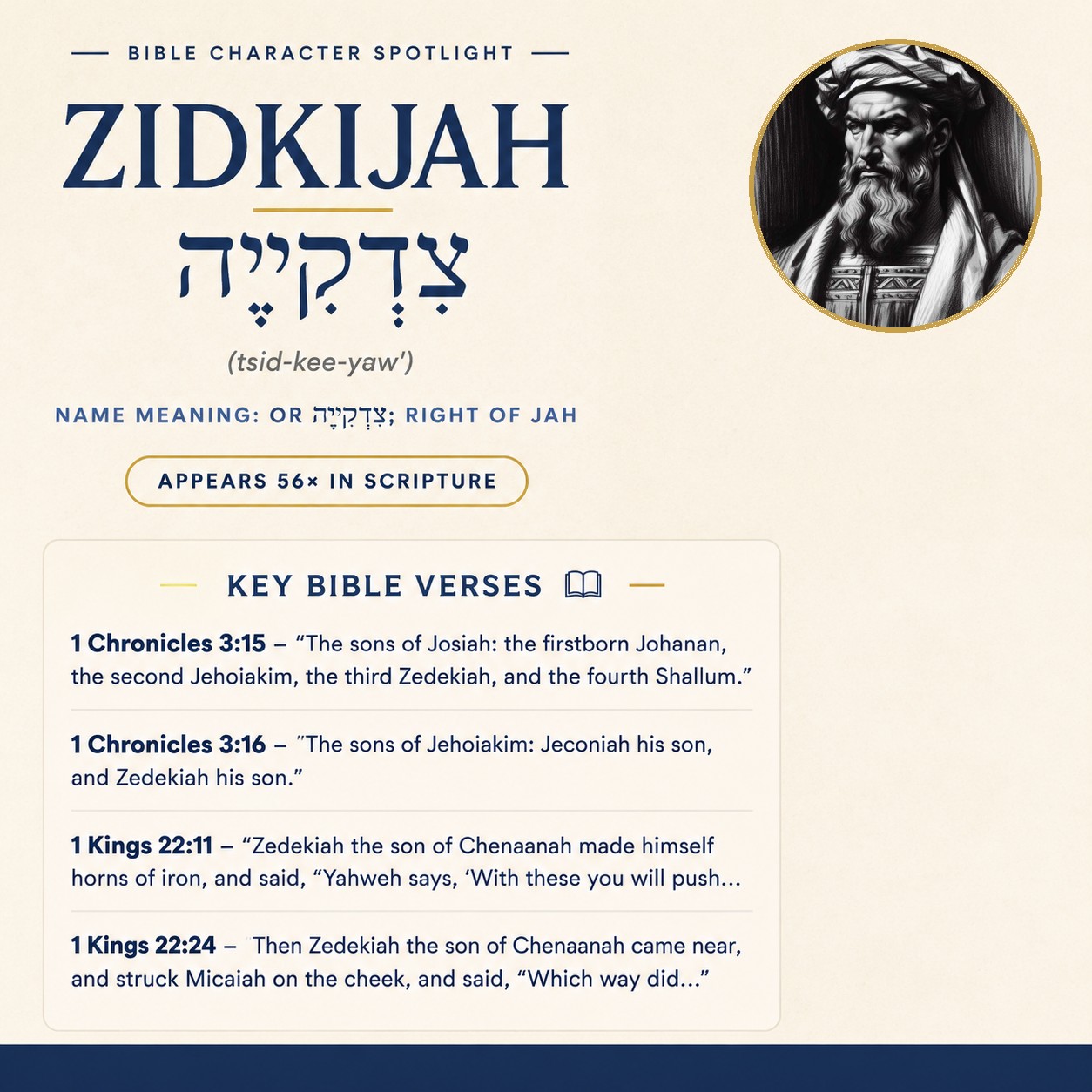
The name is written in Hebrew script as צִדְקִיָּה (also appearing in a longer form צִדְקִיָּהוּ, according to the lexicon note). Its transliteration is Tsidqiyah, and its pronunciation is given as tsid-kee-yaw’. The lexicon derives it from a Hebrew term for “the right” (natural, moral, or legal) combined with the divine element “Jah” (Yahh), yielding the sense “right of Jah.”
Observation
In the extended narrative of 2 Kings 24, Zedekiah’s reign is presented within judgment language—“through the anger of Yahweh”—and it ends the chapter with the terse notice, “Then Zedekiah rebelled against the king of Babylon” (2 Kings 24:20).
Frequently Asked Questions
What does the name Zidkijah mean?
Zidkijah means “right of Jah.”
How many times does Zidkijah appear in the Bible?
Zidkijah occurs 56 times.
Who was Zidkijah in the Bible?
Zidkijah (Tsidqiyah) is the name of six Israelites. One Zidkijah is called “the son of Chenaanah” (1 Kings 22:11).
What did Zidkijah son of Chenaanah do in the story with Micaiah?
He made horns of iron and claimed, “Yahweh says, ‘With these you will push the Syrians, until they are consumed’ ” (1 Kings 22:11). He also struck Micaiah on the cheek (1 Kings 22:24).
Explore Further
If you found this page about Zidkijah interesting and would like to discover more about other biblical characters, explore our comprehensive Encyclopedia of Biblical Characters. For those looking to delve deeper into the Greek origins of these names and terms, our Greek Lexicon is an invaluable resource.
Sources: Name and occurrence data from Strong’s Exhaustive Concordance and STEPBible reference data (CC BY). Scripture quotations from the World English Bible (public domain).





