
Who was Zethan in the bible?
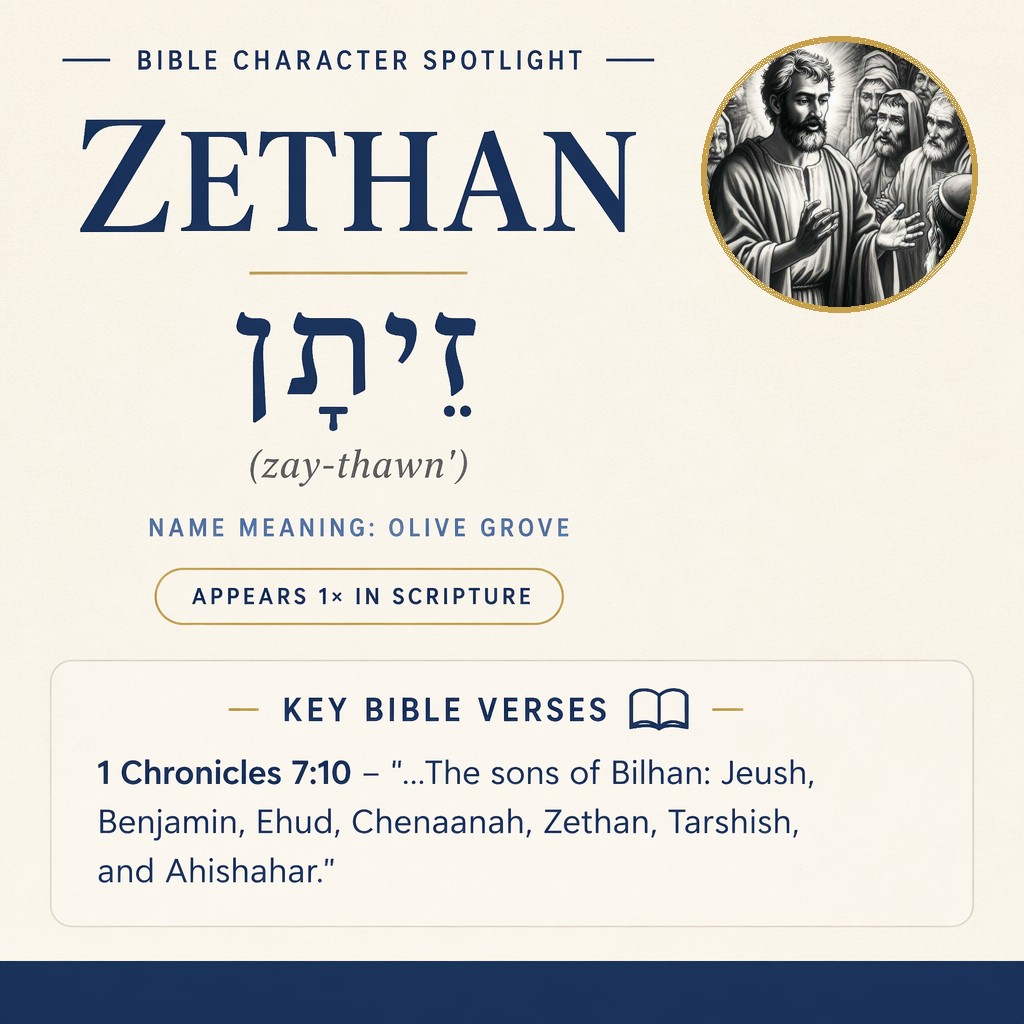
Zethan is named among the sons of Bilhan in a genealogy in 1 Chronicles 7:10.

Where Mentioned
Zethan is mentioned once in Scripture, within genealogical material in 1 Chronicles 7. “The son of Jediael: Bilhan.” (1 Chronicles 7:10)
Learn More →Name and Meaning
The name Zethan (Hebrew זֵיתָן, Zeythan) is derived from a word connected with an “olive grove” (lexicon gloss). In 1 Chronicles, it appears as a personal name in Bilhan’s list of sons (1 Chronicles 7:10).
Learn More →Zethan was an Israelite named in a genealogical listing in 1 Chronicles. His name is derived from a Hebrew term connected with an “olive grove,” built from a component meaning “an olive (as yielding illuminating oil).”
Zethan in Scripture
Zethan appears once, in a family list within 1 Chronicles 7. The surrounding context first presents another family line, then moves to Zethan’s line and briefly characterizes the wider group in military terms.
“The sons of Becher: Zemirah, Joash, Eliezer, Elioenai, Omri, Jeremoth, Abijah, Anathoth, and Alemeth. All these were the sons of Becher.” (1 Chronicles 7:8)
Immediately after listing Becher’s sons, the text describes how these men were counted and how they were regarded within their genealogical framework.
“They were listed by genealogy, after their generations, heads of their fathers’ houses, mighty men of valor, twenty thousand two hundred.” (1 Chronicles 7:9)
The passage then turns to a different branch of the genealogy, introducing Jediael and his son Bilhan, and listing Bilhan’s sons. Zethan is included among these sons.
“The son of Jediael: Bilhan. The sons of Bilhan: Jeush, Benjamin, Ehud, Chenaanah, Zethan, Tarshish, and Ahishahar.” (1 Chronicles 7:10)
Within this verse, Zethan is presented as one of several brothers (Jeush, Benjamin, Ehud, Chenaanah, Tarshish, and Ahishahar), all grouped under Bilhan, who is identified as the son of Jediael. The text does not add individual biographical details about Zethan beyond his place in this list, but it continues by describing “all these” sons of Jediael in terms of household leadership and readiness for war.
“All these were sons of Jediael, according to the heads of their fathers’ households, mighty men of valor, seventeen thousand two hundred, who were able to go out in the army for war.” (1 Chronicles 7:11)
Thus Zethan belongs to a larger counted body—“sons of Jediael”—portrayed collectively as “mighty men of valor” and “able to go out in the army for war.” The chapter then proceeds to other names and lines.
“So were Shuppim, Huppim, the sons of Ir, Hushim, and the sons of Aher.” (1 Chronicles 7:12)
“The sons of Naphtali: Jahziel, Guni, Jezer, Shallum, and the sons of Bilhah.” (1 Chronicles 7:13)
These subsequent verses show that Zethan’s mention is part of a broader sequence of genealogical notices moving from one set of names to another.
Name and Meaning
The name is written in Hebrew as זֵיתָן, transliterated Zeythan, and pronounced “zay-thawn’.” Its derivation is explained as coming from a related root (H2132) with the sense of an “olive grove,” and it is built from a component word zayith (זַיִת), meaning “an olive (as yielding illuminating oil).”
Observation
Zethan is remembered in Scripture as a named member of Bilhan’s sons, included within a larger group described as “mighty men of valor” who were “able to go out in the army for war” (1 Chronicles 7:11).
Frequently Asked Questions
What does the name Zethan mean?
Zethan means “olive grove.”
How many times does Zethan appear in the Bible?
Zethan appears 1 time.
Who was Zethan?
Zethan was an Israelite mentioned in a genealogy.
Where is Zethan mentioned, and in what context?
Zethan is listed among the sons of Bilhan in 1 Chronicles 7:10.
Explore Further
If you found this page about Zethan interesting and would like to discover more about other biblical characters, explore our comprehensive Encyclopedia of Biblical Characters. For those looking to delve deeper into the Greek origins of these names and terms, our Greek Lexicon is an invaluable resource.
Sources: Name and occurrence data from Strong’s Exhaustive Concordance and STEPBible reference data (CC BY). Scripture quotations from the World English Bible (public domain).





