
Who was Zebul in the bible?
Zebul is an Israelite in Judges 9, described as Abimelech’s officer and as “the ruler of the city” at Shechem.

Role in Shechem
When Zebul heard Gaal’s words, “his anger burned” (Judges 9:30). He later challenged Gaal: “Now where is your mouth…?…Please go out now and fight with them.” (Judges 9:38).
Learn More →Driving Out Gaal
After Abimelech lived at Arumah, “Zebul drove out Gaal and his brothers, that they should not dwell in Shechem.” (Judges 9:41).
Learn More →Zebul was an Israelite whose name is connected (by lexicon gloss) with the idea of a “dwelling” or “residence.” In Judges 9 he appears as Abimelech’s officer and as “the ruler of the city” of Shechem.
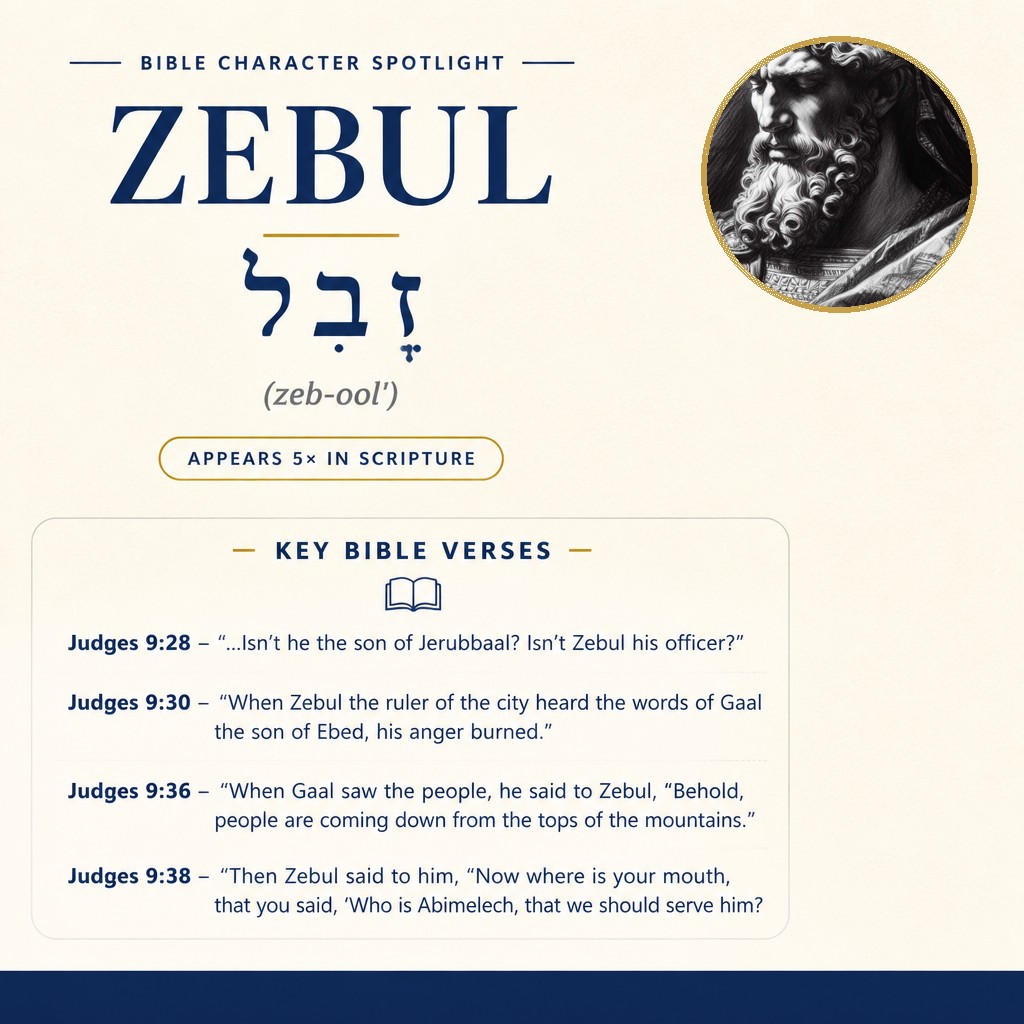
Zebul in Scripture
Within the wider story of Abimelech’s rise and conflict with Shechem, Zebul is introduced through the challenge of Gaal son of Ebed. After Abimelech had been made king at Shechem (Judges 9:6) and later tension arose between Abimelech and the men of Shechem (Judges 9:23), Gaal came to Shechem and gained the people’s trust (Judges 9:26–27). In that setting, Gaal publicly attacked Abimelech’s legitimacy and referenced Zebul as part of Abimelech’s administration:
“Gaal the son of Ebed said, “Who is Abimelech, and who is Shechem, that we should serve him? Isn’t he the son of Jerubbaal? Isn’t Zebul his officer? Serve the men of Hamor the father of Shechem, but why should we serve him?” (Judges 9:28)
This statement locates Zebul as someone serving Abimelech in an official capacity (“his officer”), while also showing that Gaal tried to stir Shechem away from serving Abimelech. The narrative then identifies Zebul’s position within Shechem itself and describes his response to Gaal’s words:
“When Zebul the ruler of the city heard the words of Gaal the son of Ebed, his anger burned.” (Judges 9:30)
From this point, Zebul acts decisively against Gaal. He informed Abimelech of Gaal’s presence and of the political threat Gaal posed in Shechem. The text states:
“He sent messengers to Abimelech craftily, saying, “Behold, Gaal the son of Ebed and his brothers have come to Shechem; and behold, they incite the city against you.” (Judges 9:31)
Zebul’s message included tactical advice for Abimelech’s response, urging a nighttime ascent and an ambush in the field so that Abimelech could strike as circumstances allowed (Judges 9:32–33). Abimelech followed this plan, laying wait against Shechem “in four companies” (Judges 9:34). When the confrontation came into view, Zebul interacted directly with Gaal at the city gate. Gaal saw figures coming down from the mountains and reported it to Zebul, but Zebul initially dismissed the warning:
“When Gaal saw the people, he said to Zebul, “Behold, people are coming down from the tops of the mountains.” Zebul said to him, “You see the shadows of the mountains as if they were men.” (Judges 9:36)
As the threat became undeniable (Judges 9:37), Zebul pressed Gaal to match his earlier words with action, confronting him with his own taunt against Abimelech and urging him to fight:
“Then Zebul said to him, “Now where is your mouth, that you said, ‘Who is Abimelech, that we should serve him?’ Isn’t this the people that you have despised? Please go out now and fight with them.” (Judges 9:38)
Gaal did go out and fought Abimelech, but Abimelech chased him and inflicted losses “even to the entrance of the gate” (Judges 9:39–40). Zebul’s final explicit action in the chapter is administrative and expulsive: he removed Gaal and his supporters from Shechem so that they could no longer remain there:
“Abimelech lived at Arumah; and Zebul drove out Gaal and his brothers, that they should not dwell in Shechem.” (Judges 9:41)
Thus, across the chapter Zebul is presented as a key local ruler in Shechem aligned with Abimelech: he is named as Abimelech’s “officer” (Judges 9:28), described as “the ruler of the city” (Judges 9:30), and shown actively opposing Gaal’s attempted uprising by covert communication with Abimelech (Judges 9:31) and by driving Gaal from the city after the defeat (Judges 9:41).
Name and Meaning
The name is written in Hebrew script as זְבֻל, transliterated Zebul, and pronounced “zeb-ool’.” According to the lexicon derivation provided, it is tied to the sense of “dwelling,” with a related component word zebuwl (זְבוּל) conveying the idea of a residence.
Observation
In Judges 9, Zebul’s role is consistently linked to city governance and loyalty to Abimelech: he is called “the ruler of the city” whose “anger burned” at Gaal’s speech (Judges 9:30), and he acted to remove Gaal so that he and his brothers “should not dwell in Shechem” (Judges 9:41).
Frequently Asked Questions
What does the name Zebul mean?
Zebul means “dwelling.”
How many times does Zebul appear in the Bible?
Zebul appears 5 times.
Who was Zebul?
Zebul is identified as an Israelite. In Judges 9 he is called Abimelech’s officer (Judges 9:28) and “the ruler of the city” (Judges 9:30).
What did Zebul do to Gaal and his brothers?
After Abimelech lived at Arumah, Zebul drove out Gaal and his brothers so they would not dwell in Shechem (Judges 9:41).
Explore Further
If you found this page about Zebul interesting and would like to discover more about other biblical characters, explore our comprehensive Encyclopedia of Biblical Characters. For those looking to delve deeper into the Greek origins of these names and terms, our Greek Lexicon is an invaluable resource.
Sources: Name and occurrence data from Strong’s Exhaustive Concordance and STEPBible reference data (CC BY). Scripture quotations from the World English Bible (public domain).





