Who was Zebadiah in the bible?
Zebadiah is the name of multiple Israelites mentioned in genealogies and lists in 1 Chronicles, 2 Chronicles, and Ezra.

In Chronicles
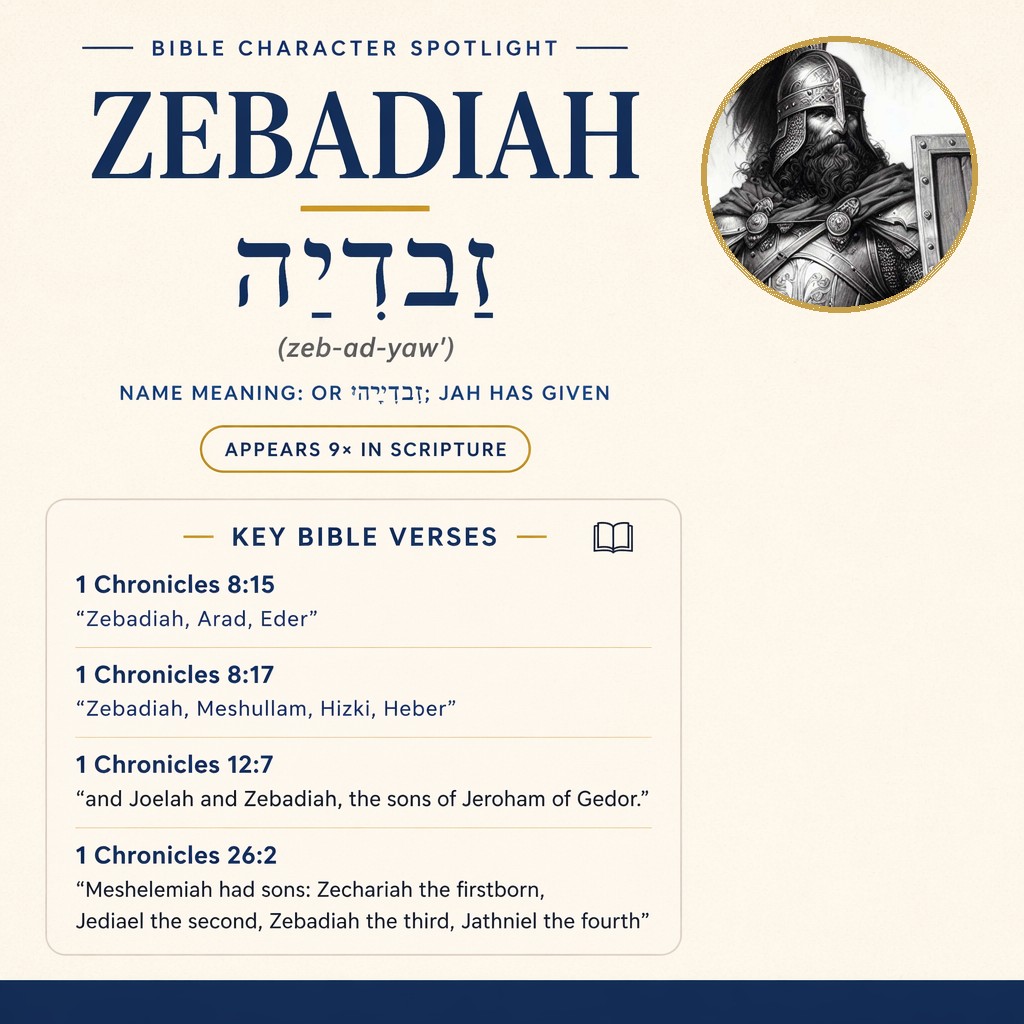
Two men named Zebadiah appear in Benjaminite genealogical lists: “Zebadiah, Arad, Eder,” (1 Chronicles 8:15) and “Zebadiah, Meshullam, Hizki, Heber,” (1 Chronicles 8:17).
Learn More →In Ezra
One Zebadiah is listed as “Zebadiah the son of Michael; and with him eighty males.” (Ezra 8:8) Another appears among “the sons of Immer: Hanani and Zebadiah.” (Ezra 10:20)
Learn More →Zebadiah is a Hebrew name borne by multiple Israelites in the biblical record. Strong’s gloss describes “Zebadjah” as “the name of nine Israelites,” and the passages below show several distinct men identified by that name in genealogies and administrative lists.
Zebadiah in Scripture
In 1 Chronicles 8, Zebadiah appears within a long Benjaminite genealogy that traces families and settlements. The chapter begins with Benjamin’s line: “Benjamin became the father of Bela his firstborn, Ashbel the second, Aharah the third” (1 Chronicles 8:1), and continues through many household heads and their descendants. Within that flow, Zebadiah is named among the descendants attached to Beriah’s branch.
After listing “and Beriah, and Shema, who were heads of fathers’ households of the inhabitants of Aijalon” (1 Chronicles 8:13), the genealogy continues with further names and then includes Zebadiah:
“Zebadiah, Arad, Eder,” (1 Chronicles 8:15)
Immediately after, the text names “Michael, Ishpah, Joha, the sons of Beriah” (1 Chronicles 8:16). The chapter proceeds to another cluster of names that includes a second Zebadiah:
“Zebadiah, Meshullam, Hizki, Heber,” (1 Chronicles 8:17)
These lists sit within the broader purpose of 1 Chronicles 8: to record lines of descent, “heads of fathers’ households,” and where they lived. The chapter later summarizes the nature of these records: “These were heads of fathers’ households throughout their generations, chief men. These lived in Jerusalem” (1 Chronicles 8:28). The genealogy continues through Gibeon and Saul’s line (1 Chronicles 8:29–33), and beyond, but Zebadiah is not further described within the chapter beyond being named in the lists.
Another Zebadiah is named among fighters from the tribe area of Benjamin-related groups in a separate list in 1 Chronicles 12. There he is paired with Joelah and identified by his father and place:
“and Joelah and Zebadiah, the sons of Jeroham of Gedor.” (1 Chronicles 12:7)
In 1 Chronicles 26, Zebadiah appears as a son in a family list associated with Meshelemiah:
“Meshelemiah had sons: Zechariah the firstborn, Jediael the second, Zebadiah the third, Jathniel the fourth,” (1 Chronicles 26:2)
In 1 Chronicles 27, Zebadiah is explicitly identified as a son of Asahel and appears in a military-administrative list of monthly captains:
“The fourth captain for the fourth month was Asahel the brother of Joab, and Zebadiah his son after him: and in his division were twenty-four thousand.” (1 Chronicles 27:7)
In 2 Chronicles 17, Zebadiah is listed among Levites sent in a group alongside priests:
“and with them the Levites, even Shemaiah, Nethaniah, Zebadiah, Asahel, Shemiramoth, Jehonathan, Adonijah, Tobijah, and Tobadonijah, the Levites; and with them Elishama and Jehoram, the priests.” (2 Chronicles 17:8)
In 2 Chronicles 19, Zebadiah is described with a civil leadership role connected to Judah and “the king’s matters.” He is identified by parentage and office in a charge that also names Amariah and mentions Levitical officers:
“Behold, Amariah the chief priest is over you in all matters of Yahweh; and Zebadiah the son of Ishmael, the ruler of the house of Judah, in all the king’s matters. Also the Levites shall be officers before you. Deal courageously, and may Yahweh be with the goo” (2 Chronicles 19:11)
In Ezra 8, Zebadiah is named as part of a return group identified by family line; he is “the son of Michael” and accompanied by “eighty males”:
“Of the sons of Shephatiah, Zebadiah the son of Michael; and with him eighty males.” (Ezra 8:8)
In Ezra 10, Zebadiah is again mentioned, here within a list “Of the sons of Immer,” alongside Hanani:
“Of the sons of Immer: Hanani and Zebadiah.” (Ezra 10:20)
Multiple bearers
The name Zebadiah belongs to multiple individuals across these passages, and several are distinguished by different contexts or patronymics.
Two Zebadiahs in Benjamin’s genealogy. In 1 Chronicles 8, the name occurs twice in close proximity within the Benjaminite lists—“Zebadiah, Arad, Eder,” (1 Chronicles 8:15) and “Zebadiah, Meshullam, Hizki, Heber,” (1 Chronicles 8:17). The text does not explicitly state whether these are the same person repeated or two different individuals; the narrative context presents them as separate list entries within the genealogy.
Zebadiah son of Jeroham. A Zebadiah is identified as one of “the sons of Jeroham of Gedor” (1 Chronicles 12:7), paired with “Joelah.”
Zebadiah son of Meshelemiah. In a family listing, Zebadiah is “the third” son named among Meshelemiah’s sons (1 Chronicles 26:2).
Zebadiah son of Asahel. In a captain list, Zebadiah is “his son after him” in relation to Asahel, and his division size is given: “twenty-four thousand” (1 Chronicles 27:7).
Zebadiah the Levite. In 2 Chronicles 17:8, Zebadiah is included among named “Levites,” in a group that also includes two named priests, “Elishama and Jehoram” (2 Chronicles 17:8).
Zebadiah son of Ishmael, ruler of the house of Judah. In 2 Chronicles 19:11, Zebadiah is identified as “the son of Ishmael” and called “the ruler of the house of Judah, in all the king’s matters” (2 Chronicles 19:11).
Zebadiah son of Michael of the sons of Shephatiah. Ezra 8:8 names him within “the sons of Shephatiah,” and specifies his group: “with him eighty males” (Ezra 8:8).
Zebadiah of the sons of Immer. Ezra 10:20 places a Zebadiah among “the sons of Immer,” listed with “Hanani” (Ezra 10:20).
Name and Meaning
The name is written in Hebrew as זְבַדְיָה, transliterated Zebadyah, pronounced zeb-ad-yaw’. Strong’s derivation connects it to a Hebrew root meaning “to confer” (zabad, זָבַד) combined with Yahh (יָהּ), a form of the divine name; in that sense, the name is explained as meaning “Jah has given.”
Observation
Across Chronicles and Ezra, Zebadiah appears repeatedly in contexts of recorded households and appointed responsibilities—ranging from genealogical lists (1 Chronicles 8:15, 1 Chronicles 8:17) to roles described as “the ruler of the house of Judah, in all the king’s matters” (2 Chronicles 19:11).
Frequently Asked Questions
What does the name Zebadiah mean?
Zebadiah means “Jah has given.”
How many times does Zebadiah appear in the Bible?
Zebadiah appears 9 times.
Who was Zebadiah in the Bible?
Zebadiah is the name of nine Israelites.
Which Zebadiah is called the ruler of the house of Judah?
2 Chronicles 19:11 mentions “Zebadiah the son of Ishmael, the ruler of the house of Judah.”
Explore Further
If you found this page about Zebadiah interesting and would like to discover more about other biblical characters, explore our comprehensive Encyclopedia of Biblical Characters. For those looking to delve deeper into the Greek origins of these names and terms, our Greek Lexicon is an invaluable resource.
Sources: Name and occurrence data from Strong’s Exhaustive Concordance and STEPBible reference data (CC BY). Scripture quotations from the World English Bible (public domain).