Who was Zachariah in the bible?
Zachariah (Zacharias) refers to a priest in Luke 1–3 and to a Zachariah mentioned by Jesus in Matthew 23:35 and Luke 11:51.
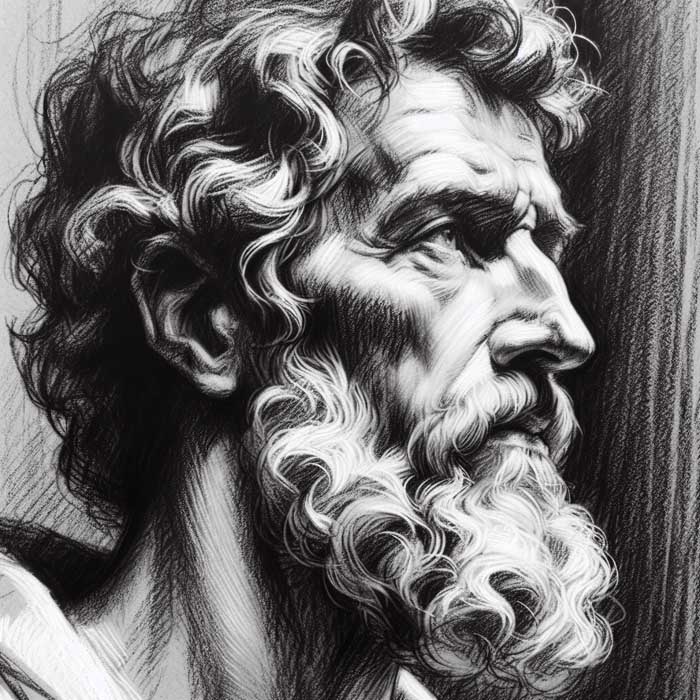
Temple Encounter
An angel spoke to him in the temple: “Don’t be afraid, Zacharias… Your wife, Elizabeth, will bear you a son, and you shall call his name John” (Luke 1:13). Gabriel said, “you will be silent and not able to speak… because you didn’t believe my words” (Luke 1:20).
Learn More →Blood of Zachariah
Jesus spoke of “the blood of Zachariah, who perished between the altar and the sanctuary” (Luke 11:51). Matthew records “Zachariah son of Barachiah, whom you killed between the sanctuary and the altar” (Matthew 23:35).
Learn More →Zachariah (Greek Zacharias, a form of the Hebrew name Zechariah) is presented in the New Testament both as a priest connected with the birth of John and as a man whose death is recalled as occurring “between the sanctuary and the altar.”
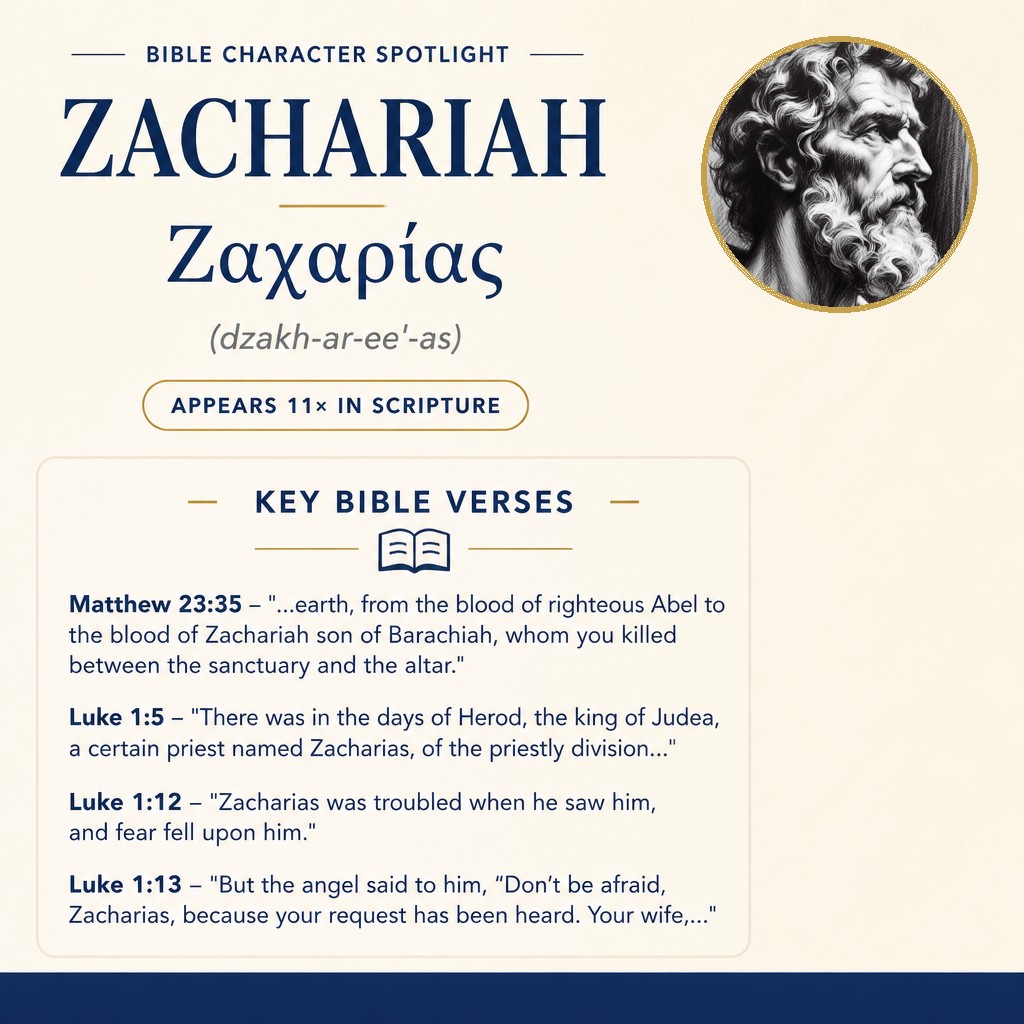
Zachariah in Scripture
In Jesus’ words recorded in Matthew, Zachariah appears as a figure whose killing is blamed on those being addressed:
“that on you may come all the righteous blood shed on the earth, from the blood of righteous Abel to the blood of Zachariah son of Barachiah, whom you killed between the sanctuary and the altar.” (Matthew 23:35)
Luke records a similar saying, describing Zachariah’s death with the same location:
“from the blood of Abel to the blood of Zachariah, who perished between the altar and the sanctuary.’ Yes, I tell you, it will be required of this generation.” (Luke 11:51)
Luke also introduces a different Zacharias in a narrative set “in the days of Herod, the king of Judea,” identifying him by priestly service and marriage:
“There was in the days of Herod, the king of Judea, a certain priest named Zacharias, of the priestly division of Abijah. He had a wife of the daughters of Aaron, and her name was Elizabeth.” (Luke 1:5)
The chapter describes Zacharias and Elizabeth together as faithful in their religious life, yet childless and elderly:
“They were both righteous before God, walking blamelessly in all the commandments and ordinances of the Lord. But they had no child, because Elizabeth was barren, and they both were well advanced in years.” (Luke 1:6–7)
While Zacharias is carrying out his priestly service, he enters “into the temple of the Lord and burn incense,” with people praying outside (Luke 1:8–10). In that setting “an angel of the Lord appeared to him” near the altar of incense, and Zacharias reacts with alarm:
“Zacharias was troubled when he saw him, and fear fell upon him.” (Luke 1:12)
The angel addresses him by name and announces that his petition has been heard, promising a son through Elizabeth and specifying the child’s name:
“But the angel said to him, ‘Don’t be afraid, Zacharias, because your request has been heard. Your wife, Elizabeth, will bear you a son, and you shall call his name John.’” (Luke 1:13)
The message includes predictions about the child’s future character and work: “he will be great in the sight of the Lord,” will abstain from “wine nor strong drink,” and will be “filled with the Holy Spirit, even from his mother’s womb” (Luke 1:15). The angel says of the child, “He will turn many of the children of Israel to the Lord their God,” and will go before “in the spirit and power of Elijah,” “to prepare a people prepared for the Lord” (Luke 1:16–17).
Zacharias questions how he can be certain of what is promised, explicitly noting his age and Elizabeth’s:
“Zacharias said to the angel, ‘How can I be sure of this? For I am an old man, and my wife is well advanced in years.’” (Luke 1:18)
The angel identifies himself and explains the consequence Zacharias will experience because of disbelief:
“The angel answered him, ‘I am Gabriel, who stands in the presence of God. I was sent to speak to you and to bring you this good news. Behold, you will be silent and not able to speak until the day that these things will happen, because you didn’t believe my words, which will be fulfilled in their proper time.’” (Luke 1:19–20)
Outside the temple, the gathered people notice the delay, and when Zacharias emerges his inability to speak makes them infer that he has seen a vision:
“The people were waiting for Zacharias, and they marveled that he delayed in the temple.” (Luke 1:21)
“When he came out, he could not speak to them. They perceived that he had seen a vision in the temple. He continued making signs to them, and remained mute.” (Luke 1:22)
After “the days of his service were fulfilled,” he returns home (Luke 1:23). The narrative then states that Elizabeth conceives, with Elizabeth interpreting the change as the Lord’s mercy toward her (Luke 1:24–25).
Later, when Mary visits Elizabeth, the account situates the visit specifically at Zacharias’ household:
“and entered into the house of Zacharias and greeted Elizabeth.” (Luke 1:40)
When Elizabeth’s child is born, neighbors and relatives rejoice with her (Luke 1:57–58). On the child’s circumcision day, those present assume the child will be named after his father, making Zacharias the reference point for the expected name:
“On the eighth day, they came to circumcise the child; and they would have called him Zacharias, after the name of his father.” (Luke 1:59)
Elizabeth insists on the name John, and when the group consults Zacharias, he confirms the name in writing:
“He asked for a writing tablet, and wrote, ‘His name is John.’ They all marveled.” (Luke 1:63)
Immediately after this, his speech is restored and he begins praising God:
“His mouth was opened immediately and his tongue freed, and he spoke, blessing God.” (Luke 1:64)
The narrative emphasizes the effect on the surrounding community: “Fear came on all who lived around them,” and the events are widely discussed (Luke 1:65). Against that backdrop, Zacharias speaks a longer prophetic utterance that Luke introduces as the result of spiritual filling:
“His father Zacharias was filled with the Holy Spirit, and prophesied, saying,” (Luke 1:67)
He blesses “the Lord, the God of Israel,” saying “he has visited and redeemed his people” and “has raised up a horn of salvation” (Luke 1:68–69). He frames this as consistent with what God “spoke by the mouth of his holy prophets who have been from of old” (Luke 1:70), describing “salvation from our enemies and from the hand of all who hate us,” mercy, covenant remembrance, and the oath to Abraham (Luke 1:71–73). He envisions God’s purpose as enabling service “without fear, in holiness and righteousness before him all the days of our life” (Luke 1:74–75).
Turning directly to the child, Zacharias declares the child’s vocation in relation to the Lord:
“And you, child, will be called a prophet of the Most High; for you will go before the face of the Lord to prepare his ways,” (Luke 1:76)
He connects this with “knowledge of salvation” and “the remission of their sins,” rooted in “the tender mercy of our God,” and portrays this mercy as light for those in darkness and guidance “into the way of peace” (Luke 1:77–79). The chapter closes by describing the child’s growth and location until public appearance (Luke 1:80).
Luke later identifies John by his father’s name:
“the word of God came to John, the son of Zacharias, in the wilderness.” (Luke 3:2)
Multiple bearers
The verses present Zachariah/Zacharias in at least two contexts. One is “Zachariah son of Barachiah,” remembered as someone “killed between the sanctuary and the altar” (Matthew 23:35) and described as one “who perished between the altar and the sanctuary” (Luke 11:51). Another is “a certain priest named Zacharias, of the priestly division of Abijah,” husband of Elizabeth, and father of John (Luke 1:5, 1:59, 3:2). The texts do not explicitly identify these two references as the same individual.
Name and Meaning
In Greek the name is written Ζαχαρίας, transliterated Zacharias and pronounced dzakh-ar-ee’-as. It is of Hebrew origin (linked with the Hebrew name Zechariah), as reflected in the lexicon gloss identifying it as the Greek form of that name.
Observation
Luke’s narrative places Zacharias’ priestly service, fear before the angel, enforced silence, and later restored speech alongside the naming of John and a Spirit-filled prophecy (Luke 1:12–13, 1:20–22, 1:63–67), presenting his experience as closely tied to the announcement and birth of “John, the son of Zacharias” (Luke 3:2).
Frequently Asked Questions
What does the name Zachariah mean?
Zachariah is the Greek form of the Hebrew name Zechariah.
How many times does Zachariah appear in the Bible?
Zachariah occurs 11 times in the listed references.
Who was Zachariah?
In Luke, Zacharias is a priest in the days of Herod, king of Judea, with a wife named Elizabeth (Luke 1:5). John is identified as “the son of Zacharias” (Luke 3:2).
What happened when an angel spoke to Zachariah?
An angel told Zacharias not to be afraid, saying his request had been heard and that Elizabeth would bear him a son (Luke 1:13). Zacharias replied that he was an old man and his wife was well advanced in years (Luke 1:18).
Explore Further
If you found this page about Zachariah interesting and would like to discover more about other biblical characters, explore our comprehensive Encyclopedia of Biblical Characters. For those looking to delve deeper into the Greek origins of these names and terms, our Greek Lexicon is an invaluable resource.
Sources: Name and occurrence data from Strong’s Exhaustive Concordance and STEPBible reference data (CC BY). Scripture quotations from the World English Bible (public domain).