
Who was Meshach in the bible?
Meshach appears in Scripture only as “Mesha,” a place named in Genesis 10:30 within a description of Joktan’s descendants’ dwelling.

Biblical Setting
The statement occurs after listing Joktan’s sons: “All these were the sons of Joktan.” (Genesis 10:29) and before summarizing Shem’s families (Genesis 10:31).
Learn More →Name and Identity
Strong’s H4852 identifies Mesha (Mesha’) as a place in Arabia, of foreign derivation; it occurs once in Genesis 10:30.
Learn More →Meshach (here corresponding to the name rendered Mesha in the provided verse) is presented as a geographic location rather than a person: Mesha is named as a place marking the extent of a group’s dwelling. The lexicon gloss describes Mesha as “a place in Arabia,” and its derivation is given as “of foreign derivation.”
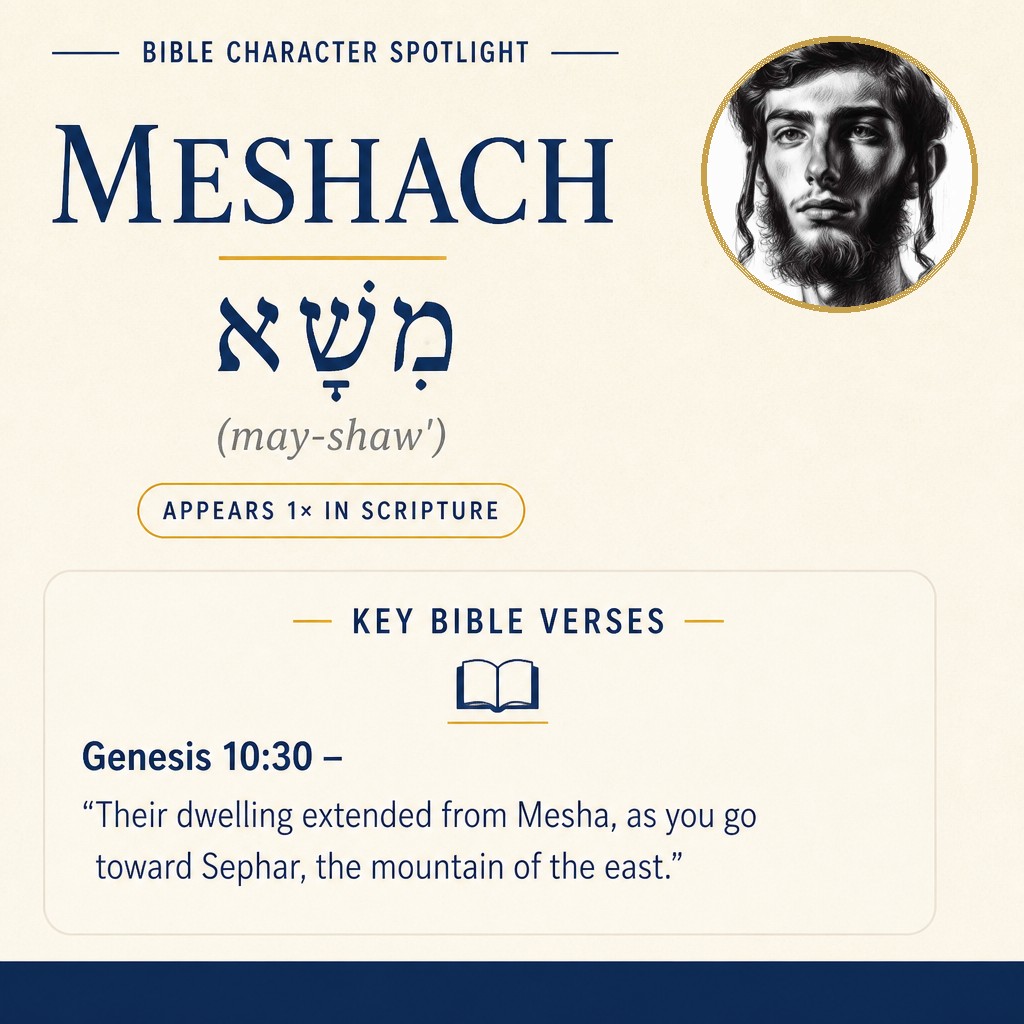
Meshach in Scripture
Mesha appears in a brief geographic statement within a larger listing that situates families and peoples. After naming several individuals as sons of Joktan, the text describes the boundaries of their settlement.
“Obal, Abimael, Sheba,” (Genesis 10:28, WEB)
“Ophir, Havilah, and Jobab. All these were the sons of Joktan.” (Genesis 10:29, WEB)
Against that family setting, Mesha functions as a point of reference for the territory where “their dwelling” reached.
“Their dwelling extended from Mesha, as you go toward Sephar, the mountain of the east.” (Genesis 10:30, WEB)
The immediate continuation frames this list and its geographic note as part of an account of peoples organized by descent and further distinguished by social groupings.
“These are the sons of Shem, by their families, according to their languages, lands, and nations.” (Genesis 10:31, WEB)
“These are the families of the sons of Noah, by their generations, according to their nations. The nations divided from these in the earth after the flood.” (Genesis 10:32, WEB)
Within this passage’s flow, Mesha is not individualized with actions or personal traits; it is used to describe how far the settlement of the sons of Joktan extended, alongside another geographic marker (“Sephar, the mountain of the east”).
Name and Meaning
The lexicon entry provides the Hebrew script מֵשָׁא, transliterated Mesha’ and pronounced “may-shaw’.” It is described as being “of foreign derivation,” and the identity gloss characterizes Mesha as a place in Arabia. In the verse where it occurs, Mesha is used as a place-name anchoring a territorial description: “Their dwelling extended from Mesha…” (Genesis 10:30, WEB).
Observation
Genesis places Mesha within an outline of “families… languages, lands, and nations” (Genesis 10:31, WEB), using it as a concrete boundary-point for describing where a particular group’s dwelling extended (Genesis 10:30, WEB).
Frequently Asked Questions
What does the name Meshach mean?
Meshach is given as Mesha, a place in Arabia.
How many times does Meshach appear in the Bible?
Meshach appears 1 time.
Who was Meshach?
Meshach is identified as Mesha, a place in Arabia.
What does Genesis 10:30 say about Meshach?
Genesis 10:30 says, “Their dwelling extended from Mesha, as you go toward Sephar, the mountain of the east.”
Explore Further
If you found this page about Meshach interesting and would like to discover more about other biblical characters, explore our comprehensive Encyclopedia of Biblical Characters. For those looking to delve deeper into the Greek origins of these names and terms, our Greek Lexicon is an invaluable resource.
Sources: Name and occurrence data from Strong’s Exhaustive Concordance and STEPBible reference data (CC BY). Scripture quotations from the World English Bible (public domain).





