Who was Manoah in the bible?
Manoah was a man of Zorah from the family of the Danites, appearing in Judges 13 in the account of Yahweh’s angel and the birth announcement of Samson.

What He Did
Manoah “entreated Yahweh” to send the man of God again to instruct them about the coming child (Judges 13:8). He asked, “What shall the child’s way of life and mission be?” (Judges 13:12).
Learn More →Angel Encounter
Manoah “took the young goat with the meal offering, and offered it on the rock to Yahweh” as the angel did “an amazing thing” (Judges 13:19). “Then Manoah knew that he was Yahweh’s angel” (Judges 13:21).
Learn More →Manoah was an Israelite man from Zorah, “of the family of the Danites” (Judges 13:2). His name is derived from a Hebrew term associated with “rest,” and a related component can carry the sense of “quiet” or “a settled spot.”
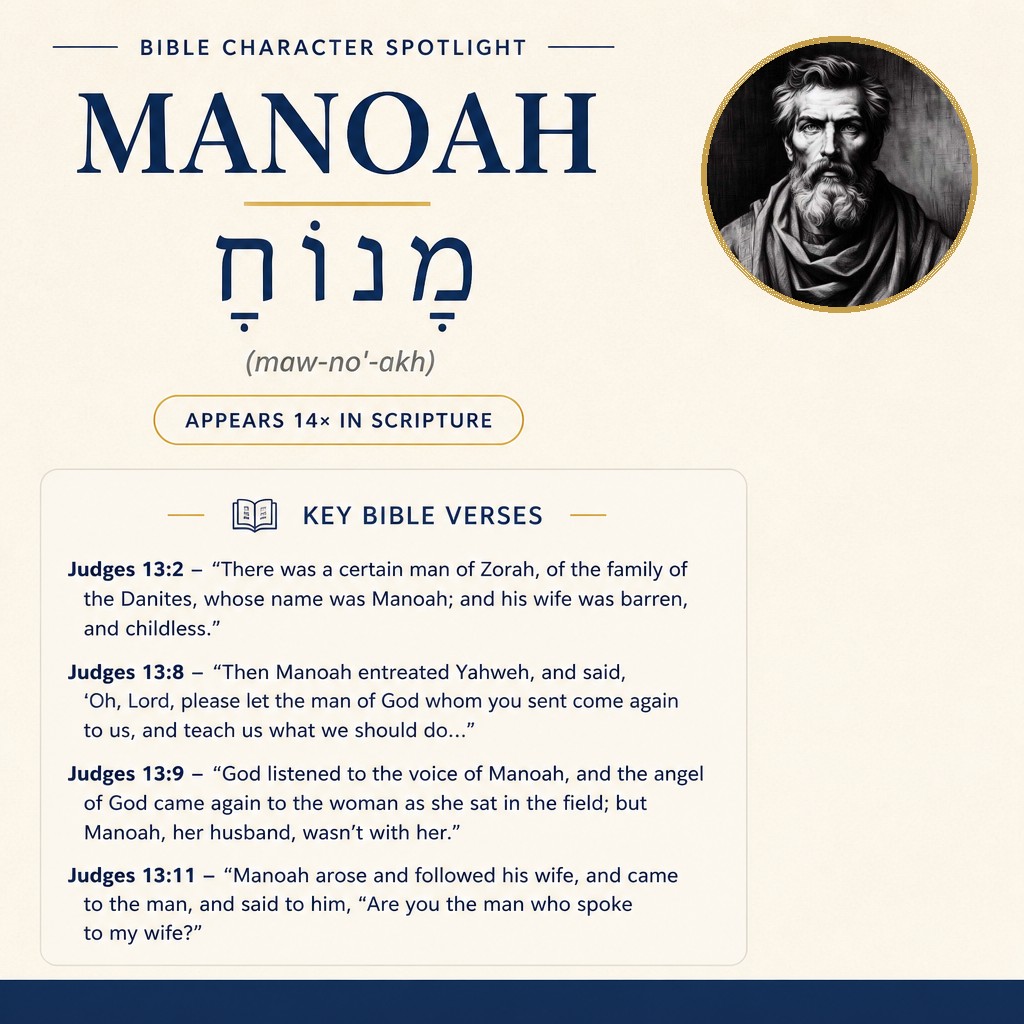
Manoah in Scripture
Manoah appears in the narrative setting in which “Yahweh delivered” Israel “into the hand of the Philistines forty years” (Judges 13:1). Within that setting, he is introduced with his location, tribal association, and his household situation:
“There was a certain man of Zorah, of the family of the Danites, whose name was Manoah; and his wife was barren, and childless.” (Judges 13:2)
The chapter first describes an appearance of “Yahweh’s angel” to Manoah’s wife (Judges 13:3). The angel announced that though she was “barren and childless,” she would “conceive and bear a son” (Judges 13:3), and gave specific instructions about what she was to avoid (Judges 13:4). The promised child’s identity and purpose were also stated: “the child shall be a Nazirite to God from the womb,” and “He shall begin to save Israel out of the hand of the Philistines” (Judges 13:5). Manoah’s wife then reported these events to Manoah, emphasizing both the awesomeness of the messenger and that she had not learned his origin or name:
“A man of God came to me, and his face was like the face of the angel of God, very awesome. I didn’t ask him where he was from, neither did he tell me his name;” (Judges 13:6)
She repeated the core message and the restrictions for the duration of the child’s life: “the child shall be a Nazirite to God from the womb to the day of his death” (Judges 13:7). Manoah’s first recorded response is prayer, asking for further guidance regarding the child who was promised:
“Then Manoah entreated Yahweh, and said, “Oh, Lord, please let the man of God whom you sent come again to us, and teach us what we should do to the child who shall be born.”” (Judges 13:8)
The narrative then states that this request was heard, though the subsequent appearance initially came to Manoah’s wife while Manoah was not present:
“God listened to the voice of Manoah, and the angel of God came again to the woman as she sat in the field; but Manoah, her husband, wasn’t with her.” (Judges 13:9)
When Manoah’s wife told him the man had appeared again (Judges 13:10), Manoah went with her and addressed the visitor directly, confirming the identity of the one who had spoken to his wife:
“Manoah arose and followed his wife, and came to the man, and said to him, “Are you the man who spoke to my wife?” He said, “I am.”” (Judges 13:11)
Manoah then asked what the child’s “way of life and mission” should be, framing his question as a desire to see the messenger’s words fulfilled:
“Manoah said, “Now let your words happen. What shall the child’s way of life and mission be?”” (Judges 13:12)
In response, “Yahweh’s angel” directed Manoah back to the instructions already given to his wife, stressing her careful obedience:
“Yahweh’s angel said to Manoah, “Of all that I said to the woman let her beware.”” (Judges 13:13)
The angel then reiterated the restrictions in concrete terms—she was not to partake of “anything that comes of the vine,” nor drink “wine or strong drink,” nor eat “any unclean thing,” but rather to “observe all that I commanded her” (Judges 13:14). Manoah’s interaction with the messenger also included hospitality and an offering. He asked the angel to remain so that a young goat could be prepared:
“Manoah said to Yahweh’s angel, “Please stay with us, that we may make a young goat ready for you.”” (Judges 13:15)
The angel declined to eat and redirected Manoah’s intention toward worship offered to Yahweh, with an explanatory note about Manoah’s limited understanding at the time:
“Yahweh’s angel said to Manoah, “Though you detain me, I won’t eat your bread. If you will prepare a burnt offering, you must offer it to Yahweh.” For Manoah didn’t know that he was Yahweh’s angel.” (Judges 13:16)
Manoah then asked the messenger’s name, linking that request to his desire to respond appropriately when the words came to pass:
“Manoah said to Yahweh’s angel, “What is your name, that when your words happen, we may honor you?”” (Judges 13:17)
The angel’s reply did not supply a name, but deflected the question: “Why do you ask about my name, since it is incomprehensible?” (Judges 13:18). Manoah proceeded with the offering. The chapter describes Manoah taking “the young goat with the meal offering” and offering it “on the rock to Yahweh,” as both Manoah and his wife watched what followed:
“So Manoah took the young goat with the meal offering, and offered it on the rock to Yahweh. Then the angel did an amazing thing as Manoah and his wife watched.” (Judges 13:19)
The “amazing thing” is then described as the angel ascending in the altar flame, and Manoah and his wife responding with reverence:
“For when the flame went up toward the sky from off the altar, Yahweh’s angel ascended in the flame of the altar. Manoah and his wife watched; and they fell on their faces to the ground.” (Judges 13:20)
After this, the angel no longer appeared to them; at that point Manoah recognized who the visitor had been:
“But Yahweh’s angel didn’t appear to Manoah or to his wife any more. Then Manoah knew that he was Yahweh’s angel.” (Judges 13:21)
Manoah’s immediate reaction is recorded as fear, expressed to his wife in a stark conclusion drawn from what they had experienced:
“Manoah said to his wife, “We shall surely die, because we have seen God.”” (Judges 13:22)
His wife answered with reasoning grounded in the fact that Yahweh had accepted their offering and shown them these things rather than destroying them:
“But his wife said to him, “If Yahweh were pleased to kill us, he wouldn’t have received a burnt offering and a meal offering at our hand, and he wouldn’t have shown us all these things, nor would he have told us such things as these at this time.”” (Judges 13:23)
The chapter then reports the birth of the promised child, naming him, and summarizing his growth and blessing:
“The woman bore a son and named him Samson. The child grew, and Yahweh blessed him.” (Judges 13:24)
It concludes by noting that “Yahweh’s Spirit began to move him in Mahaneh Dan, between Zorah and Eshtaol” (Judges 13:25), linking the outcome of the angelic announcement to developments that followed in the same region associated with Manoah (Judges 13:2, 13:25).
Name and Meaning
The name is written מָנוֹחַ, transliterated Manowach, pronounced “maw-no’-akh.” Its derivation is tied to a Hebrew term meaning “rest,” and a related component word can convey the idea of “quiet,” concretely “a settled spot.”
Observation
Manoah is portrayed as a man who sought instruction from Yahweh about the promised child (Judges 13:8, 13:12) and who moved from not recognizing the visitor—“Manoah didn’t know that he was Yahweh’s angel” (Judges 13:16)—to recognition: “Then Manoah knew that he was Yahweh’s angel” (Judges 13:21).
Frequently Asked Questions
What does the name Manoah mean?
Manoah means “rest.”
How many times does Manoah appear in the Bible?
Manoah occurs 14 times.
Who was Manoah?
Manoah is identified as an Israelite. Judges 13:2 describes him as a man of Zorah, from the family of the Danites, whose wife was barren and childless.
What did Manoah ask the man of God about the child?
He asked for guidance about the child’s future, saying, “What shall the child’s way of life and mission be?” (Judges 13:12).
Explore Further
If you found this page about Manoah interesting and would like to discover more about other biblical characters, explore our comprehensive Encyclopedia of Biblical Characters. For those looking to delve deeper into the Greek origins of these names and terms, our Greek Lexicon is an invaluable resource.
Sources: Name and occurrence data from Strong’s Exhaustive Concordance and STEPBible reference data (CC BY). Scripture quotations from the World English Bible (public domain).