
Who was Jonathan in the bible?
Jonathan is the name of multiple Israelites in Scripture, including Saul’s son in 1 Samuel 13–14 and 1 Chronicles 10, and others named in 1 Chronicles and 1 Kings.
What He Did
In Saul’s army, “one thousand were with Jonathan in Gibeah of Benjamin” (1 Samuel 13:2). “Jonathan struck the garrison of the Philistines that was in Geba” (1 Samuel 13:3).
Learn More →Other Jonathans
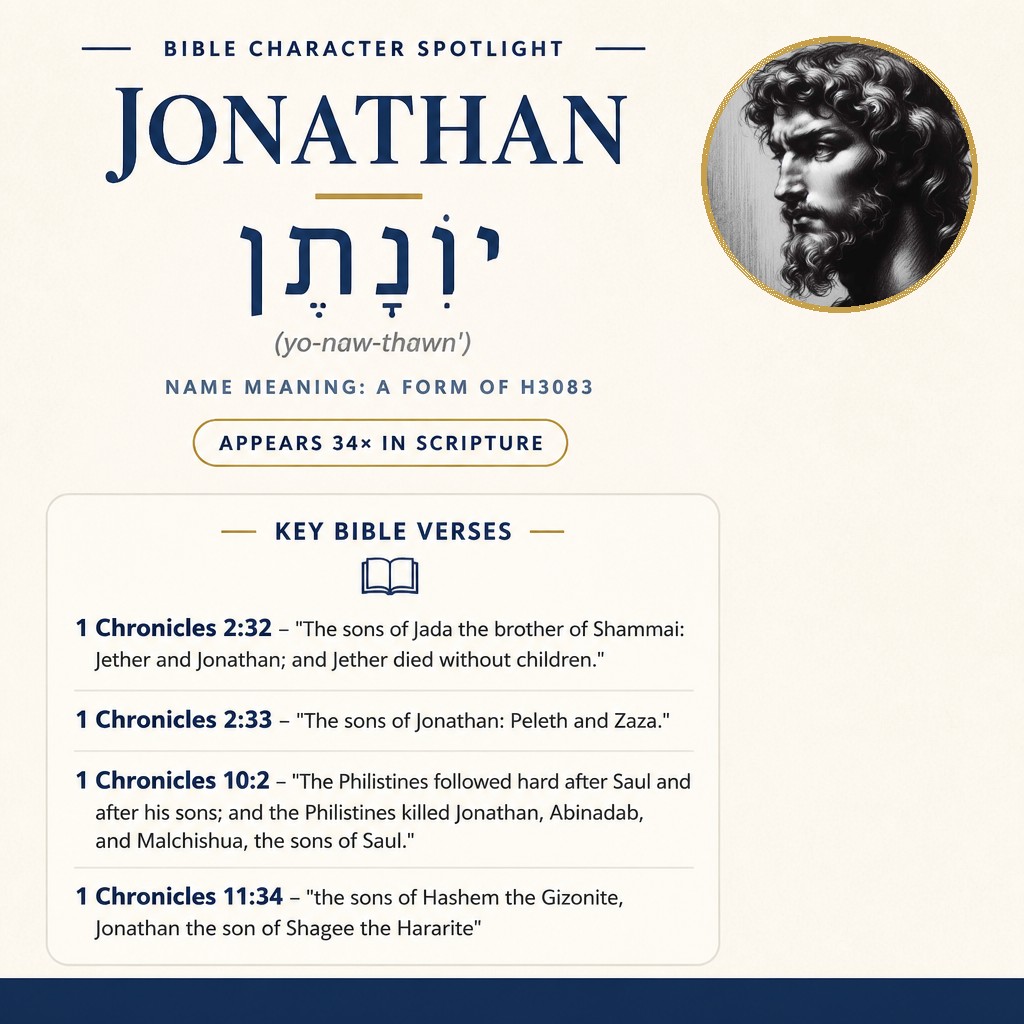
A Jonathan appears in genealogies: “Jether and Jonathan” (1 Chronicles 2:32), and “The sons of Jonathan: Peleth and Zaza” (1 Chronicles 2:33). Another is named among warriors: “Jonathan the son of Shagee the Hararite” (1 Chronicles 11:34).
Learn More →Jonathan (Hebrew יוֹנָתָן, Yownathan) is a biblical name borne by multiple Israelites. In the passages below, Jonathan appears as a son in a genealogy, as a son of Saul active in conflict with the Philistines and later killed, as “Jonathan the son of Abiathar the priest,” and as “Jonathan the son of Shagee the Hararite.”
Jonathan in Scripture
1) Jonathan in the Jerahmeel genealogy (1 Chronicles 2). One Jonathan is listed among the descendants of Jerahmeel through Jada and Shammai. The record first names him as a son, then identifies his own children.
“The sons of Jada the brother of Shammai: Jether and Jonathan; and Jether died without children.” (1 Chronicles 2:32, WEB)
“The sons of Jonathan: Peleth and Zaza. These were the sons of Jerahmeel.” (1 Chronicles 2:33, WEB)
2) Jonathan the son of Saul in the conflict with the Philistines (1 Samuel 13; also 1 Chronicles 10). In the narrative of Saul’s reign, Jonathan is presented as Saul’s son who commands a portion of Israel’s forces and initiates an attack on a Philistine garrison. Saul’s army is divided, and Jonathan is stationed with one thousand men.
“Saul chose for himself three thousand men of Israel, of which two thousand were with Saul in Michmash and in the Mount of Bethel, and one thousand were with Jonathan in Gibeah of Benjamin. He sent the rest of the people to their own tents.” (1 Samuel 13:2, WEB)
Jonathan’s action against the Philistines is described directly, and Saul publicly signals the news throughout Israel.
“Jonathan struck the garrison of the Philistines that was in Geba, and the Philistines heard of it. Saul blew the trumpet throughout all the land, saying, ‘Let the Hebrews hear!’” (1 Samuel 13:3, WEB)
The aftermath includes Israel’s fear and dispersal, and Saul’s actions at Gilgal when Samuel does not arrive within the expected time. The chapter includes Samuel’s confrontation and oracle against Saul, set in the same broader crisis created by Philistine pressure. Saul explains his reasoning, and Samuel announces judgment.
“Samuel said, ‘What have you done?’ Saul said, ‘Because I saw that the people were scattered from me, and that you didn’t come within the days appointed, and that the Philistines assembled themselves together at Michmash; therefore I said, “Now the Philistines will come down on me to Gilgal, and I haven’t entreated the favor of Yahweh.” I forced myself therefore, and offered the burnt offering.’” (1 Samuel 13:11–12, WEB)
“Samuel said to Saul, ‘You have done foolishly. You have not kept the commandment of Yahweh your God, which he commanded you; for now Yahweh would have established your kingdom on Israel forever. But now your kingdom will not continue. Yahweh has sought for himself a man after his own heart, and Yahweh has appointed him to be prince over his people, because you have not kept that which Yahweh commanded you.’” (1 Samuel 13:13–14, WEB)
After Samuel departs, Saul is depicted with a reduced force; Jonathan remains closely associated with Saul’s position and movements. They are together at Geba of Benjamin while the Philistines are encamped at Michmash.
“Saul, and Jonathan his son, and the people who were present with them, stayed in Geba of Benjamin; but the Philistines encamped in Michmash.” (1 Samuel 13:16, WEB)
The chapter also notes the Philistines’ restrictions affecting Israel’s weapons. In this setting, Saul and Jonathan are singled out as possessing arms when others do not.
“So it came to pass in the day of battle, that neither sword nor spear was found in the hand of any of the people who were with Saul and Jonathan; but Saul and Jonathan his son had them.” (1 Samuel 13:22, WEB)
In the next scene provided, Jonathan is absent from the people’s immediate awareness as he seeks a route toward a Philistine garrison, moving through a specific rocky terrain.
“The people didn’t know that Jonathan was gone.” (1 Samuel 14:3b, WEB)
“Between the passes, by which Jonathan sought to go over to the Philistines’ garrison, there was a rocky crag on the one side, and a rocky crag on the other side: and the name of the one was Bozez, and the name of the other Seneh.” (1 Samuel 14:4, WEB)
Later, Jonathan’s death is reported in a summary of Saul’s final battle.
“The Philistines followed hard after Saul and after his sons; and the Philistines killed Jonathan, Abinadab, and Malchishua, the sons of Saul.” (1 Chronicles 10:2, WEB)
3) Jonathan the son of Shagee (1 Chronicles 11). Another Jonathan appears in a list of men, identified by patronymic and place/ethnic descriptor.
“the sons of Hashem the Gizonite, Jonathan the son of Shagee the Hararite,” (1 Chronicles 11:34, WEB)
4) Jonathan the son of Abiathar the priest (1 Kings 1). In the account of Adonijah’s gathering, Jonathan arrives while speaking is underway, and Adonijah addresses him. Jonathan then reports what David has done regarding Solomon.
“While he yet spoke, behold, Jonathan the son of Abiathar the priest came; and Adonijah said, ‘Come in; for you are a worthy man, and bring good news.’” (1 Kings 1:42, WEB)
“Jonathan answered Adonijah, ‘Most certainly our lord king David has made Solomon king.’” (1 Kings 1:43, WEB)
Multiple Bearers
The name Jonathan is borne by multiple individuals in these citations: (1) a Jonathan who is a son of Jada and father of “Peleth and Zaza” (1 Chronicles 2:32–33); (2) Jonathan “his son” alongside Saul in military scenes and later named among Saul’s sons killed by the Philistines (1 Samuel 13:16, 1 Chronicles 10:2); (3) “Jonathan the son of Shagee the Hararite” (1 Chronicles 11:34); and (4) “Jonathan the son of Abiathar the priest,” a messenger who speaks to Adonijah about David’s action (1 Kings 1:42–43).
Name and Meaning
The Hebrew form is יוֹנָתָן, transliterated Yownathan (pronounced yo-naw-thawn’). Lexicon information describes it as a form of H3083, with a related component form Yehownathan (Jehonathan), and notes that it is the name used of multiple Israelites.
Observation
Across these passages, Jonathan is repeatedly identified by lineage—“Jonathan his son” (1 Samuel 13:16), “Jonathan the son of Abiathar the priest” (1 Kings 1:42), and “Jonathan the son of Shagee” (1 Chronicles 11:34)—and the narratives attach his name both to decisive action (“Jonathan struck the garrison of the Philistines” (1 Samuel 13:3)) and to the cost of war (“the Philistines killed Jonathan” (1 Chronicles 10:2)).
Frequently Asked Questions
What does the name Jonathan mean?
Jonathan means “Yahweh has given.”
How many times does Jonathan appear in the Bible?
Jonathan appears 34 times.
Who was Jonathan in the Bible?
Jonathan is the name of ten Israelites. One Jonathan is Saul’s son who was killed by the Philistines (1 Chronicles 10:2).
What did Jonathan do in the fight with the Philistines at Geba?
Jonathan struck the Philistines’ garrison that was in Geba (1 Samuel 13:3).
Explore Further
If you found this page about Jonathan interesting and would like to discover more about other biblical characters, explore our comprehensive Encyclopedia of Biblical Characters. For those looking to delve deeper into the Greek origins of these names and terms, our Greek Lexicon is an invaluable resource.
Sources: Name and occurrence data from Strong’s Exhaustive Concordance and STEPBible reference data (CC BY). Scripture quotations from the World English Bible (public domain).




