Who was Jabez in the bible?
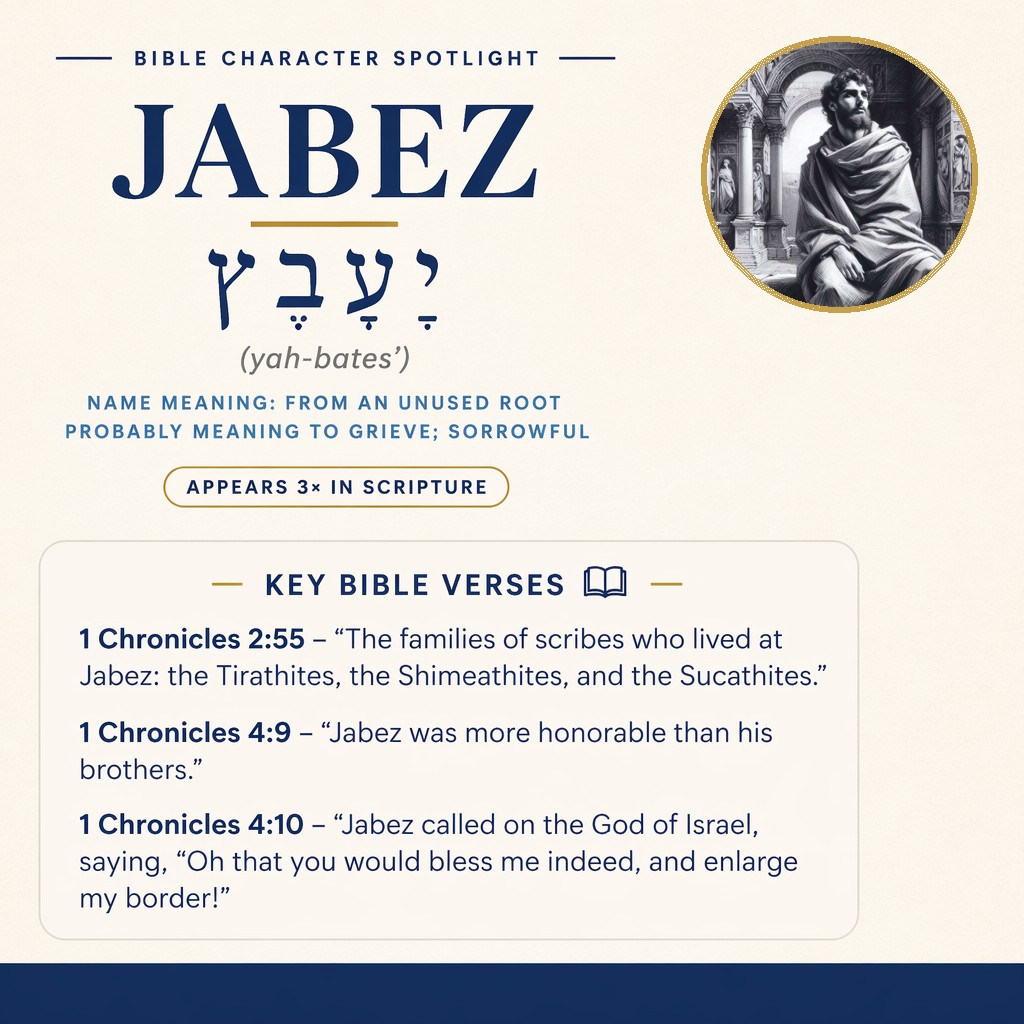
Jabez is a man in 1 Chronicles 4:9–10, and the name also appears as a location where scribal families lived in 1 Chronicles 2:55.

Birth Naming
“His mother named him Jabez, saying, ‘Because I bore him with sorrow.’” (1 Chronicles 4:9)
Learn More →Prayer Answered
Jabez prayed, “Oh that you would bless me indeed, and enlarge my border!” (1 Chronicles 4:10). “God granted him that which he requested.” (1 Chronicles 4:10)
Learn More →Jabez is the name of an Israelite remembered in Chronicles for his honor and for a prayer to “the God of Israel” that God granted; the same name is also used for a place where “families of scribes” lived. The name is associated (by lexicon derivation) with grief or sorrow, fitting the explanation given for his naming.
Jabez in Scripture
Chronicles presents “Jabez” in two related but distinct ways: as a location connected with scribal families, and as an individual whose mother named him in connection with sorrow and who called on God for blessing and protection.
In the genealogical setting of 1 Chronicles 2, the narrative moves through families and settlements and then pauses to mention a community located at Jabez. The text reads:
“The families of scribes who lived at Jabez: the Tirathites, the Shimeathites, and the Sucathites. These are the Kenites who came from Hammath, the father of the house of Rechab.” (1 Chronicles 2:55, WEB)
This places “Jabez” on the map of Israel’s clans as a habitation where scribal families lived, and it identifies those families by name. The same verse also situates them among “the Kenites who came from Hammath,” tied to “the father of the house of Rechab,” so Jabez functions here as a known place associated with a particular group’s residence and heritage.
The other references appear in 1 Chronicles 4, amid a sequence of family notices. In the verses immediately surrounding Jabez, the Chronicler lists births and descendants: “Naarah bore him Ahuzzam, Hepher, Temeni, and Haahashtari” (1 Chronicles 4:6, WEB), and “The sons of Helah were Zereth, Izhar, and Ethnan” (1 Chronicles 4:7, WEB). Then, after mentioning other figures—“Hakkoz became the father of Anub, Zobebah, and the families of Aharhel the son of Harum” (1 Chronicles 4:8, WEB)—the account pauses to single out Jabez with a brief character sketch and an explanation of his name.
“Jabez was more honorable than his brothers. His mother named him Jabez, saying, ‘Because I bore him with sorrow.’” (1 Chronicles 4:9, WEB)
This statement is the main descriptive claim about the man himself: he is distinguished as “more honorable than his brothers.” The naming scene is also explicit: his mother gives the name and provides the reason, directly connecting Jabez’s name to the experience of “sorrow” in his birth.
Immediately after, the Chronicler preserves Jabez’s prayer in full, describing it as an act of calling on God and recording its outcome:
“Jabez called on the God of Israel, saying, ‘Oh that you would bless me indeed, and enlarge my border! May your hand be with me, and may you keep me from evil, that I may not cause pain!’ God granted him that which he requested.” (1 Chronicles 4:10, WEB)
Within the prayer, Jabez asks for four things: blessing (“bless me indeed”), expansion (“enlarge my border”), divine presence and support (“May your hand be with me”), and moral and existential protection (“keep me from evil, that I may not cause pain”). The narrative response is brief and emphatic: “God granted him that which he requested,” presenting the prayer as heard and answered.
After Jabez, the chapter resumes its genealogical rhythm without further comment on him: “Chelub the brother of Shuhah became the father of Mehir, who was the father of Eshton” (1 Chronicles 4:11, WEB), and “Eshton became the father of Beth Rapha, Paseah, and Tehinnah the father of Ir Nahash. These are the men of Recah” (1 Chronicles 4:12, WEB). Other lines continue in the same manner, naming “the sons of Kenaz” (1 Chronicles 4:13, WEB) and noting craftspeople—“Seraiah became the father of Joab the father of Ge Harashim; for they were craftsmen” (1 Chronicles 4:14, WEB). In this flow of births, sons, and fathers, the short notice about Jabez stands out as an interruption that highlights personal character (“more honorable”) and a direct address to God (“called on the God of Israel”).
Multiple Bearers
The name “Jabez” refers to both a place and an individual in Chronicles. As a place, it is the residence of scribal clans:
“The families of scribes who lived at Jabez…” (1 Chronicles 2:55, WEB)
As an individual, Jabez is the man described as “more honorable than his brothers,” named in connection with sorrow, and known for a prayer that God granted (1 Chronicles 4:9–10, WEB). The passages do not explicitly state whether the place-name and the man are connected beyond sharing the same name.
Name and Meaning
In Hebrew the name is written יַעְבֵּץ (Ya’bets), pronounced yah-bates’. Lexicon derivation connects it to an unused root probably meaning “to grieve,” giving the sense “sorrowful.” In Scripture, that sense is echoed by the mother’s explanation: “Because I bore him with sorrow.” (1 Chronicles 4:9, WEB)
Brief Observation
Chronicles frames Jabez with two linked themes: a name associated with “sorrow” (1 Chronicles 4:9) and a prayer that asks God to “keep me from evil, that I may not cause pain,” followed by the report that “God granted him that which he requested” (1 Chronicles 4:10, WEB).
Frequently Asked Questions
What does the name Jabez mean?
Jabez means “sorrowful,” from a root probably meaning “to grieve.”
How many times does Jabez appear in the Bible?
Jabez appears 3 times.
Who was Jabez?
Jabez is the name of an Israelite, and also the name of a place in Palestine. 1 Chronicles 4:9 says he was “more honorable than his brothers,” and that his mother named him Jabez because she bore him “with sorrow.”
What did Jabez ask God for?
In 1 Chronicles 4:10, Jabez called on the God of Israel, asking for blessing, enlarged borders, God’s hand to be with him, and protection from evil.
Explore Further
If you found this page about Jabez interesting and would like to discover more about other biblical characters, explore our comprehensive Encyclopedia of Biblical Characters. For those looking to delve deeper into the Greek origins of these names and terms, our Greek Lexicon is an invaluable resource.
Sources: Name and occurrence data from Strong’s Exhaustive Concordance and STEPBible reference data (CC BY). Scripture quotations from the World English Bible (public domain).