Who was Ishpan in the bible?
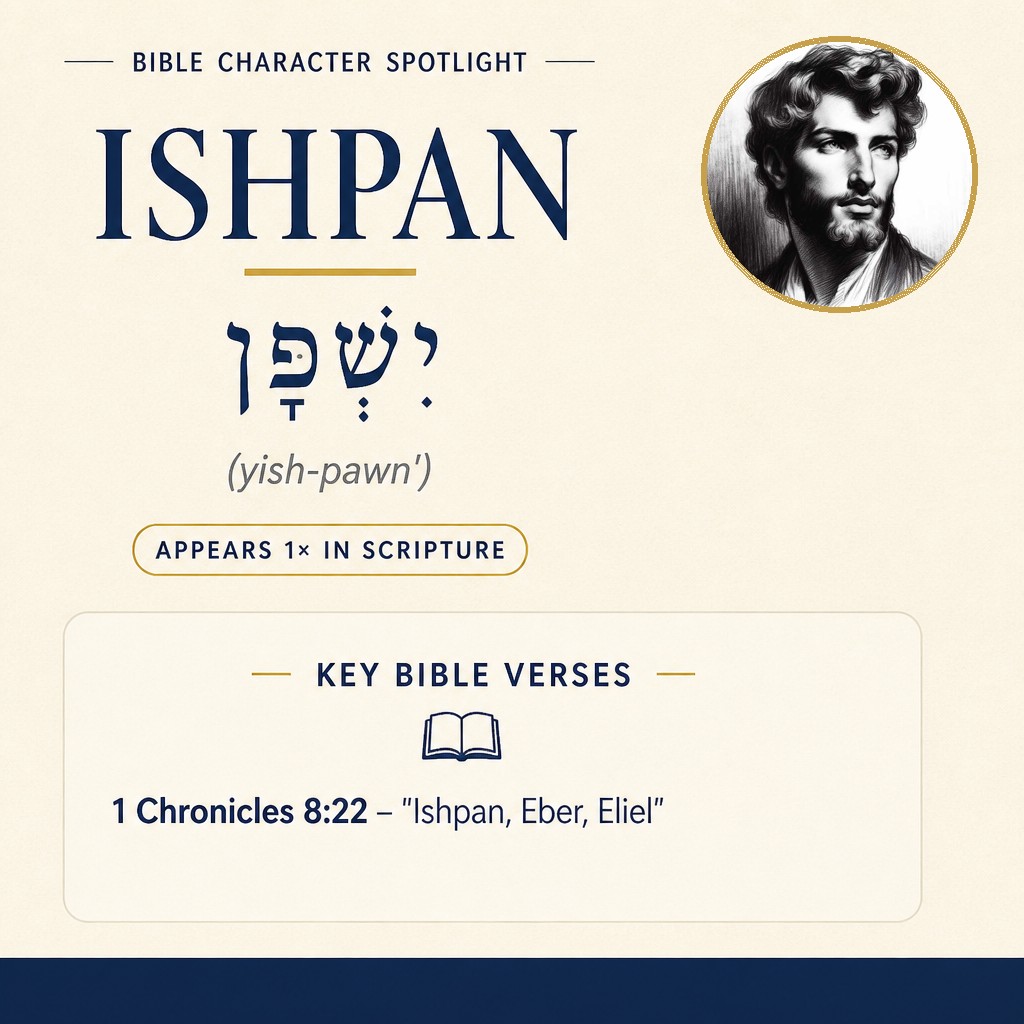
Ishpan is listed among names in a genealogy in 1 Chronicles 8:22.
Biblical Context
He is included in a sequence of names in 1 Chronicles 8:19–27, a genealogical list.
Learn More →Name Meaning
Strong’s H3473 (Yishpan) is explained as meaning “he will hide,” likely related to a word for a rock-rabbit.
Learn More →Ishpan (Hebrew יִשְׁפָּן, Yishpan) is named once in Scripture, in a genealogical listing in 1 Chronicles 8. Lexically, the name is explained as probably meaning “he will hide,” connected with the word shaphan, a species of rock-rabbit associated with hiding.
Ishpan in Scripture
Ishpan appears in 1 Chronicles 8 within a sequence of names presented as family lines and household heads. In the immediate lead-up, the passage lists several individuals in a flowing register of names. The text first gives a brief cluster:
“Jakim, Zichri, Zabdi,” (1 Chronicles 8:19, WEB)
It continues with another grouping, keeping the same list-like form:
“Elienai, Zillethai, Eliel,” (1 Chronicles 8:20, WEB)
Next, the writer attaches a set of names explicitly to a father, introducing a small family unit within the broader register:
“Adaiah, Beraiah, Shimrath, the sons of Shimei,” (1 Chronicles 8:21, WEB)
Immediately following that father-linked phrase, Ishpan is named in a short triad. The verse gives no additional description beyond placing him in the list:
“Ishpan, Eber, Eliel,” (1 Chronicles 8:22, WEB)
After Ishpan, the genealogical register continues uninterrupted, supplying more names in the same style:
“Abdon, Zichri, Hanan,” (1 Chronicles 8:23, WEB)
The list extends through additional verses, again combining names into compact sequences:
“Hananiah, Elam, Anthothijah,” (1 Chronicles 8:24, WEB)
Then another set is tied to a father, paralleling the earlier “sons of Shimei” formula and showing how the chapter alternates between simple name clusters and family-attribution phrases:
“Iphdeiah, Penuel, the sons of Shashak,” (1 Chronicles 8:25, WEB)
The genealogy continues with more names:
“Shamsherai, Shehariah, Athaliah,” (1 Chronicles 8:26, WEB)
And again the text adds a father-linked description, rounding out the run of names that frames Ishpan’s appearance:
“Jaareshiah, Elijah, Zichri, and the sons of Jeroham.” (1 Chronicles 8:27, WEB)
After presenting these sequences, the chapter pauses to characterize the people just named. Rather than giving biographical details for individuals like Ishpan, it summarizes the status and location of the broader set:
“These were heads of fathers’ households throughout their generations, chief men. These lived in Jerusalem.” (1 Chronicles 8:28, WEB)
The narrative then shifts to another locale and household, stating who lived in Gibeon and naming his wife, followed by their offspring. This continuation shows that the chapter is organizing families by household leadership and residence:
“The father of Gibeon, whose wife’s name was Maacah, lived in Gibeon,” (1 Chronicles 8:29, WEB)
It then lists the firstborn and other sons in a format consistent with the earlier registers:
“with his firstborn son Abdon, Zur, Kish, Baal, Nadab,” (1 Chronicles 8:30, WEB)
The section continues with more names as the genealogy proceeds:
“Gedor, Ahio, and Zecher.” (1 Chronicles 8:31, WEB)
Within this chapter flow, Ishpan is therefore presented as one named member of a larger set of “heads of fathers’ households,” included among those described as “chief men,” and associated with the group said to have lived in Jerusalem. The only direct statement that includes Ishpan by name is the brief list in 1 Chronicles 8:22, and no separate actions, sayings, or personal events are attributed to him in the cited text.
Name and Meaning
The name appears in Hebrew as יִשְׁפָּן, transliterated Yishpan and pronounced yish-pawn’. Strong’s derivation suggests it is probably from the same root as H8227, with the sense “he will hide,” and it is connected by component to shaphan (שָׁפָן), a species of rock-rabbit described in relation to hiding.
Observation
In 1 Chronicles 8, Ishpan’s single mention functions within a broader record of family leadership—names gathered together as “heads of fathers’ households throughout their generations, chief men,” with the shared note, “These lived in Jerusalem” (1 Chronicles 8:28, WEB).
Frequently Asked Questions
What does the name Ishpan mean?
The name Ishpan means “he will hide.”
How many times does Ishpan appear in the Bible?
Ishpan appears 1 time.
Who was Ishpan?
Ishpan (Jishpan) is identified as an Israelite.
Where is Ishpan mentioned in the Bible?
Ishpan is mentioned in 1 Chronicles 8:22.
Explore Further
If you found this page about Ishpan interesting and would like to discover more about other biblical characters, explore our comprehensive Encyclopedia of Biblical Characters. For those looking to delve deeper into the Greek origins of these names and terms, our Greek Lexicon is an invaluable resource.
Sources: Name and occurrence data from Strong’s Exhaustive Concordance and STEPBible reference data (CC BY). Scripture quotations from the World English Bible (public domain).