Who was Iddo in the bible?
Iddo is a name borne by multiple Israelites, appearing in genealogies, royal records, priestly lists, and Ezra’s account, including mentions in 1 Chronicles, 1 Kings, 2 Chronicles, Ezra, Nehemiah, and Zechariah.

Prophet and Seer
Royal records refer to “Iddo the seer” (2 Chronicles 12:15) and “the prophet Iddo” (2 Chronicles 13:22). Zechariah is identified as “the son of Berechiah, the son of Iddo, the prophet” (Zechariah 1:7).
Learn More →Chief and Lists
Ezra writes, “I sent them out to Iddo the chief at the place Casiphia” (Ezra 8:17). Nehemiah lists “Iddo” among priests who went up with Zerubbabel (Nehemiah 12:4) and later notes “of Iddo, Zechariah” (Nehemiah 12:16).
Learn More →Iddo is the name of multiple Israelites mentioned across several books of Scripture; the name is also explained in one lexicon entry as meaning “timely.” In the provided passages, bearers of the name include a person in a genealogical line, a father of a district official, a prophet or seer associated with written records, a priestly name listed among returnees with Zerubbabel, and a leader at Casiphia connected with “the temple servants.”
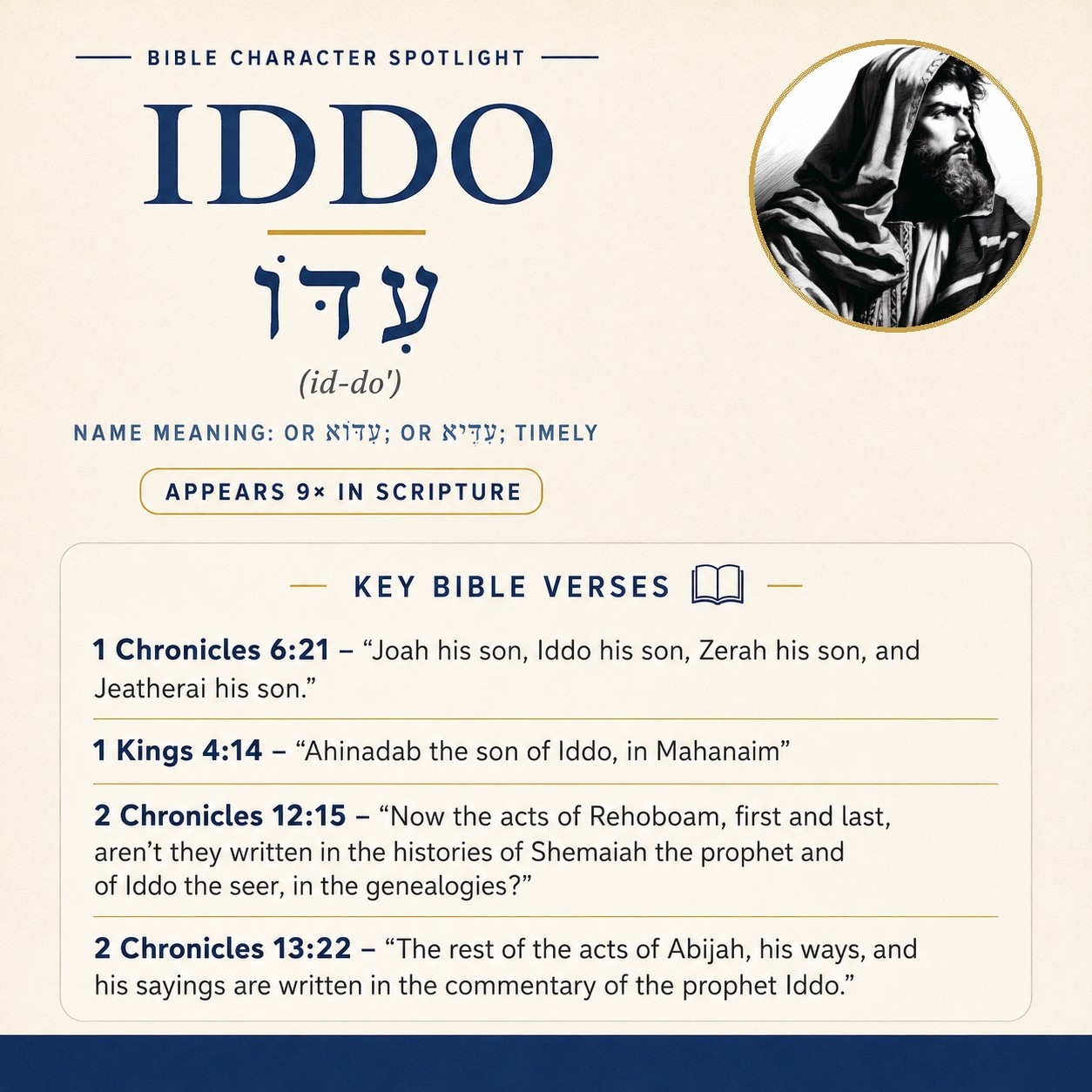
Iddo in Scripture
1) Iddo in a genealogical line (1 Chronicles)
“Joah his son, Iddo his son, Zerah his son, and Jeatherai his son.” (1 Chronicles 6:21)
This verse places Iddo within a sequence of descent: “Joah” is named as his father, and “Zerah” as his son.
2) Iddo as the father of Ahinadab (1 Kings)
“Ahinadab the son of Iddo, in Mahanaim;” (1 Kings 4:14)
Here Iddo is identified by patronymic as the father of “Ahinadab,” who is connected with “Mahanaim.”
3) Iddo as a seer or prophet whose writings are cited (2 Chronicles)
“Now the acts of Rehoboam, first and last, aren’t they written in the histories of Shemaiah the prophet and of Iddo the seer, in the genealogies? There were wars between Rehoboam and Jeroboam continually.” (2 Chronicles 12:15)
This reference associates an Iddo with historical records described as “the histories of Shemaiah the prophet and of Iddo the seer,” and it connects those records with “genealogies.”
“The rest of the acts of Abijah, his ways, and his sayings are written in the commentary of the prophet Iddo.” (2 Chronicles 13:22)
Another notice links an Iddo with written material called “the commentary of the prophet Iddo,” presented as a source for “the rest of the acts of Abijah.”
4) Iddo as Zechariah’s ancestor and as a priestly family name (Ezra, Nehemiah, Zechariah)
“The elders of the Jews built and prospered, through the prophesying of Haggai the prophet and Zechariah the son of Iddo. They built and finished it, according to the commandment of the God of Israel, and according to the decree of Cyrus, Darius, and Artaxerxes” (Ezra 6:14)
In this statement, Zechariah is identified as “the son of Iddo,” and his prophesying (along with Haggai’s) is said to accompany the elders’ progress: they “built and prospered” and “built and finished it.”
“On the twenty-fourth day of the eleventh month, which is the month Shebat, in the second year of Darius, Yahweh’s word came to Zechariah the son of Berechiah, the son of Iddo, the prophet, saying,” (Zechariah 1:7)
This verse further situates Iddo in Zechariah’s lineage: Zechariah is “the son of Berechiah, the son of Iddo,” and Zechariah is identified as “the prophet” at the moment “Yahweh’s word came” to him.
Nehemiah 12 presents a longer narrative context where Iddo appears within priestly lists associated with those who “went up with Zerubbabel,” and then again in a later listing of heads of fathers’ households “in the days of Joiakim.” The chapter also describes the organization of priests, Levites, singers, and gatekeepers, and culminates in the dedication of Jerusalem’s wall with processions and sacrifices.
“Now these are the priests and the Levites who went up with Zerubbabel the son of Shealtiel, and Jeshua: Seraiah, Jeremiah, Ezra,” (Nehemiah 12:1)
The chapter begins by identifying priests and Levites who “went up with Zerubbabel… and Jeshua,” then lists names. Within that early list, Iddo appears among other priestly names.
“Iddo, Ginnethoi, Abijah,” (Nehemiah 12:4)
This places Iddo among those named in the initial priestly roll.
Later, in the portion describing priestly heads of households during Joiakim’s days, the name Iddo appears again as a priestly house with an identified head.
“In the days of Joiakim were priests, heads of fathers’ households: …” (Nehemiah 12:12)
“of Iddo, Zechariah; of Ginnethon, Meshullam;” (Nehemiah 12:16)
Here “of Iddo, Zechariah” reads as an association between the name Iddo and a figure named Zechariah who is presented as the head for that household in that period.
Nehemiah 12 then continues with broader administrative and liturgical descriptions: it notes recordings of household heads (Nehemiah 12:22–23); describes Levitical chiefs “to praise and give thanks” (Nehemiah 12:24); identifies gatekeepers “keeping the watch” (Nehemiah 12:25); and situates the lists in time by stating, “These were in the days of Joiakim… and in the days of Nehemiah the governor, and of Ezra the priest and scribe” (Nehemiah 12:26). The dedication scene follows, where Levites are gathered “to keep the dedication with gladness” using “giving thanks” and music (Nehemiah 12:27). The account describes purification—“The priests and the Levites purified themselves; and they purified the people, and the gates, and the wall” (Nehemiah 12:30)—and two processional companies giving thanks that ultimately stand “in God’s house” (Nehemiah 12:40). The chapter closes with “great sacrifices” and rejoicing so widely heard that “the joy of Jerusalem was heard even far away” (Nehemiah 12:43), along with appointments for storerooms and continued duties for priests, Levites, singers, and gatekeepers (Nehemiah 12:44–47). Within this full narrative, Iddo’s role is not described beyond his appearance in the priestly lists.
5) Iddo as “the chief” at Casiphia (Ezra 8)
Ezra 8 provides a specific situational context in which Iddo is approached to help supply personnel “for the house of our God.” Ezra first describes gathering people at a river encampment and observing a lack of Levites present.
“I gathered them together to the river that runs to Ahava; and there we encamped three days: and I looked around at the people and the priests, and found there were none of the sons of Levi.” (Ezra 8:15)
Ezra then sends for “chief men” and “teachers” (Ezra 8:16), and after that dispatches them to Iddo.
“I sent them out to Iddo the chief at the place Casiphia; and I told them what they should tell Iddo, and his brothers the temple servants, at the place Casiphia, that they should bring to us ministers for the house of our God.” (Ezra 8:17)
In this setting, Iddo is called “the chief” at “the place Casiphia,” and he is linked with “his brothers the temple servants.” Ezra’s stated aim is that they “should bring to us ministers for the house of our God.” The passage then reports results “according to the good hand of our God on us,” including the arrival of Levites and “two hundred twenty temple servants” (Ezra 8:18–20), though those individuals are not described as Iddo’s relatives beyond the earlier phrase “his brothers the temple servants.”
Multiple Bearers
The provided verses present more than one person named Iddo.
Iddo in descent lists and patronymics. One Iddo appears in a genealogical chain: “Joah his son, Iddo his son, Zerah his son” (1 Chronicles 6:21). Another Iddo is identified only as a father: “Ahinadab the son of Iddo” (1 Kings 4:14).
Iddo connected with prophetic records. In Chronicles, an Iddo is described as “Iddo the seer” whose “histories” are cited with Shemaiah’s (2 Chronicles 12:15), and “the prophet Iddo” whose “commentary” contains information on Abijah (2 Chronicles 13:22). The text does not explicitly identify this Iddo with any other occurrence.
Iddo connected with Zechariah and priestly listings. Ezra and Zechariah identify Zechariah as “the son of Iddo” (Ezra 6:14) and “the son of Berechiah, the son of Iddo” (Zechariah 1:7). Nehemiah lists “Iddo” among priests who “went up with Zerubbabel” (Nehemiah 12:1, 12:4) and later says, “of Iddo, Zechariah” (Nehemiah 12:16). These passages together present Iddo as a named point in Zechariah’s lineage and as a priestly household name within Nehemiah’s lists.
Iddo at Casiphia. Ezra 8 describes “Iddo the chief at the place Casiphia” (Ezra 8:17), associated with “his brothers the temple servants.” The verse does not connect this Iddo explicitly to the others.
Name and Meaning
In one lexicon entry, the name is written עִדּוֹ, transliterated ’Iddow and pronounced “id-do,” and it is derived (per that entry) from H5710 with the sense “timely,” with a component explained there as ’adah (עָדָה), “to advance, i.e. pass on or continue.” A second lexicon entry also gives the spelling אִדּוֹ, transliterated ’Iddow and pronounced “id-do,” but describes the derivation as uncertain.
Observation
Across these passages, the name Iddo is repeatedly attached to lines of descent and written records—“in the genealogies” (2 Chronicles 12:15), “the son of Iddo” (Ezra 6:14), and “the son of Berechiah, the son of Iddo” (Zechariah 1:7)—so that Iddo is remembered primarily through lists, sources, and family identification.
Frequently Asked Questions
What does the name Iddo mean?
The name Iddo is said to mean “timely.”
How many times does Iddo appear in the Bible?
Iddo appears 9 times in the Bible.
Who was Iddo?
Iddo is the name of multiple Israelites, including a seer or prophet whose writings are mentioned in connection with King Rehoboam and King Abijah (2 Chronicles 12:15; 2 Chronicles 13:22). The name is also used for the father of Ahinadab (1 Kings 4:14) and in genealogical lists (1 Chronicles 6:21).
Was there more than one person named Iddo?
Yes. One Iddo is linked with prophetic or historical writings (2 Chronicles 12:15; 2 Chronicles 13:22), another is the father of Ahinadab (1 Kings 4:14), another is connected with Zechariah as “the son of Iddo” (Ezra 6:14; Zechariah 1:7), and another is “Iddo the chief” at Casiphia (Ezra 8:17).
Explore Further
If you found this page about Iddo interesting and would like to discover more about other biblical characters, explore our comprehensive Encyclopedia of Biblical Characters. For those looking to delve deeper into the Greek origins of these names and terms, our Greek Lexicon is an invaluable resource.
Sources: Name and occurrence data from Strong’s Exhaustive Concordance and STEPBible reference data (CC BY). Scripture quotations from the World English Bible (public domain).