Who was Hanan in the bible?
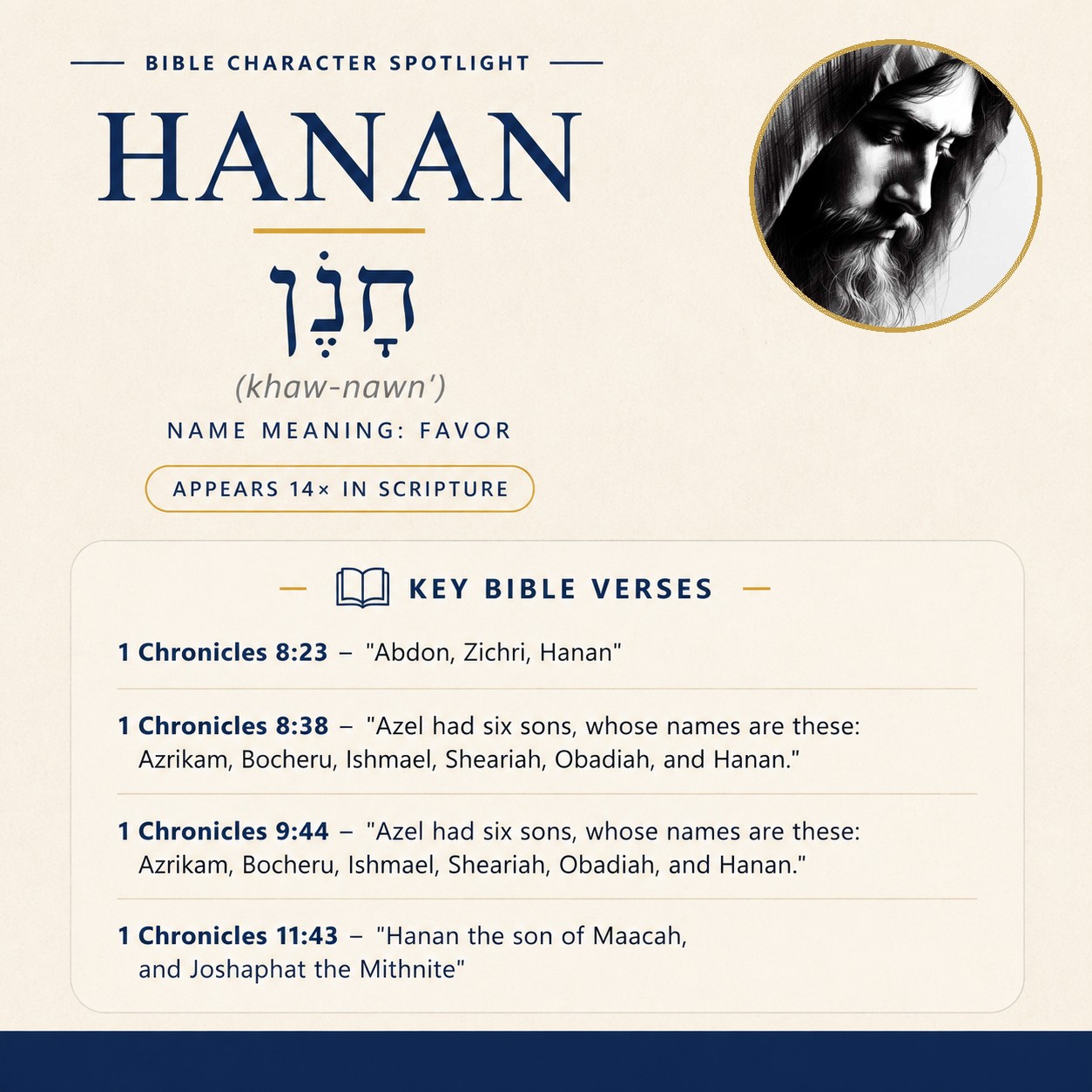
Hanan (Hebrew Chanan) is a name borne by multiple Israelites listed in Chronicles, Ezra, Jeremiah, and Nehemiah; a similar Greek form (Chanaan) appears in Acts for Canaan.

Where He Appears
Hanan is named among descendants and associates in Chronicles (e.g., “Abdon, Zichri, Hanan,” 1 Chronicles 8:23; “and Hanan,” 1 Chronicles 8:38). In Nehemiah, Hanan appears among those connected with public commitments and temple administration (Nehemiah 10:10; 13:13).
Learn More →Name and Meaning
Strong’s derives Chanan from a Hebrew root meaning to show favor or kindness. The Greek Χαναάν (Chanaan) in Acts refers to “Canaan” (Acts 7:11; 13:19).
Learn More →Hanan is a personal name borne by multiple Israelites in the Bible; the name is associated (by Hebrew derivation) with the idea of favor. In addition, a similar Greek form (Chanaan) appears in Acts as the place name Canaan, not a person.
Hanan in Scripture
The Hebrew name Hanan appears across genealogies, lists, and administrative or covenant contexts, referring to distinct individuals and groups.
“Abdon, Zichri, Hanan,” (1 Chronicles 8:23)
In 1 Chronicles, Hanan appears within a list of names.
“Azel had six sons, whose names are these: Azrikam, Bocheru, Ishmael, Sheariah, Obadiah, and Hanan. All these were the sons of Azel.” (1 Chronicles 8:38)
“Azel had six sons, whose names are these: Azrikam, Bocheru, Ishmael, Sheariah, Obadiah, and Hanan. These were the sons of Azel.” (1 Chronicles 9:44)
These two passages present Hanan as one of “the sons of Azel.”
“Hanan the son of Maacah, and Joshaphat the Mithnite,” (1 Chronicles 11:43)
Elsewhere in Chronicles, “Hanan the son of Maacah” appears in a list alongside “Joshaphat the Mithnite.”
“the children of Hagab, the children of Shamlai, the children of Hanan,” (Ezra 2:46)
In Ezra, “the children of Hanan” are listed among groups returning or being enumerated.
“the children of Hanan, the children of Giddel, the children of Gahar,” (Nehemiah 7:49)
Nehemiah similarly lists “the children of Hanan” among other family groups.
“and I brought them into Yahweh’s house, into the room of the sons of Hanan the son of Igdaliah, the man of God, which was by the room of the princes, which was above the room of Maaseiah the son of Shallum, the keeper of the threshold.” (Jeremiah 35:4)
Jeremiah mentions “the sons of Hanan the son of Igdaliah,” locating their room “in Yahweh’s house” relative to other rooms (including “the room of the princes” and “the room of Maaseiah the son of Shallum, the keeper of the threshold”).
“Also Jeshua, Bani, Sherebiah, Jamin, Akkub, Shabbethai, Hodiah, Maaseiah, Kelita, Azariah, Jozabad, Hanan, Pelaiah, and the Levites, caused the people to understand the law; and the people stayed in their place.” (Nehemiah 8:7)
In Nehemiah 8, Hanan is named among Levites (together with others) who “caused the people to understand the law.”
Nehemiah 10 provides an extended setting: it begins with those who “sealed” and then lists priests, Levites, and chiefs, followed by the people entering covenant commitments. Within this chapter, the name Hanan appears multiple times in different list sections.
“Now those who sealed were: Nehemiah the governor, the son of Hacaliah, and Zedekiah,” (Nehemiah 10:1)
After naming “the priests” (Nehemiah 10:2–8), the chapter lists “The Levites,” including one Hanan among them.
“The Levites: namely, Jeshua the son of Azaniah, Binnui of the sons of Henadad, Kadmiel;” (Nehemiah 10:9)
“and their brothers, Shebaniah, Hodiah, Kelita, Pelaiah, Hanan,” (Nehemiah 10:10)
Then, among “The chiefs of the people,” Hanan appears again in the list.
“Pelatiah, Hanan, Anaiah,” (Nehemiah 10:22)
“Ahiah, Hanan, Anan,” (Nehemiah 10:26)
After these lists, “The rest of the people” join in a covenant commitment described as entering “into a curse, and into an oath” to follow God’s law and ordinances.
“The rest of the people, the priests, the Levites, the gatekeepers, the singers, the temple servants, and all those who had separated themselves from the peoples of the lands to the law of God, their wives, their sons, and their daughters—everyone who had knowledge, and understanding—” (Nehemiah 10:28)
“joined with their brothers, their nobles, and entered into a curse, and into an oath, to walk in God’s law, which was given by Moses the servant of God, and to observe and do all the commandments of Yahweh our Lord, and his ordinances and his statutes;” (Nehemiah 10:29)
The chapter continues by stating specific commitments, including family intermarriage restrictions, Sabbath commerce restrictions, and support for the house of God through assigned payments and offerings. The chapter concludes with a collective resolve.
“We will not forsake the house of our God.” (Nehemiah 10:39)
Finally, Nehemiah names a Hanan in a treasury role, identifying him by lineage and describing his reputation.
“I made treasurers over the treasuries, Shelemiah the priest, and Zadok the scribe, and of the Levites, Pedaiah: and next to them was Hanan the son of Zaccur, the son of Mattaniah; for they were counted faithful, and their business was to distribute to their br” (Nehemiah 13:13)
Multiple Bearers
The name Hanan is borne by multiple individuals and groups in the cited passages, and several are distinguished by family identification or context:
(1) Hanan in Benjaminite genealogical lists: One Hanan is named in a list in 1 Chronicles 8:23, and another is specifically stated to be among “the sons of Azel” (1 Chronicles 8:38; 9:44).
(2) Hanan son of Maacah: Listed as “Hanan the son of Maacah” (1 Chronicles 11:43).
(3) Hanan associated with a family group: “the children of Hanan” are included in Ezra 2:46 and Nehemiah 7:49.
(4) Hanan son of Igdaliah: Jeremiah refers to “the sons of Hanan the son of Igdaliah, the man of God,” connected to a room “in Yahweh’s house” (Jeremiah 35:4).
(5) Hanan among Levites and covenant sealers: Nehemiah 8:7 places Hanan among Levites who taught the law. Nehemiah 10 includes “Hanan” among “their brothers” connected with “The Levites” (Nehemiah 10:10) and also lists “Hanan” among “The chiefs of the people” (Nehemiah 10:22; 10:26); these may refer to one or more individuals sharing the name within the covenant lists.
(6) Hanan son of Zaccur: Appointed among “treasurers over the treasuries,” described as “counted faithful,” with work “to distribute” (Nehemiah 13:13).
Name and Meaning
In Hebrew script the name is חָנָן, transliterated Chanan and pronounced khaw-nawn’. Its derivation is connected with the notion of “favor,” from a related Hebrew root (chanan, חָנַן) described in lexicon paraphrase as “to bend or stoop in kindness.”
Canaan (Greek Chanaan)
A separate lexicon entry presents the Greek form Chanaan (Χαναάν) as “Canaan,” a place name rather than a person in the cited passages. It appears in Acts in statements about events affecting “the land of Egypt and Canaan” and about “the land of Canaan.”
“Now a famine came over all the land of Egypt and Canaan, and great affliction. Our fathers found no food.” (Acts 7:11)
“When he had destroyed seven nations in the land of Canaan, he gave them their land for an inheritance for about four hundred fifty years.” (Acts 13:19)
Observation
Across the passages, the name Hanan is repeatedly attached to community life—genealogies, family groups, teaching “the law,” covenant commitments, and trusted administration—captured in the description of those appointed to treasury work: “for they were counted faithful” (Nehemiah 13:13).
Frequently Asked Questions
What does the name Hanan mean?
Hanan means “favor.”
How many times does Hanan appear in the Bible?
Across the two entries given, the name appears 14 times total.
Who was Hanan?
Hanan (Chanan) is the name of seven Israelites. Specific individuals mentioned include “Hanan the son of Maacah” (1 Chronicles 11:43) and “Hanan the son of Zaccur” (Nehemiah 13:13).
Was there more than one person named Hanan?
Yes. The name Hanan (Chanan) is used for seven Israelites, and a related Greek form (Chanaan) refers to Canaan (Acts 7:11; Acts 13:19).
Explore Further
If you found this page about Hanan interesting and would like to discover more about other biblical characters, explore our comprehensive Encyclopedia of Biblical Characters. For those looking to delve deeper into the Greek origins of these names and terms, our Greek Lexicon is an invaluable resource.
Sources: Name and occurrence data from Strong’s Exhaustive Concordance and STEPBible reference data (CC BY). Scripture quotations from the World English Bible (public domain).