
Who was Gedaliah in the bible?
Gedaliah (Hebrew Gedalyah) appears in 2 Kings 25 and Jeremiah 39–40 as the Babylon-appointed governor over those left in Judah, and is also named in 1 Chronicles 25 and Ezra 10.

What Happened
Gedaliah told the captains, “Dwell in the land, and serve the king of Babylon, and it will be well with you” (2 Kings 25:24). “Ishmael… struck Gedaliah, so that he died… at Mizpah” (2 Kings 25:25).
Learn More →Name and Bearers
Strong’s gloss identifies “Gedaljah” as the name of five Israelites, with a sense paraphrased as “Jah has become great.” The name appears among Jeduthun’s sons (1 Chronicles 25:3) and among priests (Ezra 10:18).
Learn More →Gedaliah (also spelled Gedaljah) is the name of multiple Israelites in the Bible; one prominent Gedaliah is “the son of Ahikam, the son of Shaphan,” whom the king of Babylon made “governor” over the people left in the land of Judah (2 Kings 25:22). The name is explained in lexicon form as meaning that Jah has become great.
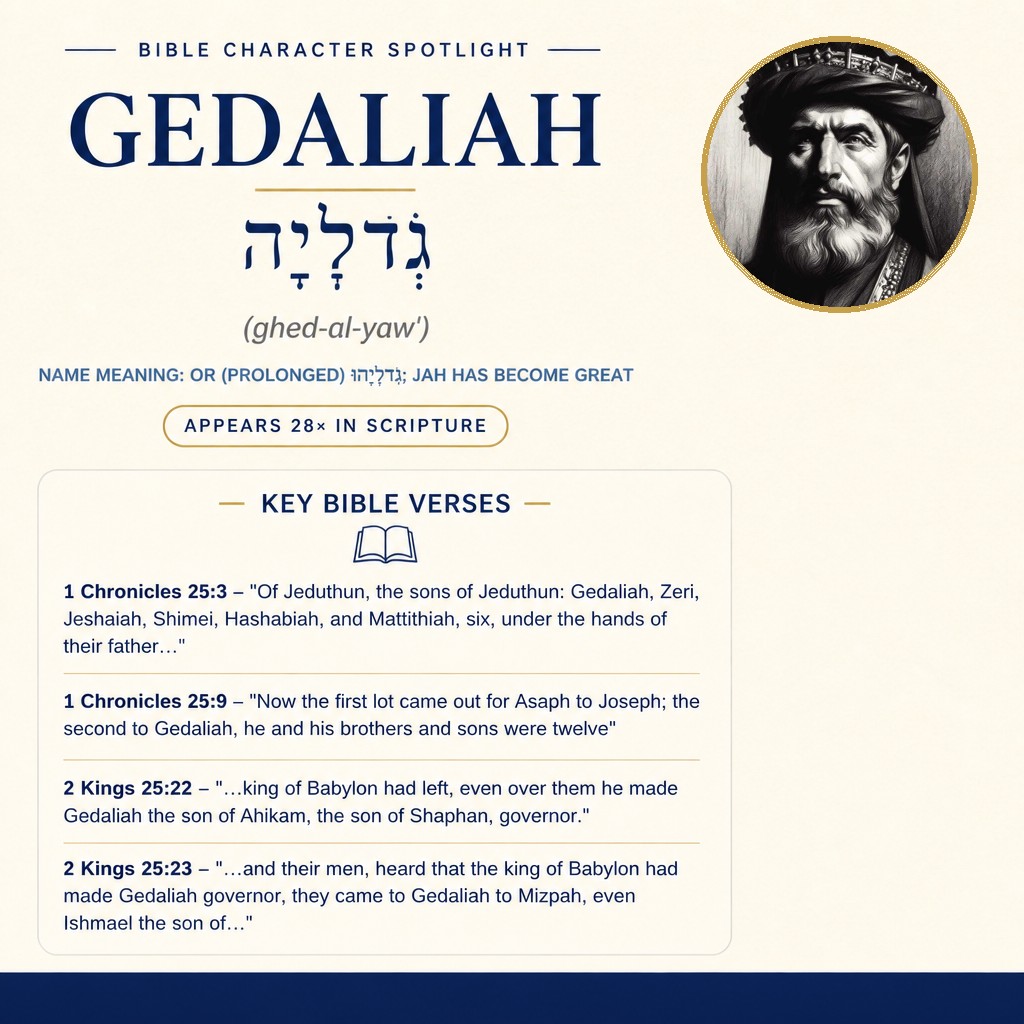
Gedaliah in Scripture
In 1 Chronicles, Gedaliah appears among the sons of Jeduthun associated with music and prophecy in worship:
“Of Jeduthun, the sons of Jeduthun: Gedaliah, Zeri, Jeshaiah, Shimei, Hashabiah, and Mattithiah, six, under the hands of their father Jeduthun, who prophesied in giving thanks and praising Yahweh with the harp.” (1 Chronicles 25:3, WEB)
In the same chapter, a Gedaliah is named in the casting of lots:
“Now the first lot came out for Asaph to Joseph; the second to Gedaliah, he and his brothers and sons were twelve;” (1 Chronicles 25:9, WEB)
Ezra lists a Gedaliah among priests found to have married foreign women:
“Among the sons of the priests there were found who had married foreign women: of the sons of Jeshua, the son of Jozadak, and his brothers, Maaseiah, and Eliezer, and Jarib, and Gedaliah.” (Ezra 10:18, WEB)
The best-developed narrative concerns Gedaliah “the son of Ahikam, the son of Shaphan,” especially in the concluding chapter of 2 Kings and in Jeremiah. 2 Kings 25 sets the setting by describing Jerusalem under siege, the city’s fall, and the carrying away of captives, while also stating that “some of the poorest of the land” were left behind to work the land (2 Kings 25:12). After this upheaval, authority over the remaining population is assigned:
“As for the people who were left in the land of Judah, whom Nebuchadnezzar king of Babylon had left, even over them he made Gedaliah the son of Ahikam, the son of Shaphan, governor.” (2 Kings 25:22, WEB)
When news spread that Gedaliah had been appointed governor, military leaders came to him at Mizpah:
“Now when all the captains of the forces, they and their men, heard that the king of Babylon had made Gedaliah governor, they came to Gedaliah to Mizpah, even Ishmael the son of Nethaniah, and Johanan the son of Kareah, and Seraiah the son of Tanhumeth the Netophathite, and Jaazaniah the son of the Maacathite, they and their men.” (2 Kings 25:23, WEB)
Gedaliah responded by oath and by urging them to settle and submit without fear:
“Gedaliah swore to them and to their men, and said to them, ‘Don’t be afraid because of the servants of the Chaldeans. Dwell in the land, and serve the king of Babylon, and it will be well with you.’” (2 Kings 25:24, WEB)
However, the narrative quickly turns to violence against him:
“But in the seventh month, Ishmael the son of Nethaniah, the son of Elishama, of the royal offspring came, and ten men with him, and struck Gedaliah, so that he died, with the Jews and the Chaldeans that were with him at Mizpah.” (2 Kings 25:25, WEB)
The chapter then reports the fear-driven response of the population:
“All the people, both small and great, and the captains of the forces, arose, and came to Egypt; for they were afraid of the Chaldeans.” (2 Kings 25:26, WEB)
Jeremiah also presents Gedaliah son of Ahikam son of Shaphan in connection with the prophet Jeremiah’s welfare after Jeremiah’s confinement. After Jeremiah is taken from “the court of the guard,” he is entrusted to Gedaliah:
“they sent, and took Jeremiah out of the court of the guard, and committed him to Gedaliah the son of Ahikam, the son of Shaphan, that he should carry him home. So he lived among the people.” (Jeremiah 39:14, WEB)
Later, Jeremiah 40 records instructions that direct Jeremiah toward Gedaliah, identifying him again as the Babylonian-appointed governor:
“‘Go back then,’ he said, ‘to Gedaliah the son of Ahikam, the son of Shaphan, whom the king of Babylon has made governor over the cities of Judah, and dwell with him among the people; or go wherever it seems right to you to go.’” (Jeremiah 40:5, WEB)
Jeremiah follows that direction:
“Then Jeremiah went to Gedaliah the son of Ahikam to Mizpah, and lived with him among the people who were left in the land.” (Jeremiah 40:6, WEB)
The same chapter aligns with 2 Kings in describing captains in the fields hearing of Gedaliah’s appointment, along with the charge entrusted to him:
“Now when all the captains of the forces who were in the fields, even they and their men, heard that the king of Babylon had made Gedaliah the son of Ahikam governor in the land, and had committed to him men, women, children, and of the poorest of the land, of …” (Jeremiah 40:7, WEB)
It then lists the approach of key figures to Gedaliah at Mizpah:
“then Ishmael the son of Nethaniah, and Johanan and Jonathan the sons of Kareah, and Seraiah the son of Tanhumeth, and the sons of Ephai the Netophathite, and Jezaniah the son of the Maacathite, they and their men came to Gedaliah to Mizpah.” (Jeremiah 40:8, WEB)
Multiple People Named Gedaliah
The lexicon gloss identifies Gedaliah as “the name of five Israelites,” and the cited passages show at least three distinct bearers of the name.
First, in 1 Chronicles 25, a Gedaliah is counted among “the sons of Jeduthun” who were “under the hands of their father Jeduthun,” and he is linked with prophesying “in giving thanks and praising Yahweh with the harp” (1 Chronicles 25:3). A Gedaliah is also connected to a numbered lot alongside “his brothers and sons” (1 Chronicles 25:9).
Second, Ezra names a Gedaliah among “the sons of the priests” who “had married foreign women,” within the group associated with “the sons of Jeshua, the son of Jozadak” (Ezra 10:18).
Third, 2 Kings and Jeremiah describe Gedaliah “the son of Ahikam, the son of Shaphan,” appointed “governor” over those “left in the land of Judah” (2 Kings 25:22) and over “the cities of Judah” (Jeremiah 40:5). Captains came to him at Mizpah (2 Kings 25:23; Jeremiah 40:8); he urged them, “Dwell in the land, and serve the king of Babylon, and it will be well with you” (2 Kings 25:24); and he was later struck down at Mizpah (2 Kings 25:25). Jeremiah was committed to his care and lived among the people with him (Jeremiah 39:14; 40:6).
Name and Meaning
The name is written in Hebrew script as גְּדַּלְיָה, transliterated Gedalyah, and pronounced ghed-al-yaw’. Its derivation is explained as coming from a Hebrew verb meaning to be (or make) large or great together with Yahh (Jah), yielding the sense that Jah has become great.
Observation
Across the passages, the Gedaliah who was made governor is portrayed as seeking stability for those “left in the land,” urging them not to fear and to “serve the king of Babylon,” yet his governorship ends abruptly when he is struck and dies at Mizpah (2 Kings 25:24–25).
Frequently Asked Questions
What does the name Gedaliah mean?
Gedaliah means “Jah has become great.”
How many times does Gedaliah appear in the Bible?
Gedaliah appears 28 times.
Who was Gedaliah in the Bible?
Gedaliah is the name of five Israelites. One Gedaliah is described as “the son of Ahikam” who was made governor over the people left in the land of Judah (2 Kings 25:22).
What happened to Gedaliah after he was made governor?
Ishmael “struck Gedaliah” when he came with ten men (2 Kings 25:25).
Explore Further
If you found this page about Gedaliah interesting and would like to discover more about other biblical characters, explore our comprehensive Encyclopedia of Biblical Characters. For those looking to delve deeper into the Greek origins of these names and terms, our Greek Lexicon is an invaluable resource.
Sources: Name and occurrence data from Strong’s Exhaustive Concordance and STEPBible reference data (CC BY). Scripture quotations from the World English Bible (public domain).





