Who was Elkanah in the bible?
Elkanah is the name of several Israelites mentioned in 1 Samuel 1 and in genealogical and service lists in 1 Chronicles 6, 9, 12, and 15.

In Samuel
In 1 Samuel, Elkanah sacrificed and distributed portions: “he gave to Peninnah his wife, and to all her sons and her daughters, portions;” (1 Samuel 1:4, WEB). He said to Hannah, “Am I not better to you than ten sons?” (1 Samuel 1:8, WEB).
Learn More →In Chronicles
In 1 Chronicles 6, multiple references place Elkanah within Levitical genealogies, including: “The sons of Elkanah: Amasai and Ahimoth.” (1 Chronicles 6:25, WEB). Another Elkanah is listed among those who served with the ark: “Berechiah and Elkanah were doorkeepers for the ark.” (1 Chronicles 15:23, WEB).
Learn More →Elkanah is the name of several Israelites in the Bible; the name is explained in a lexicon as meaning “God has obtained.” In Scripture, different men named Elkanah appear in genealogies and in brief narrative scenes, including one Elkanah connected with sacrificial portions and speech to his wife Hannah.
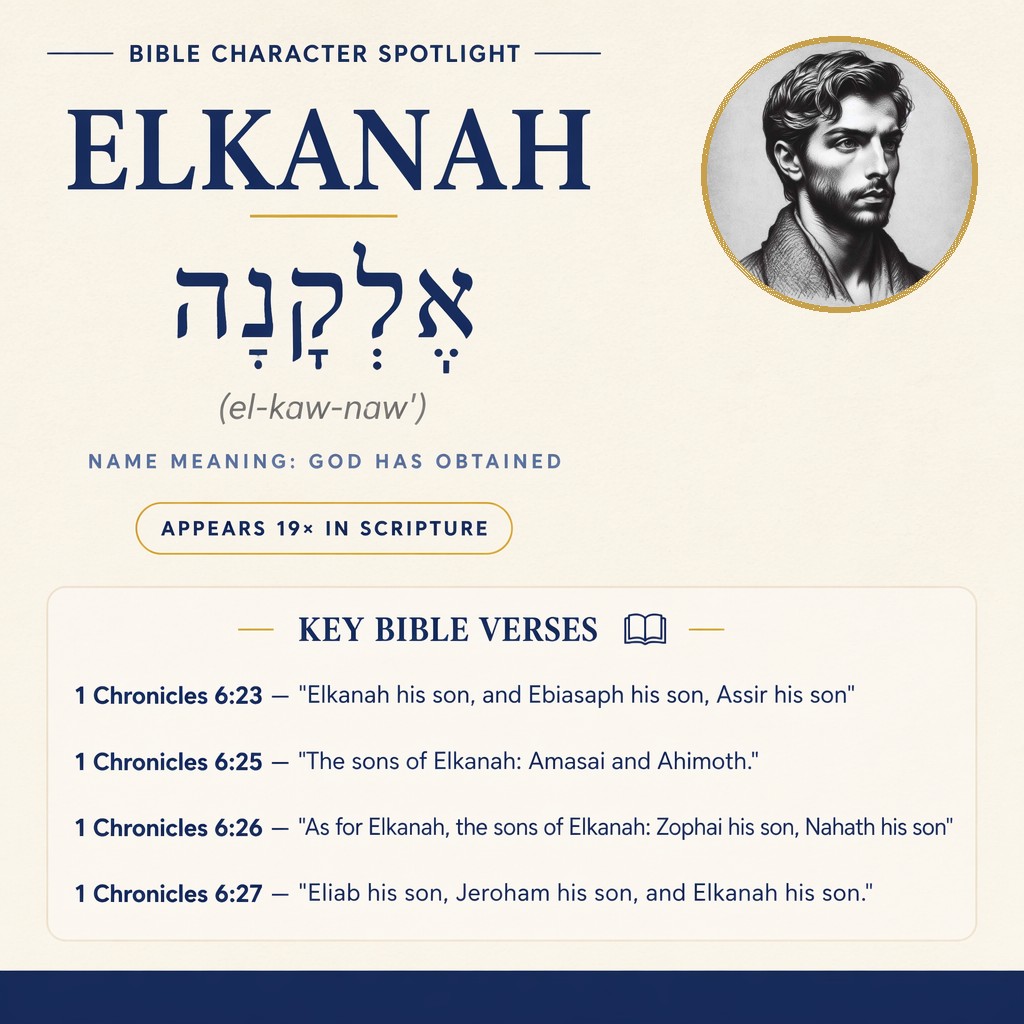
Elkanah in Scripture
In 1 Chronicles 6, Elkanah appears repeatedly within a long register focused on Levi and especially the Kohathite lines, moving from fathers to sons and then into the lines associated with song-service “after the ark came to rest there.” The chapter begins broadly:
The sons of Levi: Gershon, Kohath, and Merari. (1 Chronicles 6:1)
Within the Kohathite sequence, Elkanah first appears as a son within a chain of descent:
Elkanah his son, and Ebiasaph his son, Assir his son, (1 Chronicles 6:23)
The genealogy then identifies sons of an Elkanah:
The sons of Elkanah: Amasai and Ahimoth. (1 Chronicles 6:25)
It continues with another statement about Elkanah’s descendants:
As for Elkanah, the sons of Elkanah: Zophai his son, Nahath his son, (1 Chronicles 6:26)
The same immediate context proceeds through additional names and ends that segment with another Elkanah listed as a son in the chain:
Eliab his son, Jeroham his son, and Elkanah his son. (1 Chronicles 6:27)
After naming “The sons of Samuel,” the chapter turns toward those appointed for music-service connected to Yahweh’s house, describing how the appointed singers “ministered with song” and then giving their descent. In that lineage Elkanah appears as an ancestor within Heman’s line:
These are they whom David set over the service of song in Yahweh’s house, after the ark came to rest there. (1 Chronicles 6:31)
Heman the singer, the son of Joel, the son of Samuel, (1 Chronicles 6:33)
the son of Elkanah, the son of Jeroham, the son of Eliel, the son of Toah, (1 Chronicles 6:34)
the son of Zuph, the son of Elkanah, the son of Mahath, the son of Amasai, (1 Chronicles 6:35)
the son of Elkanah, the son of Joel, the son of Azariah, the son of Zephaniah, (1 Chronicles 6:36)
In these verses, Elkanah functions as a genealogical link in the ancestry given for the line associated with Heman’s song-service, and the name occurs more than once within that ancestry.
Outside 1 Chronicles 6, another Elkanah appears in a brief genealogical notice connected with a man living “in the villages of the Netophathites”:
and Obadiah the son of Shemaiah, the son of Galal, the son of Jeduthun, and Berechiah the son of Asa, the son of Elkanah, who lived in the villages of the Netophathites. (1 Chronicles 9:16)
Here Elkanah is part of the ancestry of Berechiah (“the son of Asa, the son of Elkanah”), and the verse adds the locality note for Berechiah (“who lived in the villages of the Netophathites”).
Elkanah is also named among “the Korahites” in a list of men:
Elkanah, Isshiah Azarel, Joezer, and Jashobeam, the Korahites; (1 Chronicles 12:6)
In 1 Chronicles 15, an Elkanah is identified with a specific duty related to the ark:
Berechiah and Elkanah were doorkeepers for the ark. (1 Chronicles 15:23)
This short statement defines Elkanah’s role as a doorkeeper “for the ark,” paired with Berechiah.
In 1 Samuel 1, Elkanah appears in a narrative setting centered on a day of sacrifice and family distribution of portions. One verse describes his action:
When the day came that Elkanah sacrificed, he gave to Peninnah his wife, and to all her sons and her daughters, portions; (1 Samuel 1:4)
In the same chapter he is also shown speaking directly to Hannah, described as “her husband”:
Elkanah her husband said to her, “Hannah, why do you weep? Why don’t you eat? Why is your heart grieved? Am I not better to you than ten sons?” (1 Samuel 1:8)
These verses present Elkanah as a man who participates in sacrifice, distributes portions within his household, and addresses Hannah with questions about her grief, ending with his rhetorical comparison, “Am I not better to you than ten sons?”
Multiple bearers
The name Elkanah belongs to multiple Israelites, and the biblical occurrences supplied show distinct settings. In 1 Chronicles 6, Elkanah appears within Levitical/Kohathite genealogies and within the ancestry of Heman the singer, with multiple Elkanahs occurring in that chain (“Elkanah his son,” “The sons of Elkanah,” and “the son of Elkanah” in the line). In 1 Chronicles 9:16, Elkanah is an ancestor of Berechiah (“the son of Asa, the son of Elkanah”), with Berechiah connected to “the villages of the Netophathites.” In 1 Chronicles 12:6, Elkanah is listed among “the Korahites.” In 1 Chronicles 15:23, an Elkanah serves as a “doorkeeper[] for the ark.” In 1 Samuel 1:4, 8, an Elkanah sacrifices, distributes portions to “Peninnah his wife, and to all her sons and her daughters,” and speaks to Hannah as “her husband.”
Name and Meaning
Elkanah is written in Hebrew as אֶלְקָנָה, transliterated ‘Elqanah and pronounced el-kaw-naw’. A lexicon derives it from words paraphrased as ’el (אֵל), “strength,” used as an adjective for “mighty,” and qanah (קָנָה), “to erect,” extended to “create,” yielding the sense “God has obtained.”
Observation
Across the passages, Elkanah is remembered both as a name embedded in long family lines (especially in the Levitical records of 1 Chronicles 6) and as a figure with defined actions and words: “When the day came that Elkanah sacrificed” (1 Samuel 1:4) and “Elkanah her husband said to her” (1 Samuel 1:8).
Frequently Asked Questions
What does the name Elkanah mean?
Elkanah means “God has obtained.”
How many times does Elkanah appear in the Bible?
Elkanah appears 19 times.
Who was Elkanah in the Bible?
Elkanah is the name of several Israelites. In 1 Samuel 1:4 and 1 Samuel 1:8, Elkanah is described as Hannah’s husband and Peninnah’s husband.
What is one specific event Elkanah is described doing?
In 1 Samuel 1:4, Elkanah sacrifices and gives portions to Peninnah his wife and to all her sons and daughters.
Explore Further
If you found this page about Elkanah interesting and would like to discover more about other biblical characters, explore our comprehensive Encyclopedia of Biblical Characters. For those looking to delve deeper into the Greek origins of these names and terms, our Greek Lexicon is an invaluable resource.
Sources: Name and occurrence data from Strong’s Exhaustive Concordance and STEPBible reference data (CC BY). Scripture quotations from the World English Bible (public domain).