Who was Chuza in the bible?
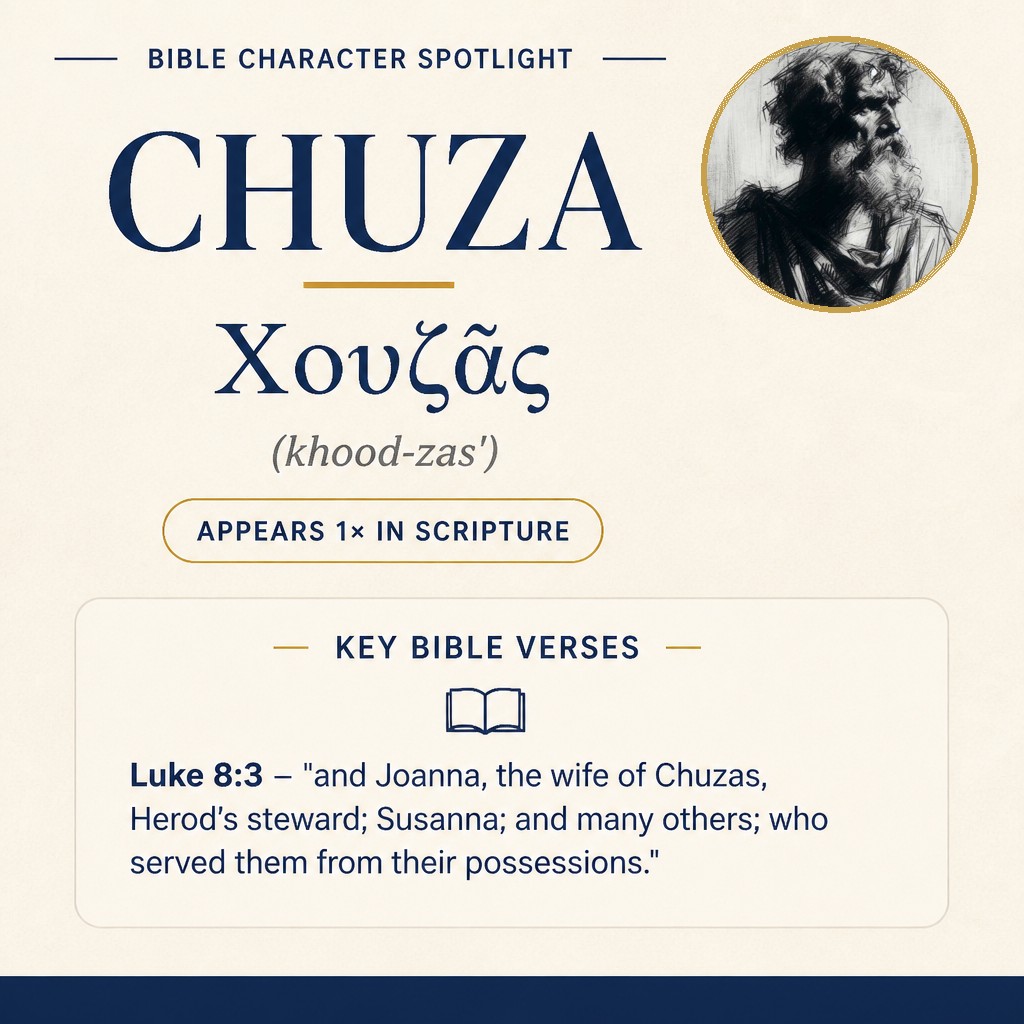
Chuza is mentioned once in Scripture as the husband of Joanna in Luke 8:3, where he is identified in connection with Herod’s steward.

Where Mentioned
Chuza appears only in a list of women associated with Jesus’ ministry travels (Luke 8:1–3).
Learn More →Name and Origin
Strong’s Greek G5529 (Chouzas) lists the name’s origin as uncertain and glosses it as Chuza.
Learn More →Chuza (Greek Chouzas) is a man mentioned in the Gospel of Luke as the husband of Joanna and as “Herod’s steward” (Luke 8:3). The name’s origin is described in one lexicon entry as uncertain.
Chuza in Scripture
Chuza appears only within Luke’s description of the people who accompanied Jesus during an itinerant preaching ministry. Luke sets the scene by describing Jesus moving from place to place announcing God’s kingdom, and he names those traveling with him.
“Soon afterwards, he went about through cities and villages, preaching and bringing the good news of God’s Kingdom. With him were the twelve,” (Luke 8:1).
Immediately after introducing this setting, Luke adds that certain women were present who had experienced healing.
“and certain women who had been healed of evil spirits and infirmities: Mary who was called Magdalene, from whom seven demons had gone out;” (Luke 8:2).
Within the same list, Chuza is brought into view indirectly, by way of Joanna’s identification. Luke does not record Chuza speaking or acting in this passage; rather, Chuza is identified by his role in relation to Herod, and Joanna is identified by her relationship to him.
“and Joanna, the wife of Chuzas, Herod’s steward; Susanna; and many others; who served them from their possessions.” (Luke 8:3).
From this statement, two details are explicitly given about Chuza: first, that Joanna is “the wife of Chuzas,” and second, that Chuza is “Herod’s steward.” Luke’s narrative emphasis, however, falls on the group as a whole—Joanna, Susanna, and “many others”—and on their material support: they “served them from their possessions” (Luke 8:3). Chuza’s name functions in the sentence as part of Joanna’s description, situating her by marital connection to a man who held an administrative post.
After naming these people and describing their service, Luke continues the same scene by describing crowds gathering and Jesus teaching by parable. The narrative shifts from identifying companions and supporters to reporting Jesus’ instruction when “a great multitude” converged on him.
“When a great multitude came together, and people from every city were coming to him, he spoke by a parable.” (Luke 8:4).
Jesus then gives the parable of a farmer sowing seed, detailing multiple outcomes according to where the seed falls. He describes seed that is destroyed on the road, seed that withers on rock, seed choked among thorns, and seed that flourishes in “good ground,” yielding abundantly. Luke reports Jesus’ closing call for attention.
“The farmer went out to sow his seed. As he sowed, some fell along the road, and it was trampled under foot, and the birds of the sky devoured it.” (Luke 8:5).
“Other fell into the good ground, and grew, and produced one hundred times as much fruit.” (Luke 8:8).
“As he said these things, he called out, ‘He who has ears to hear, let him hear!’” (Luke 8:8).
Luke then records that the disciples asked for the meaning of the parable, and Jesus explains the purpose of parables in terms of what is “given” to the disciples versus “the rest.”
“Then his disciples asked him, ‘What does this parable mean?’” (Luke 8:9).
“He said, ‘To you it is given to know the mysteries of God’s Kingdom, but to the rest in parables; that ‘seeing they may not see, and hearing they may not understand.’’” (Luke 8:10).
Jesus further interprets the parable by identifying the seed: “the seed is the word of God” (Luke 8:11). He explains one of the negative outcomes—those along the road—as people who hear, but then the devil removes the word “from their heart.”
“Now the parable is this: The seed is the word of God.” (Luke 8:11).
“Those along the road are those who hear, then the devil comes, and takes away the word from their heart, that they may not believe and be saved.” (Luke 8:12).
Within this chapter segment, Chuza is not named again. His sole appearance remains Luke 8:3, where he is mentioned in connection with Joanna and identified by his stewardship under Herod.
Name and Meaning
In Greek script Chuza’s name is Χουζᾶς, transliterated Chouzas and pronounced khood-zas’. One lexicon entry describes the name as being of uncertain origin.
Observation
Luke’s only reference to Chuza occurs in a context emphasizing Jesus’ public proclamation of “the good news of God’s Kingdom” (Luke 8:1) and the practical support given by named individuals and “many others; who served them from their possessions” (Luke 8:3).
Frequently Asked Questions
What does the name Chuza mean?
Chuza is given as the name form “Chuza,” with an uncertain origin.
How many times does Chuza appear in the Bible?
Chuza appears 1 time.
Who was Chuza?
Chuza is mentioned in Luke 8:3 as Joanna’s husband and as Herod’s steward.
Where is Chuza mentioned?
Chuza is mentioned in Luke 8:3.
Explore Further
If you found this page about Chuza interesting and would like to discover more about other biblical characters, explore our comprehensive Encyclopedia of Biblical Characters. For those looking to delve deeper into the Greek origins of these names and terms, our Greek Lexicon is an invaluable resource.
Sources: Name and occurrence data from Strong’s Exhaustive Concordance and STEPBible reference data (CC BY). Scripture quotations from the World English Bible (public domain).