Who was Bilhan in the bible?
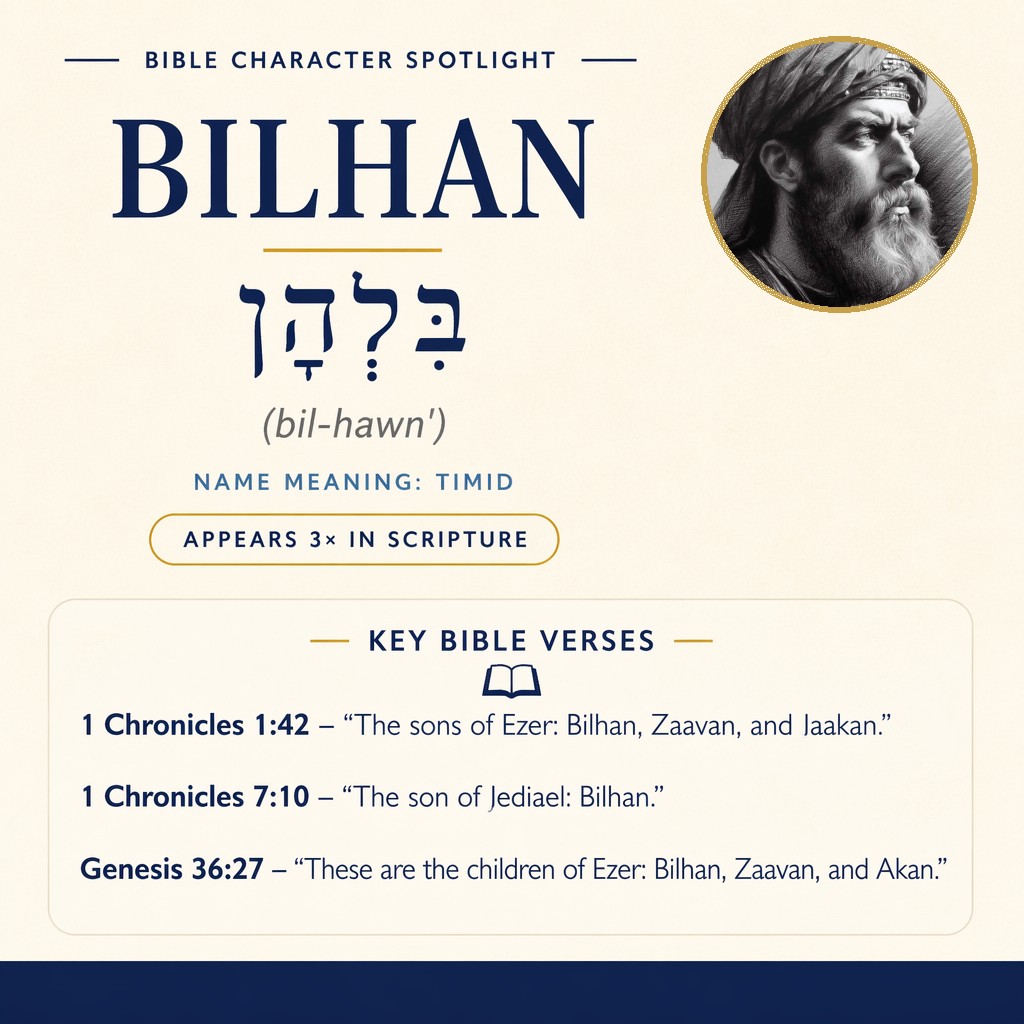
Bilhan is the name of an Edomite and an Israelite, appearing in Genesis 36:27, 1 Chronicles 1:42, and 1 Chronicles 7:10.
Israelite Line
In a separate genealogy, “The son of Jediael: Bilhan” (1 Chronicles 7:10). “The sons of Bilhan: Jeush, Benjamin, Ehud, Chenaanah, Zethan, Tarshish, and Ahishahar” (1 Chronicles 7:10).
Learn More →Name Meaning
Strong’s derives the name Bilhan from a root meaning “timid.” The lexicon gloss identifies Bilhan as the name of an Edomite and of an Israelite.
Learn More →Bilhan is a biblical name borne by more than one person: an Edomite (in a Horite/Edom genealogy) and an Israelite (in a tribal genealogy). Strong’s derivation connects the name with the sense of being “timid,” linked to a Hebrew root associated with palpitating or trembling.
Bilhan in Scripture
The name Bilhan appears first in a genealogy connected with Seir and Edom. In Genesis, Bilhan is listed among the descendants of Ezer:
“These are the children of Ezer: Bilhan, Zaavan, and Akan.” (Genesis 36:27)
This statement sits within a longer chain of names that situates Ezer among chiefs and families associated with “the land of Seir.” Immediately around Bilhan’s mention, Genesis frames multiple related lines of descent and then summarizes leading figures:
“These are the children of Dishon: Hemdan, Eshban, Ithran, and Cheran.” (Genesis 36:26)
“These are the children of Ezer: Bilhan, Zaavan, and Akan.” (Genesis 36:27)
“These are the children of Dishan: Uz and Aran.” (Genesis 36:28)
After listing these family branches, the chapter names the “chiefs who came of the Horites” and includes Ezer among them, which provides the broader setting in which Bilhan’s father (or ancestor line) is counted:
“These are the chiefs who came of the Horites: chief Lotan, chief Shobal, chief Zibeon, chief Anah,
chief Dishon, chief Ezer, and chief Dishan. These are the chiefs who came of the Horites, according to their chiefs in the land of Seir.” (Genesis 36:29–30)
Chronicles preserves a parallel genealogical notice, also naming Bilhan as one of Ezer’s sons, but with a slightly different spelling for one of the brothers in that list. In 1 Chronicles, Bilhan again appears in an Edom-related register:
“The sons of Ezer: Bilhan, Zaavan, and Jaakan. The sons of Dishan: Uz and Aran.” (1 Chronicles 1:42)
The surrounding verses in 1 Chronicles 1 set this within a sequence of genealogies that flow through several families before moving into a notice about kings in Edom. The immediate context leading into Bilhan’s appearance mentions other lines (Shobal, Zibeon, Anah, Dishon) before reaching Ezer:
“The sons of Shobal: Alian, Manahath, Ebal, Shephi, and Onam. The sons of Zibeon: Aiah and Anah.” (1 Chronicles 1:40)
“The son of Anah: Dishon. The sons of Dishon: Hamran, Eshban, Ithran, and Cheran.” (1 Chronicles 1:41)
“The sons of Ezer: Bilhan, Zaavan, and Jaakan. The sons of Dishan: Uz and Aran.” (1 Chronicles 1:42)
After this, the Chronicler transitions from listing family lines to naming rulers in Edom, reinforcing that the genealogy is tied to that region and people:
“Now these are the kings who reigned in the land of Edom, before any king reigned over the children of Israel: Bela the son of Beor; and the name of his city was Dinhabah.” (1 Chronicles 1:43)
In addition to this Edomite bearer of the name, another Bilhan appears in a different genealogical setting: a line within Israel. In the tribal listings of 1 Chronicles 7, Bilhan is named as a son of Jediael, and then Bilhan’s own sons are listed:
“The son of Jediael: Bilhan. The sons of Bilhan: Jeush, Benjamin, Ehud, Chenaanah, Zethan, Tarshish, and Ahishahar.” (1 Chronicles 7:10)
The immediate context presents these names within a genealogical and military framework, describing the listed families as strong fighters and providing numbers. The Chronicler first gives the sons of Becher and describes their registration in genealogies, then proceeds to Jediael and his line:
“The sons of Becher: Zemirah, Joash, Eliezer, Elioenai, Omri, Jeremoth, Abijah, Anathoth, and Alemeth. All these were the sons of Becher.” (1 Chronicles 7:8)
“They were listed by genealogy, after their generations, heads of their fathers’ houses, mighty men of valor, twenty thousand two hundred.” (1 Chronicles 7:9)
“The son of Jediael: Bilhan. The sons of Bilhan: Jeush, Benjamin, Ehud, Chenaanah, Zethan, Tarshish, and Ahishahar.” (1 Chronicles 7:10)
Continuing from Bilhan’s listing, the chapter gathers “all these” under the broader house of Jediael and repeats the theme of military capability, which places Bilhan’s descendants within that counted strength:
“All these were sons of Jediael, according to the heads of their fathers’ households, mighty men of valor, seventeen thousand two hundred, who were able to go out in the army for war.” (1 Chronicles 7:11)
Multiple Bearers
Scripture uses the name Bilhan for at least two distinct individuals.
1) Bilhan in the Edomite/Horite line: In Genesis 36 and 1 Chronicles 1, Bilhan is identified as one of the “children” or “sons” of Ezer:
“These are the children of Ezer: Bilhan, Zaavan, and Akan.” (Genesis 36:27)
“The sons of Ezer: Bilhan, Zaavan, and Jaakan.” (1 Chronicles 1:42)
Within the same immediate Genesis context, Ezer is listed among “the chiefs who came of the Horites … in the land of Seir” (Genesis 36:29–30), and the Chronicles context continues into “the land of Edom” (1 Chronicles 1:43).
2) Bilhan in an Israelite genealogy: In 1 Chronicles 7, Bilhan is a son of Jediael and the father of seven named sons:
“The son of Jediael: Bilhan. The sons of Bilhan: Jeush, Benjamin, Ehud, Chenaanah, Zethan, Tarshish, and Ahishahar.” (1 Chronicles 7:10)
In this context, the line is included among those described as “mighty men of valor” and “able to go out in the army for war” (1 Chronicles 7:9–11), which is the only characterization attached to this genealogical listing.
Name and Meaning
The name is written in Hebrew as בִּלְהָן, transliterated Bilhan and pronounced bil-hawn’. Strong’s derivation connects it to a Hebrew root (H1089) and explains it with the sense “timid,” associating that root with the idea of palpitating or trembling.
Brief Observation
Across the passages where it occurs, Bilhan is presented through genealogy: once as a descendant of Ezer in lists tied to “the land of Seir” and “the land of Edom” (Genesis 36:29–30; 1 Chronicles 1:43), and once as part of a counted Israelite line described as “mighty men of valor” (1 Chronicles 7:9–11).
Frequently Asked Questions
What does the name Bilhan mean?
The name Bilhan is said to mean “timid.”
How many times does Bilhan appear in the Bible?
Bilhan appears 3 times.
Who was Bilhan in the Bible?
Bilhan is given as the name of an Edomite and also the name of an Israelite. He is listed among the children of Ezer (Genesis 36:27; 1 Chronicles 1:42), and also appears in a genealogy as the son of Jediael and the father of several sons (1 Chronicles 7:10).
Where is Bilhan listed among the children of Ezer?
Bilhan is named as one of Ezer’s children in Genesis 36:27 and 1 Chronicles 1:42.
Explore Further
If you found this page about Bilhan interesting and would like to discover more about other biblical characters, explore our comprehensive Encyclopedia of Biblical Characters. For those looking to delve deeper into the Greek origins of these names and terms, our Greek Lexicon is an invaluable resource.
Sources: Name and occurrence data from Strong’s Exhaustive Concordance and STEPBible reference data (CC BY). Scripture quotations from the World English Bible (public domain).