Who was Bethlehem in the bible?
Bethlehem (Beth-Lechem) is a place in Palestine mentioned in 1 Samuel and 1 Chronicles, including David’s well of Bethlehem “by the gate” (1 Chronicles 11:17).
In David’s Days
“The garrison of the Philistines was in Bethlehem at that time” (1 Chronicles 11:16). David said, “Oh that one would give me water to drink from the well of Bethlehem, which is by the gate!” (1 Chronicles 11:17).
Learn More →In Samuel’s Visit
“Samuel did that which Yahweh spoke, and came to Bethlehem” (1 Samuel 16:4). “The elders of the city came to meet him trembling” (1 Samuel 16:4).
Learn More →Bethlehem (Beth-Lechem) is presented in these passages as a place in Palestine. Its Hebrew name is explained (by lexicon gloss) as meaning “house of bread.”
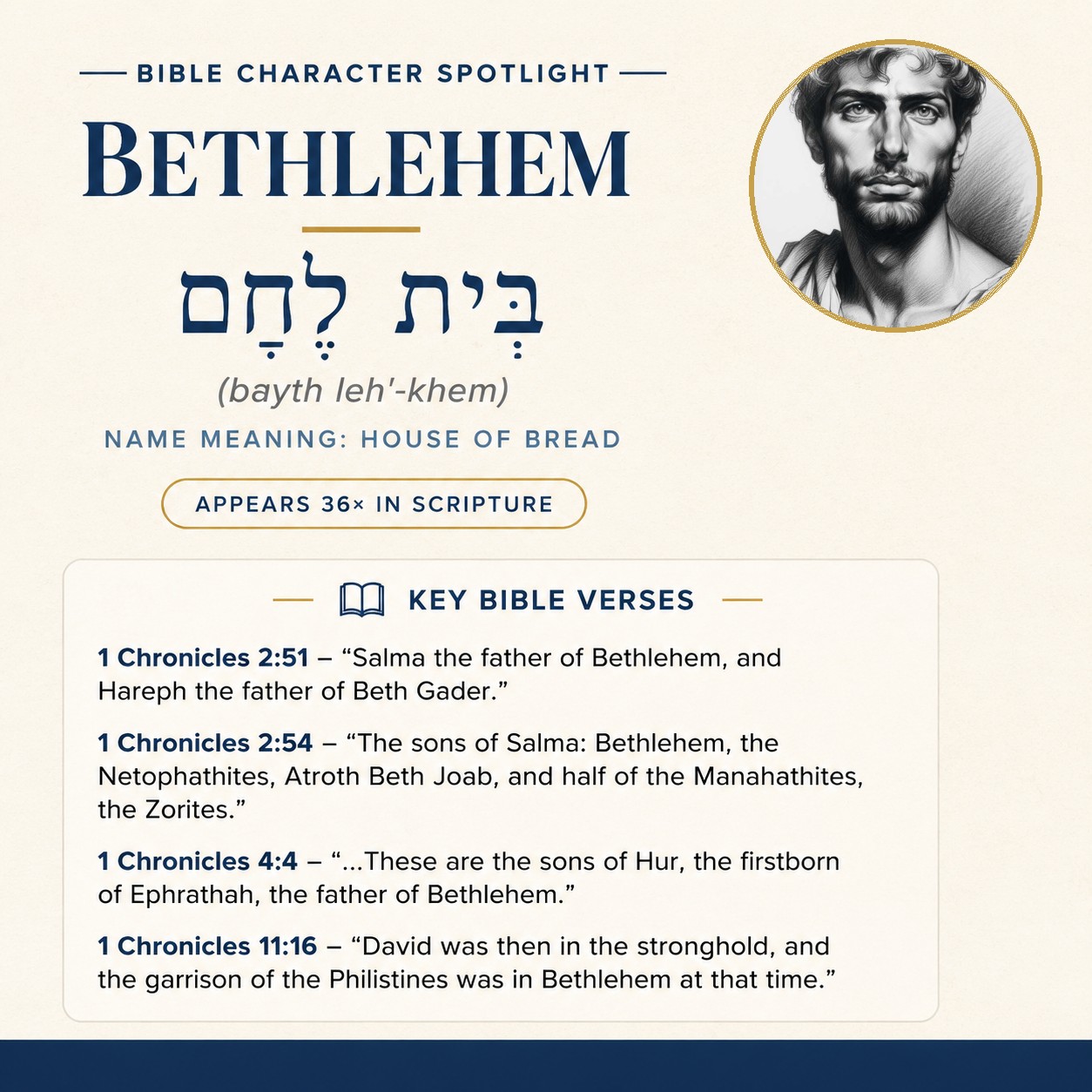
Bethlehem in Scripture
In Chronicles, “Bethlehem” appears in genealogical notices connected with family lines. One notice states:
“Salma the father of Bethlehem, and Hareph the father of Beth Gader.” (1 Chronicles 2:51, WEB)
A later verse lists “Bethlehem” again among descendants associated with Salma:
“The sons of Salma: Bethlehem, the Netophathites, Atroth Beth Joab, and half of the Manahathites, the Zorites.” (1 Chronicles 2:54, WEB)
Another genealogy connects Bethlehem with Hur and Ephrathah:
“Penuel was the father of Gedor and Ezer the father of Hushah. These are the sons of Hur, the firstborn of Ephrathah, the father of Bethlehem.” (1 Chronicles 4:4, WEB)
In Samuel, Bethlehem appears as a city to which Samuel traveled and whose elders responded with fear:
“Samuel did that which Yahweh spoke, and came to Bethlehem. The elders of the city came to meet him trembling, and said, ‘Do you come peaceably?’” (1 Samuel 16:4, WEB)
Bethlehem is also used to locate Jesse and David:
“Now David was the son of that Ephrathite of Bethlehem Judah, whose name was Jesse; and he had eight sons. The man was an elderly old man in the days of Saul.” (1 Samuel 17:12, WEB)
David is described as moving between Saul and Bethlehem, where his father’s sheep were kept:
“Now David went back and forth from Saul to feed his father’s sheep at Bethlehem.” (1 Samuel 17:15, WEB)
Later, Bethlehem is mentioned as David’s city and as the location of a family sacrifice:
“If your father misses me at all, then say, ‘David earnestly asked leave of me that he might run to Bethlehem his city; for it is the yearly sacrifice there for all the family.’” (1 Samuel 20:6, WEB)
“Jonathan answered Saul, ‘David earnestly asked permission of me to go to Bethlehem.’” (1 Samuel 20:28, WEB)
In 1 Chronicles 11, Bethlehem appears in a narrative episode set within the account of David’s reign and the list of his mighty men. The chapter first describes how “all Israel” came to David at Hebron, recalling that Yahweh had said to David, “You shall be shepherd of my people Israel, and you shall be prince over my people Israel.” (1 Chronicles 11:1–2, WEB). The elders came, “David made a covenant with them in Hebron before Yahweh; and they anointed David king over Israel, according to Yahweh’s word by Samuel.” (1 Chronicles 11:3, WEB). It then recounts David’s capture of Jerusalem (Jebus) and his establishment there, with David living “in the stronghold,” and the city being called “David’s city.” (1 Chronicles 11:4–9, WEB). The chapter proceeds to identify leading warriors who “showed themselves strong with him in his kingdom” (1 Chronicles 11:10, WEB), including a list of “the mighty men.”
Within that setting, Bethlehem is named as a location occupied by hostile forces at a particular time. The text says:
“David was then in the stronghold, and the garrison of the Philistines was in Bethlehem at that time.” (1 Chronicles 11:16, WEB)
While David was in the stronghold, he expressed a desire connected to a specific feature of Bethlehem:
“David longed, and said, ‘Oh that one would give me water to drink from the well of Bethlehem, which is by the gate!’” (1 Chronicles 11:17, WEB)
Three of the warriors responded by breaking through the Philistine force and drawing water from the well named by David. The narrative emphasizes both the risk taken and David’s response:
“The three broke through the army of the Philistines, and drew water out of the well of Bethlehem, that was by the gate, and took it, and brought it to David; but David would not drink any of it, but poured it out to Yahweh,” (1 Chronicles 11:18, WEB)
“and said, ‘My God forbid me, that I should do this! Shall I drink the blood of these men who have put their lives in jeopardy?’ For they risked their lives to bring it. Therefore he would not drink it. The three mighty men did these things.” (1 Chronicles 11:19, WEB)
Thus Bethlehem is portrayed not only as a city with “a garrison of the Philistines” (1 Chronicles 11:16) but also as a city with “the well of Bethlehem, which is by the gate” (1 Chronicles 11:17), which becomes the focus of a notable act of bravery and David’s refusal to drink what was obtained at such risk.
In the same chapter’s list of mighty men, Bethlehem appears as an identifying origin for at least one warrior:
“The mighty men of the armies also include Asahel the brother of Joab, Elhanan the son of Dodo of Bethlehem,” (1 Chronicles 11:26, WEB)
Name and Meaning
The name is written in Hebrew as בֵּית לֶחֶם (transliterated Beyth Lechem, pronounced bayth leh’-khem). According to the lexicon derivation provided, it is formed from the Hebrew words bayith, meaning “a house,” and lechem, meaning food, especially bread, yielding the sense “house of bread.” The identity gloss describes Beth-Lechem as a place in Palestine.
Observation
Across these passages, Bethlehem is tied to both civic life—its “elders of the city” (1 Samuel 16:4) and “the yearly sacrifice there for all the family” (1 Samuel 20:6)—and to conflict and valor, as when “the garrison of the Philistines was in Bethlehem” and yet the “three broke through the army of the Philistines” to draw water from “the well of Bethlehem, that was by the gate” (1 Chronicles 11:16–18).
Frequently Asked Questions
What does the name Bethlehem mean?
Bethlehem means “house of bread.”
How many times does Bethlehem appear in the Bible?
Bethlehem occurs 36 times.
Who was Bethlehem?
Bethlehem (Beth-Lechem) is a place in Palestine. It is mentioned as a city, including “Bethlehem Judah” connected with Jesse and David (1 Samuel 17:12).
What happened at the well of Bethlehem?
David said, “Oh that one would give me water to drink from the well of Bethlehem, which is by the gate!” (1 Chronicles 11:17). Three men broke through the Philistine army and drew water from that well and brought it to David (1 Chronicles 11:18).
Explore Further
If you found this page about Bethlehem interesting and would like to discover more about other biblical characters, explore our comprehensive Encyclopedia of Biblical Characters. For those looking to delve deeper into the Greek origins of these names and terms, our Greek Lexicon is an invaluable resource.
Sources: Name and occurrence data from Strong’s Exhaustive Concordance and STEPBible reference data (CC BY). Scripture quotations from the World English Bible (public domain).