Who was Aristarchus in the bible?
Aristarchus was a Macedonian from Thessalonica, Paul’s companion in travel, mentioned in Acts 19:29; 20:4; 27:2; Colossians 4:10; and Philemon 1:24.

Where He Appears
In Ephesus, a crowd seized “Gaius and Aristarchus” during a citywide confusion (Acts 19:29). He also traveled with Paul’s group “as far as Asia” (Acts 20:4) and sailed with him (Acts 27:2).
Learn More →Paul’s Associate
Paul writes, “Aristarchus, my fellow prisoner, greets you” (Colossians 4:10). He is also named among Paul’s “fellow workers” (Philemon 1:24).
Learn More →Aristarchus is a man named in the New Testament as one of Paul’s associates, described as a Macedonian and connected with Thessalonica. Lexicon information derives his Greek name from components associated with an early meal and being first.
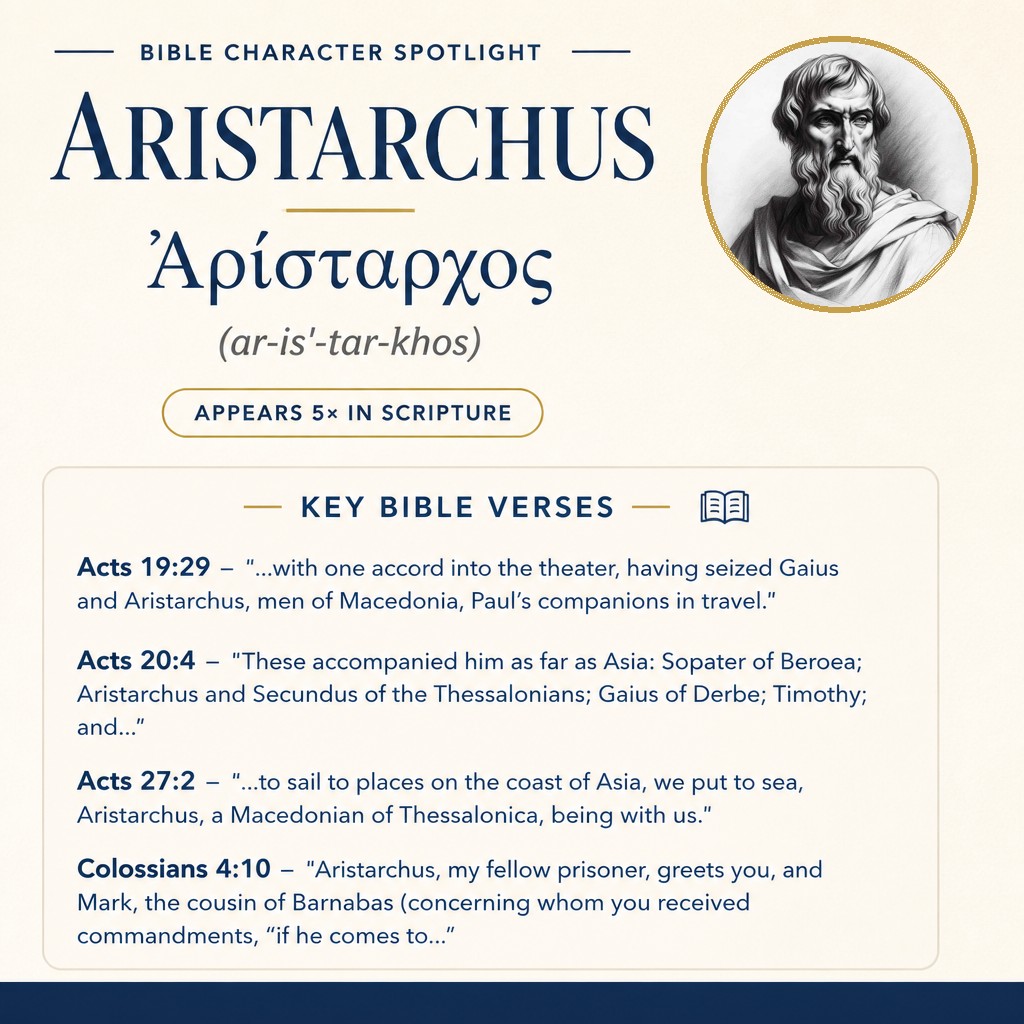
Aristarchus in Scripture
Aristarchus first appears during a public disturbance in Ephesus connected with opposition to “the Way.” In Acts 19, Paul is depicted teaching for an extended time, with the narrative describing how “all those who lived in Asia heard the word of the Lord Jesus” (Acts 19:10), and how “the word of the Lord was growing and becoming mighty” (Acts 19:20). After this, the chapter turns to a civic uproar.
A silversmith named Demetrius gathers craftsmen and argues that Paul’s teaching threatens both their trade and the status of Artemis (Acts 19:24–27). The crowd reacts loudly, and the situation escalates into confusion and a rushed seizure of Paul’s traveling companions.
“The whole city was filled with confusion, and they rushed with one accord into the theater, having seized Gaius and Aristarchus, men of Macedonia, Paul’s companions in travel.” (Acts 19:29)
In the same scene, Paul wants to enter the public gathering, but “the disciples didn’t allow him” (Acts 19:30). Others also urge caution (Acts 19:31). The assembly itself is described as chaotic: “Some therefore cried one thing, and some another, for the assembly was in confusion. Most of them didn’t know why they had come together.” (Acts 19:32). After extended shouting—“for a time of about two hours” (Acts 19:34)—the town clerk quiets the crowd and argues that legal channels exist if there are charges to be brought (Acts 19:35–39). He warns of the danger of being accused “concerning today’s riot” without cause (Acts 19:40) and then dismisses the assembly (Acts 19:41). Within this narrative, Aristarchus is identified as Macedonian and as one of those seized in the theater amid the uproar.
Later, Aristarchus is named among those who traveled with Paul as far as Asia. Here, the text links him specifically with Thessalonica.
“These accompanied him as far as Asia: Sopater of Beroea; Aristarchus and Secundus of the Thessalonians; Gaius of Derbe; Timothy; and Tychicus and Trophimus of Asia.” (Acts 20:4)
This verse situates Aristarchus within a group of companions representing different places, and it describes him as one of “the Thessalonians” (Acts 20:4).
Aristarchus also appears in the account of a sea voyage, again described as Macedonian and connected to Thessalonica.
“Embarking in a ship of Adramyttium, which was about to sail to places on the coast of Asia, we put to sea, Aristarchus, a Macedonian of Thessalonica, being with us.” (Acts 27:2)
In this setting, Aristarchus is explicitly said to be “a Macedonian of Thessalonica” and is included among those who “put to sea” (Acts 27:2).
In Paul’s letter to the Colossians, Aristarchus sends greetings, and Paul describes him with a particular status in relation to imprisonment.
“Aristarchus, my fellow prisoner, greets you, and Mark, the cousin of Barnabas (concerning whom you received commandments, “if he comes to you, receive him”),” (Colossians 4:10)
Within this line, Aristarchus is called “my fellow prisoner” by Paul and is presented as one who “greets” the recipients (Colossians 4:10).
Finally, in Philemon, Aristarchus appears in a list of people associated with Paul’s work, where Paul calls them “my fellow workers.”
“as do Mark, Aristarchus, Demas, and Luke, my fellow workers.” (Philemon 1:24)
Taken together, these references present Aristarchus as (1) a Macedonian, (2) connected with Thessalonica, (3) a traveling companion of Paul, (4) present with Paul on a voyage, (5) described by Paul as “my fellow prisoner,” and (6) counted among Paul’s “fellow workers.”
Name and Meaning
The Greek form of the name is Ἀρίσταρχος (transliteration: Aristarchos; pronunciation: ar-is’-tar-khos). Lexicon information derives the name from elements related to ariston, an early meal, and archo, to be first.
Observation
Across narrative and letters, Aristarchus is consistently positioned close to Paul—seized in a public riot as “Paul’s companions in travel” (Acts 19:29), traveling among the Thessalonians (Acts 20:4), “being with us” at sea (Acts 27:2), and later greeting churches as Paul’s “fellow prisoner” (Colossians 4:10) and “fellow worker” (Philemon 1:24).
Frequently Asked Questions
What does the name Aristarchus mean?
The name Aristarchus is derived from words meaning “best” and “to rule.”
How many times does Aristarchus appear in the Bible?
Aristarchus appears 5 times.
Who was Aristarchus?
Aristarchus is named as a Macedonian, including being described as “a Macedonian of Thessalonica” (Acts 27:2). He is also called Paul’s “fellow prisoner” (Colossians 4:10) and one of Paul’s “fellow workers” (Philemon 1:24).
Where is Aristarchus described as Paul’s fellow prisoner?
He is called Paul’s “fellow prisoner” in Colossians 4:10.
Explore Further
If you found this page about Aristarchus interesting and would like to discover more about other biblical characters, explore our comprehensive Encyclopedia of Biblical Characters. For those looking to delve deeper into the Greek origins of these names and terms, our Greek Lexicon is an invaluable resource.
Sources: Name and occurrence data from Strong’s Exhaustive Concordance and STEPBible reference data (CC BY). Scripture quotations from the World English Bible (public domain).