
Who was Aner in the bible?
Aner is named as an Amorite allied with Abram in Genesis 14 and as a place listed among Levitical towns in 1 Chronicles 6:70.

Portion Taken
Abram said, “the portion of the men who went with me: Aner, Eshcol, and Mamre. Let them take their portion” (Genesis 14:24).
Learn More →Place Named Aner
“Out of the half-tribe of Manasseh, Aner with its pasture lands” is listed “for the rest of the family of the sons of Kohath” (1 Chronicles 6:70).
Learn More →Aner is a name used in Scripture for (1) an Amorite man associated with Mamre and allied with Abram, and (2) a town in the territory connected with the half-tribe of Manasseh, listed among Levitical allocations. The lexicon entry also associates the name with the idea of a “boy” (from a related Hebrew word).
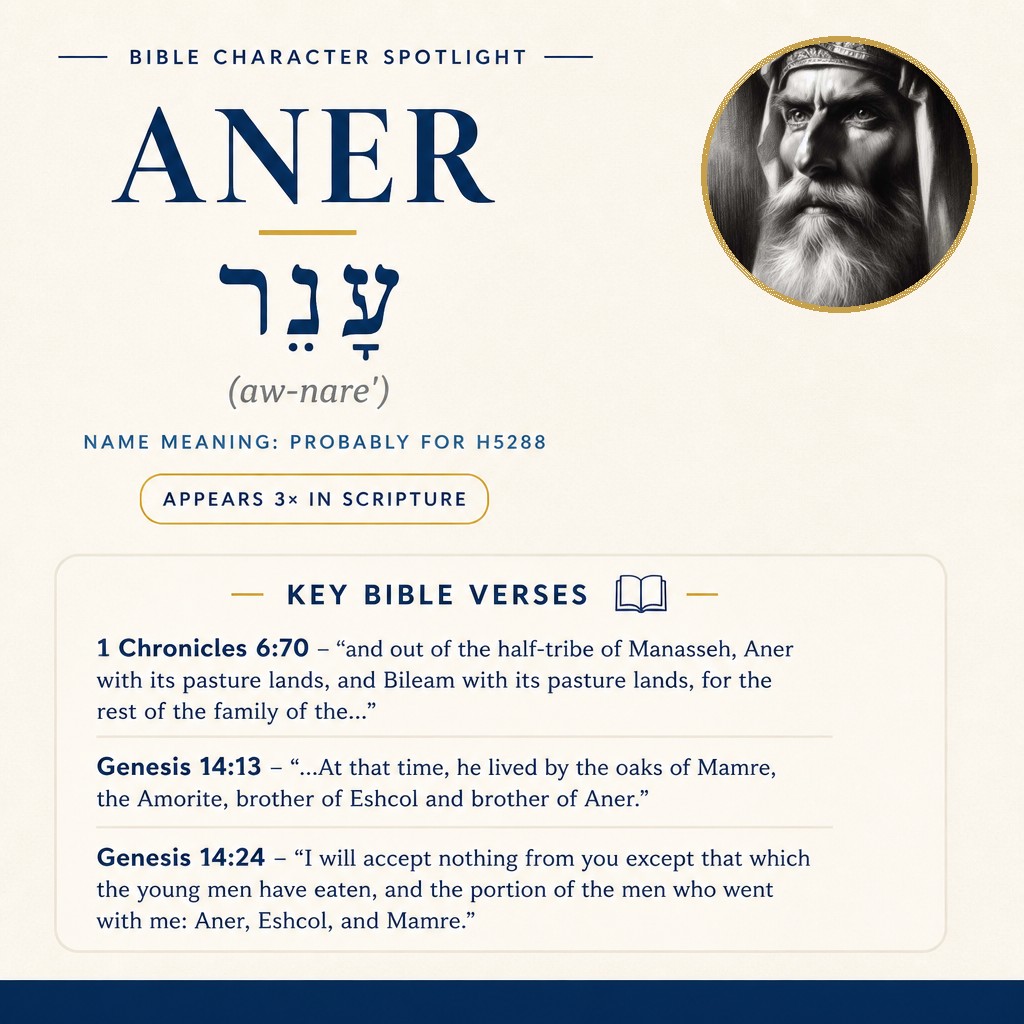
Aner in Scripture
In Genesis 14, Aner appears within the narrative of Abram’s response after Lot is taken captive. The setting begins with the aftermath of a raid:
“They took Lot, Abram’s brother’s son, who lived in Sodom, and his goods, and departed.” (Genesis 14:12, WEB)
News reaches Abram through a survivor, and Aner is introduced by his connection to Mamre and Eshcol and by his political alignment with Abram:
“One who had escaped came and told Abram, the Hebrew. At that time, he lived by the oaks of Mamre, the Amorite, brother of Eshcol and brother of Aner. They were allies of Abram.” (Genesis 14:13, WEB)
Within this chapter’s account, Abram responds immediately upon hearing of the capture. The narrative describes his mobilization and pursuit:
“When Abram heard that his relative was taken captive, he led out his three hundred eighteen trained men, born in his house, and pursued as far as Dan.” (Genesis 14:14, WEB)
Abram’s action continues as a coordinated nighttime strike and pursuit, followed by the recovery of people and goods:
“He divided himself against them by night, he and his servants, and struck them, and pursued them to Hobah, which is on the left hand of Damascus.” (Genesis 14:15, WEB)
“He brought back all the goods, and also brought back his relative Lot and his goods, and the women also, and the other people.” (Genesis 14:16, WEB)
Later in the chapter, after Abram’s success, the narrative turns to Abram’s refusal to enrich himself from the king of Sodom’s goods. He states his oath and his refusal in strong terms:
“Abram said to the king of Sodom, ‘I have lifted up my hand to Yahweh, God Most High, possessor of heaven and earth, that I will not take a thread nor a sandal strap nor anything that is yours, lest you should say, ‘I have made Abram rich.’” (Genesis 14:22–23, WEB)
At that point, Aner appears again, not as a speaker, but as one of the men whose share Abram explicitly protects. Abram distinguishes what he himself will accept from what others may rightly receive:
“I will accept nothing from you except that which the young men have eaten, and the portion of the men who went with me: Aner, Eshcol, and Mamre. Let them take their portion.” (Genesis 14:24, WEB)
Thus, within Genesis 14, Aner is portrayed as an Amorite connected to Mamre and Eshcol, allied with Abram (Genesis 14:13), and counted among “the men who went with” Abram, whose “portion” Abram insists they should receive (Genesis 14:24).
In 1 Chronicles 6, Aner appears not as a person but as a place-name in a list of towns with “pasture lands” given in connection with Levitical families. The immediate context describes towns assigned across tribal territories, and then mentions Aner in relation to the half-tribe of Manasseh:
“and out of the half-tribe of Manasseh, Aner with its pasture lands, and Bileam with its pasture lands, for the rest of the family of the sons of Kohath.” (1 Chronicles 6:70, WEB)
This mention is embedded among other allocations of towns with pasture lands (1 Chronicles 6:68–73). In this context, Aner is simply identified as a town (“Aner with its pasture lands”) included among the places associated with the Kohathite families.
Multiple Bearers
The name Aner refers to two distinct entities in the cited passages. First, it is the name of an Amorite man connected to Mamre and Eshcol: “Mamre, the Amorite, brother of Eshcol and brother of Aner. They were allies of Abram” (Genesis 14:13, WEB). Second, it is the name of a town: “Aner with its pasture lands” (1 Chronicles 6:70, WEB), listed among Levitical town allocations.
Name and Meaning
In the Hebrew script the name is written עָנֵר, transliterated ‘Aner and pronounced “aw-nare.” The lexicon entry connects the name probably to a related Hebrew term (na’ar, נַעַר), which can refer concretely to a boy (viewed as active).
Observation
In Genesis 14, Aner is remembered in a brief but concrete way: he is named among Abram’s allies and among those for whom Abram insists, “Let them take their portion” (Genesis 14:24, WEB).
Frequently Asked Questions
What does the name Aner mean?
Aner is used as the name of an Amorite, and also as a place in Palestine.
How many times does Aner appear in the Bible?
Aner appears 3 times.
Who was Aner in the Bible?
Aner is identified as an Amorite in Genesis 14:13, mentioned alongside Eshcol and Mamre.
What role did Aner have with Abram?
In Genesis 14:24, Abram says that Aner, Eshcol, and Mamre were among “the men who went with me,” and that they should take their portion.
Explore Further
If you found this page about Aner interesting and would like to discover more about other biblical characters, explore our comprehensive Encyclopedia of Biblical Characters. For those looking to delve deeper into the Greek origins of these names and terms, our Greek Lexicon is an invaluable resource.
Sources: Name and occurrence data from Strong’s Exhaustive Concordance and STEPBible reference data (CC BY). Scripture quotations from the World English Bible (public domain).




