
Who was Ahio in the bible?
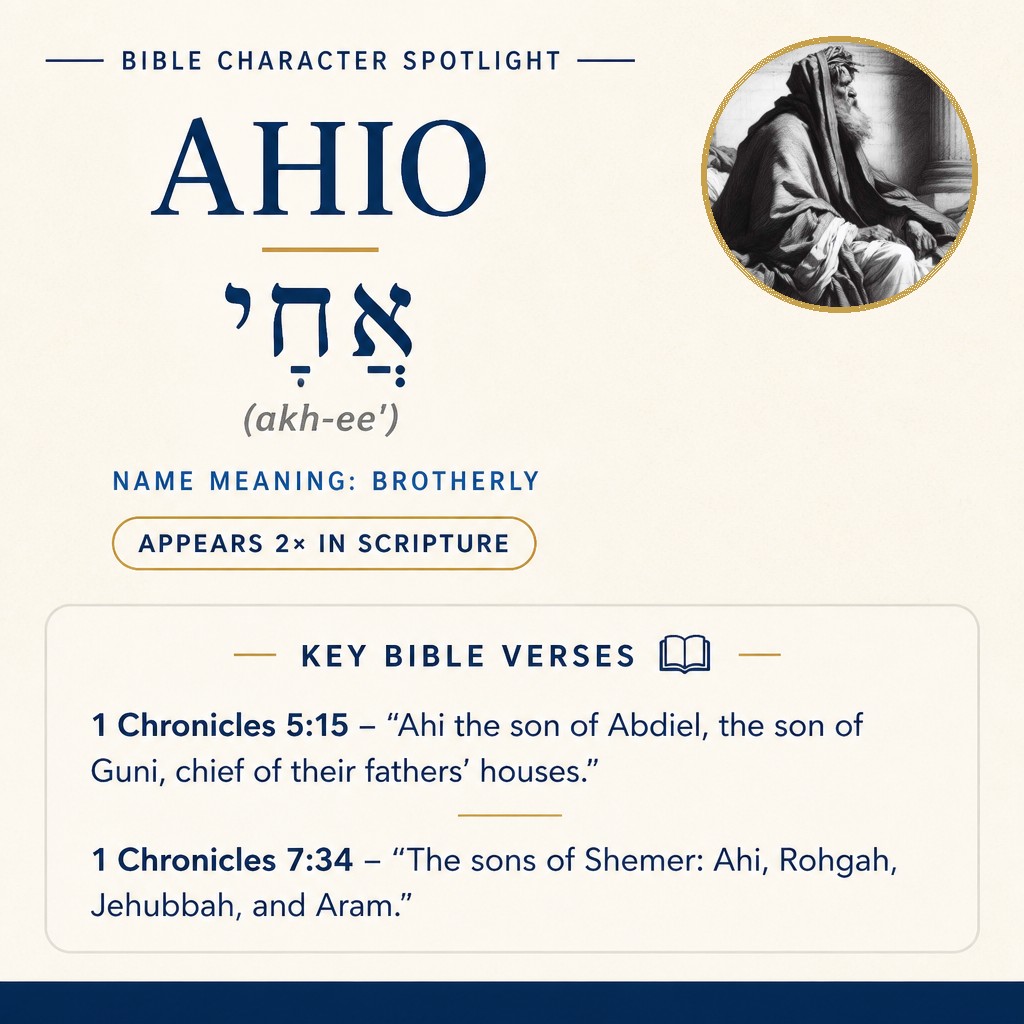
Ahi (Ahio) is a name borne by two Israelites in genealogies, appearing in 1 Chronicles 5:15 and 1 Chronicles 7:34.

Family Listing
Another Ahi appears among siblings: “The sons of Shemer: Ahi, Rohgah, Jehubbah, and Aram” (1 Chronicles 7:34).
Learn More →Name Meaning
Strong’s derives the name from a Hebrew word for “brother,” giving the sense “brotherly” (Strong’s H277).
Learn More →Ahio (Ahi) is a biblical name borne by two Israelites named in genealogical lists in 1 Chronicles. The name is explained in a lexicon as having a “brotherly” sense, derived from a Hebrew word for “brother.”
Ahio in Scripture
The first Ahi appears in a genealogy connected with the Reubenites, the Gadites, and the half-tribe of Manasseh, presented in a cluster of names and family lines.
“Their brothers of their fathers’ houses: Michael, Meshullam, Sheba, Jorai, Jacan, Zia, and Eber, seven.” (1 Chronicles 5:13, WEB)
“These were the sons of Abihail, the son of Huri, the son of Jaroah, the son of Gilead, the son of Michael, the son of Jeshishai, the son of Jahdo, the son of Buz;” (1 Chronicles 5:14, WEB)
“Ahi the son of Abdiel, the son of Guni, chief of their fathers’ houses.” (1 Chronicles 5:15, WEB)
Within this passage, Ahi is identified by lineage—“the son of Abdiel, the son of Guni”—and by role, being called “chief of their fathers’ houses” (1 Chronicles 5:15). The larger setting associates these families with particular regions and with genealogical registration.
“They lived in Gilead in Bashan, and in its towns, and in all the pasture lands of Sharon, as far as their borders.” (1 Chronicles 5:16, WEB)
“All these were listed by genealogies in the days of Jotham king of Judah, and in the days of Jeroboam king of Israel.” (1 Chronicles 5:17, WEB)
“The sons of Reuben, the Gadites, and the half-tribe of Manasseh, of valiant men, men able to bear buckler and sword, and to shoot with bow, and skillful in war, were forty-four thousand seven hundred sixty, that were able to go out to war.” (1 Chronicles 5:18, WEB)
In this immediate context, Ahi’s mention sits among descriptions of related households (“their brothers of their fathers’ houses,” 1 Chronicles 5:13), extended ancestry (1 Chronicles 5:14), the places where “they lived” (1 Chronicles 5:16), and a note that “all these were listed by genealogies” (1 Chronicles 5:17). The passage also records the military capacity of the broader tribal grouping as “valiant men” skilled with weapons (1 Chronicles 5:18), though Ahi himself is not individually described beyond his lineage and leadership title.
The second Ahi appears in another genealogical segment, in a list descending through Heber and Japhlet and then naming the sons of Shemer.
“Heber became the father of Japhlet, Shomer, Hotham, and Shua their sister.” (1 Chronicles 7:32, WEB)
“The sons of Japhlet: Pasach, Bimhal, and Ashvath. These are the children of Japhlet.” (1 Chronicles 7:33, WEB)
“The sons of Shemer: Ahi, Rohgah, Jehubbah, and Aram.” (1 Chronicles 7:34, WEB)
Here Ahi is identified simply as one of four sons: “Ahi, Rohgah, Jehubbah, and Aram” (1 Chronicles 7:34). The surrounding verses continue the genealogical flow by naming additional relatives and descendants.
“The sons of Helem his brother: Zophah, Imna, Shelesh, and Amal.” (1 Chronicles 7:35, WEB)
“The sons of Zophah: Suah, Harnepher, Shual, Beri, Imrah,” (1 Chronicles 7:36, WEB)
“Bezer, Hod, Shamma, Shilshah, Ithran, and Beera.” (1 Chronicles 7:37, WEB)
This section offers no further narrative about Ahi beyond his place in Shemer’s family line, but it situates him within a sequence of named kin across multiple generations.
Two Bearers of the Name
A lexicon gloss describes Ahi as the name of two Israelites, and 1 Chronicles supplies two distinct placements for the name. One Ahi is “the son of Abdiel, the son of Guni,” and is called “chief of their fathers’ houses” (1 Chronicles 5:15). The other Ahi is listed as one of Shemer’s sons: “The sons of Shemer: Ahi, Rohgah, Jehubbah, and Aram” (1 Chronicles 7:34). The texts do not explicitly connect these two individuals to each other.
Name and Meaning
The name is written in Hebrew as אֲחִי, transliterated ’Achiy, and pronounced “akh-ee.” A lexicon explains it as derived from a root meaning “brother,” giving the name a “brotherly” sense.
Observation
In both appearances, Ahi is known through genealogy: once with a leadership designation—“chief of their fathers’ houses” (1 Chronicles 5:15)—and once as a son within a list of siblings (1 Chronicles 7:34).
Frequently Asked Questions
What does the name Ahio mean?
Ahio means “brotherly.”
How many times does Ahio appear in the Bible?
Ahio appears 2 times.
Who was Ahio in the Bible?
Ahio (Achi) is the name of two Israelites mentioned in 1 Chronicles.
Where is Ahio mentioned in 1 Chronicles?
Ahio is named in genealogical lists in 1 Chronicles 5:15 and 1 Chronicles 7:34.
Explore Further
If you found this page about Ahio interesting and would like to discover more about other biblical characters, explore our comprehensive Encyclopedia of Biblical Characters. For those looking to delve deeper into the Greek origins of these names and terms, our Greek Lexicon is an invaluable resource.
Sources: Name and occurrence data from Strong’s Exhaustive Concordance and STEPBible reference data (CC BY). Scripture quotations from the World English Bible (public domain).





