
Who was Absalom in the bible?
Absalom is named as the son of David, appearing in 2 Samuel 3:3 and prominently in 2 Samuel 13, and also in genealogical notices in 1 Chronicles 3:2.

His Story
After Tamar was forced by Amnon, “Absalom hated Amnon, because he had forced his sister Tamar” (2 Samuel 13:22). Absalom later commanded, “Strike Amnon,” and “The servants of Absalom did to Amnon as Absalom had commanded” (2 Samuel 13:28-29).
Learn More →Name Meaning
Strong’s H53 derives the name from words meaning “father” and “peace.” The identity gloss describes Abshalom as a son of David.
Learn More →Absalom (also spelled Abshalom) is presented in Scripture as “Absalom the son of David,” a son born to David by Maacah of Geshur, and a brother to Tamar and Amnon. His name is explained in lexicon material as meaning “father of peace,” derived from words for “father” and “peace/well-being.”
Absalom in Scripture
Absalom appears in lists of David’s sons, where his mother and her connections are stated.
“and his second, Chileab, of Abigail the wife of Nabal the Carmelite; and the third, Absalom the son of Maacah the daughter of Talmai king of Geshur;” (2 Samuel 3:3, WEB)
“the third, Absalom the son of Maacah the daughter of Talmai king of Geshur; the fourth, Adonijah the son of Haggith;” (1 Chronicles 3:2, WEB)
The fullest narrative in the supplied material comes in 2 Samuel 13, where Absalom is identified as David’s son and as Tamar’s brother, and where Absalom’s actions are set in the aftermath of Tamar being violated by Amnon.
“After this, Absalom the son of David had a beautiful sister, whose name was Tamar; and Amnon the son of David loved her.” (2 Samuel 13:1, WEB)
In the chapter’s opening movement, Amnon’s desire for Tamar is stated, along with his own description of her as Absalom’s sister.
“Amnon said to him, “I love Tamar, my brother Absalom’s sister.”” (2 Samuel 13:4, WEB)
David is shown sending Tamar to Amnon’s house to prepare food, and the account narrates Amnon’s assault of Tamar. After Tamar is put out and left in grief, Absalom speaks to her directly and she takes refuge in his household.
“Absalom her brother said to her, “Has Amnon your brother been with you? But now hold your peace, my sister. He is your brother. Don’t take this thing to heart.” So Tamar remained desolate in her brother Absalom’s house.” (2 Samuel 13:20, WEB)
Absalom’s inner response is then described as hostility toward Amnon, expressed in silence rather than immediate confrontation.
“Absalom spoke to Amnon neither good nor bad; for Absalom hated Amnon, because he had forced his sister Tamar.” (2 Samuel 13:22, WEB)
Two years later, Absalom arranges a festive occasion at sheep-shearing time and invites the king’s sons. He asks David to attend, but David declines, and Absalom then requests that Amnon go. When permitted, Absalom gives explicit instructions to his servants to kill Amnon when Absalom signals them.
“After two full years, Absalom had sheep shearers in Baal Hazor, which is beside Ephraim: and Absalom invited all the king’s sons.” (2 Samuel 13:23, WEB)
“Absalom came to the king, and said, “See now, your servant has sheep shearers. Please let the king and his servants go with your servant.”” (2 Samuel 13:24, WEB)
“Then Absalom said, “If not, please let my brother Amnon go with us.” The king said to him, “Why should he go with you?”” (2 Samuel 13:26, WEB)
“Absalom commanded his servants, saying, “Mark now, when Amnon’s heart is merry with wine; and when I tell you, ‘Strike Amnon,’ then kill him. Don’t be afraid. Haven’t I commanded you? Be courageous, and be valiant!”” (2 Samuel 13:28, WEB)
The narrative reports that the servants do what Absalom ordered and that the other royal sons flee. A false report then reaches David that Absalom has killed all the king’s sons, which is corrected by Jonadab, who attributes Amnon’s death to a settled purpose tied to Tamar’s violation.
“The servants of Absalom did to Amnon as Absalom had commanded. Then all the king’s sons arose, and every man got up on his mule, and fled.” (2 Samuel 13:29, WEB)
“While they were on the way, the news came to David, saying, “Absalom has slain all the king’s sons, and there is not one of them left!”” (2 Samuel 13:30, WEB)
“Jonadab, the son of Shimeah, David’s brother, answered, “Don’t let my lord suppose that they have killed all the young men the king’s sons; for Amnon only is dead; for by the appointment of Absalom this has been determined from the day that he forced his sister Tamar.”” (2 Samuel 13:32, WEB)
Absalom flees, going to Talmai king of Geshur, and remains there for a stated period. David’s grief and later longing toward Absalom are also recorded.
“But Absalom fled.” (2 Samuel 13:34, WEB)
“But Absalom fled, and went to Talmai the son of Ammihur, king of Geshur. David mourned for his son every day.” (2 Samuel 13:37, WEB)
“So Absalom fled, and went to Geshur, and was there three years.” (2 Samuel 13:38, WEB)
“King David longed to go out to Absalom; for he was comforted concerning Amnon, since he was dead.” (2 Samuel 13:39, WEB)
Later references in Kings assume Absalom as a known point in David’s family history. One notice remarks that Adonijah “was born after Absalom.”
“His father had not displeased him at any time in saying, “Why have you done so?” and he was also a very handsome man; and he was born after Absalom.” (1 Kings 1:6, WEB)
Absalom is also invoked in David’s later instruction regarding Barzillai’s sons, where David recalls receiving help “when I fled from Absalom your brother.”
“But show kindness to the sons of Barzillai the Gileadite, and let them be among those who eat at your table; for so they came to me when I fled from Absalom your brother.” (1 Kings 2:7, WEB)
And in a brief note about Joab’s political alignments, the text states:
“This news came to Joab; for Joab had followed Adonijah, although he didn’t follow Absalom. Joab fled to Yahweh’s Tent, and held onto the horns of the altar.” (1 Kings 2:28, WEB)
Multiple bearers of the name
The lexicon identity gloss indicates that the name Abshalom/Absalom can refer to more than one person, including David’s son and (in a fuller form) a later Israelite. Within the supplied verses, however, only David’s son is directly described in narrative, while other occurrences use the name as part of later genealogical identifications.
In the period of the kings after David, a woman named Maacah is identified as “the daughter of Abishalom” and as the mother of a reigning king.
“He reigned three years in Jerusalem. His mother’s name was Maacah the daughter of Abishalom.” (1 Kings 15:2, WEB)
“He reigned forty-one years in Jerusalem. His mother’s name was Maacah the daughter of Abishalom.” (1 Kings 15:10, WEB)
Chronicles also mentions “Maacah the daughter of Absalom” in connection with Rehoboam’s family, including the children she bore him and Rehoboam’s particular affection for her.
“After her, he took Maacah the daughter of Absalom; and she bore him Abijah, Attai, Ziza, and Shelomith.” (2 Chronicles 11:20, WEB)
“Rehoboam loved Maacah the daughter of Absalom above all his wives and his concubines; for he took eighteen wives and sixty concubines, and became the father of twenty-eight sons and sixty daughters.” (2 Chronicles 11:21, WEB)
Name and Meaning
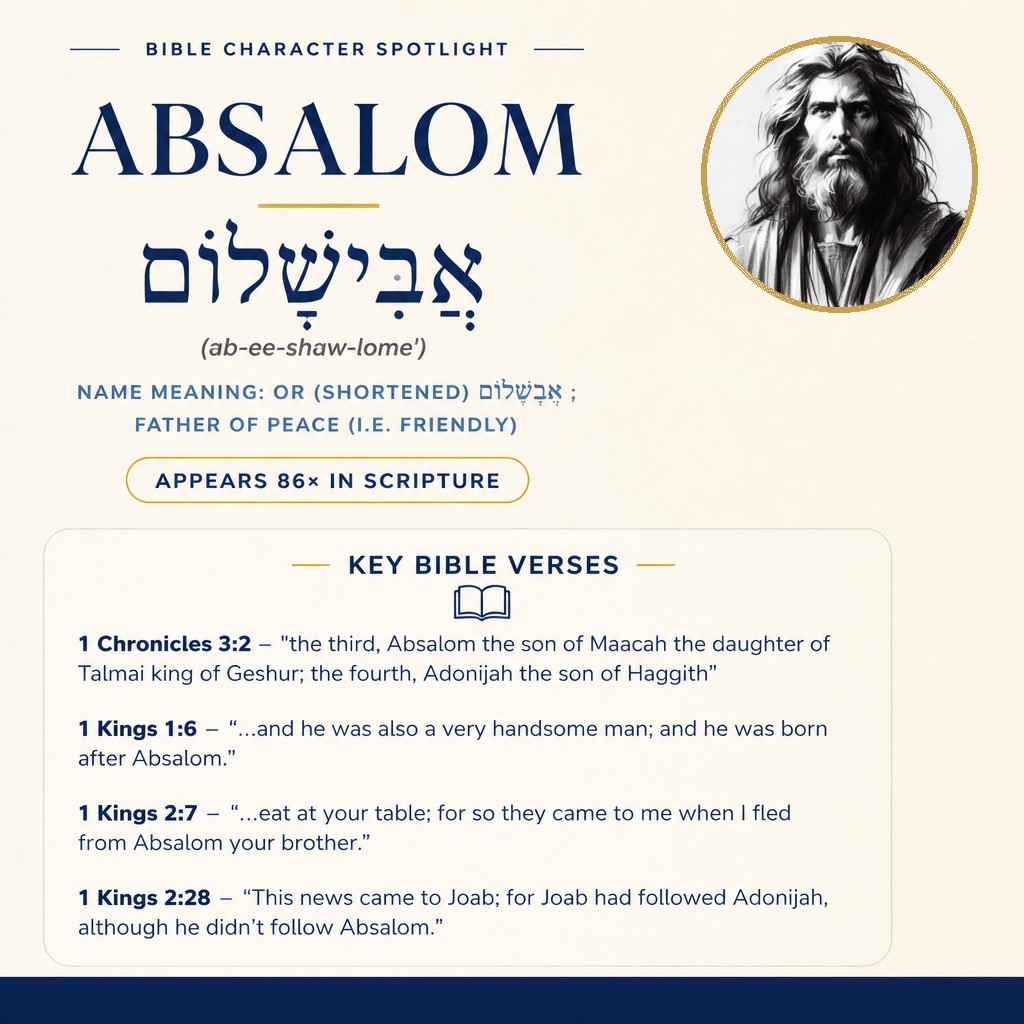
In Hebrew script the name is אֲבִישָׁלוֹם, transliterated ‘Abiyshalowm and pronounced “ab-ee-shaw-lome.” The Strong’s derivation explains it as coming from a term meaning “father” (אָב, ab) joined with a term meaning “peace,” “safe,” or “well-being” (שָׁלוֹם, shalowm), yielding the sense “father of peace” (with the idea of being friendly).
Observation
Across the cited passages, Absalom is portrayed both as a brother who takes Tamar into his house after her violation (2 Samuel 13:20) and as one who acts with settled hatred toward Amnon, culminating in a planned killing “by the appointment of Absalom” (2 Samuel 13:32) and his ensuing flight (2 Samuel 13:37–38).
Frequently Asked Questions
What does the name Absalom mean?
Absalom means “father of peace” (i.e., friendly).
How many times does Absalom appear in the Bible?
Absalom appears 86 times.
Who was Absalom?
Absalom was a son of David, the son of Maacah the daughter of Talmai king of Geshur (2 Samuel 3:3).
What happened between Absalom and Amnon in connection with Tamar?
Amnon said he loved Tamar, identified as “my brother Absalom’s sister” (2 Samuel 13:4). Absalom later hated Amnon “because he had forced his sister Tamar” (2 Samuel 13:22).
Explore Further
If you found this page about Absalom interesting and would like to discover more about other biblical characters, explore our comprehensive Encyclopedia of Biblical Characters. For those looking to delve deeper into the Greek origins of these names and terms, our Greek Lexicon is an invaluable resource.
Sources: Name and occurrence data from Strong’s Exhaustive Concordance and STEPBible reference data (CC BY). Scripture quotations from the World English Bible (public domain).




