Who was Abda in the bible?
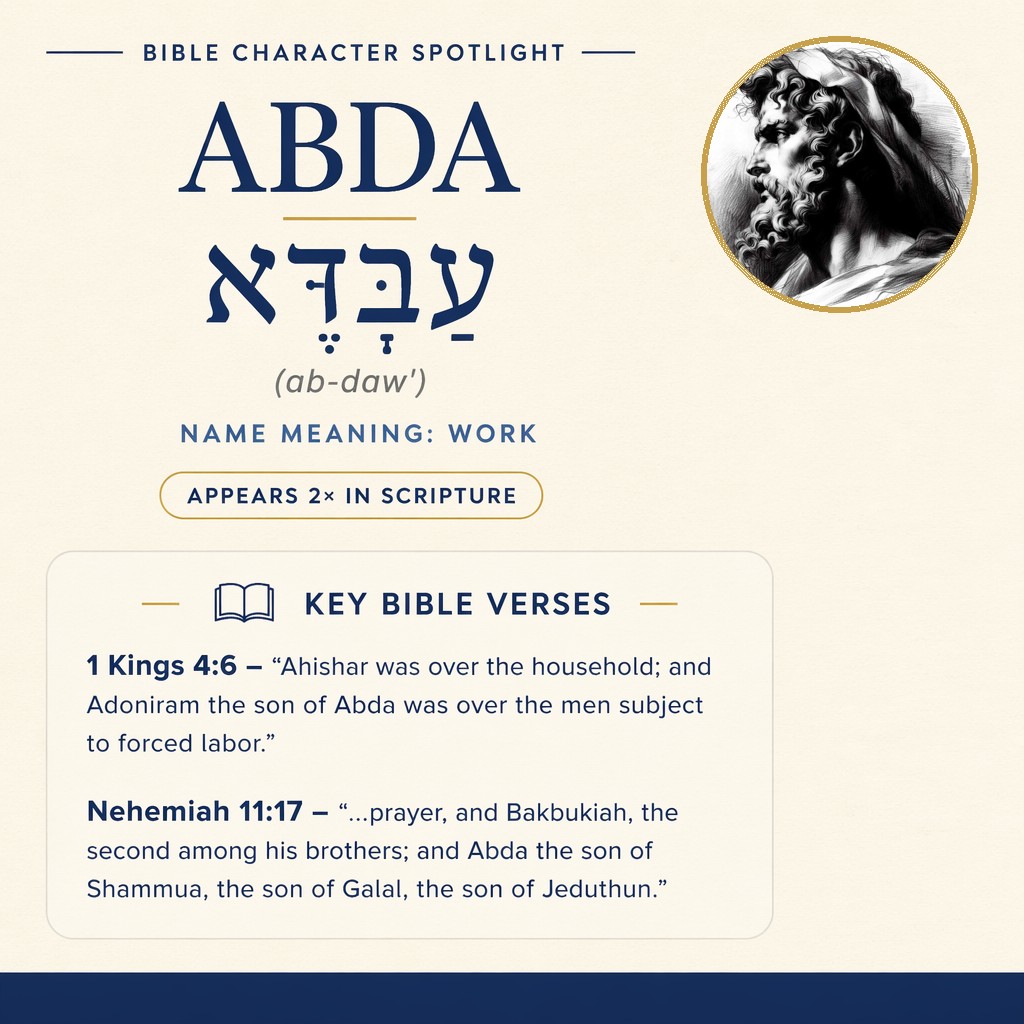
Abda is the name of two Israelites mentioned in 1 Kings 4:6 and Nehemiah 11:17.

In Solomon’s Court
“Adoniram the son of Abda was over the men subject to forced labor” (1 Kings 4:6).
Learn More →In a Genealogy
“Abda the son of Shammua, the son of Galal, the son of Jeduthun” is listed among the Levites in the holy city (Nehemiah 11:17–18).
Learn More →Abda is a Hebrew personal name (from a root connected with “work”), and the Bible uses it for two Israelites in two different settings: one appears as the father of an official in Solomon’s administration, and the other appears in a genealogy among Levites living in the holy city.
Abda in Scripture
The name first appears in a list describing offices under Solomon, placed among other named officials and their responsibilities. The immediate context names military and priestly leadership and other court roles before identifying an administrator connected with forced labor.
“Benaiah the son of Jehoiada was over the army; Zadok and Abiathar were priests;” (1 Kings 4:4, WEB)
“Azariah the son of Nathan was over the officers; Zabud the son of Nathan was chief minister, the king’s friend;” (1 Kings 4:5, WEB)
“Ahishar was over the household; and Adoniram the son of Abda was over the men subject to forced labor.” (1 Kings 4:6, WEB)
In this passage, Abda is not described by an office of his own; he is identified as the father of Adoniram. Adoniram’s assignment is stated directly: he “was over the men subject to forced labor” (1 Kings 4:6). The narrative continues to describe a broader structure of provisioning for the king, indicating that the list in which Adoniram is mentioned belongs to a wider account of Solomon’s officers.
“Solomon had twelve officers over all Israel, who provided food for the king and his household. Each man had to make provision for a month in the year.” (1 Kings 4:7, WEB)
“These are their names: Ben Hur, in the hill country of Ephraim;” (1 Kings 4:8, WEB)
“Ben Deker, in Makaz, in Shaalbim, Beth Shemesh, and Elon Beth Hanan;” (1 Kings 4:9, WEB)
Abda’s second appearance is in Nehemiah, in a section that enumerates residents and officers connected with worship and service in “the holy city.” Here Abda is part of a genealogical line, presented alongside other named Levites and their duties. The context begins by introducing Levites and then specific oversight roles before naming leaders in thanksgiving and prayer.
“Of the Levites: Shemaiah the son of Hasshub, the son of Azrikam, the son of Hashabiah, the son of Bunni;” (Nehemiah 11:15, WEB)
“and Shabbethai and Jozabad, of the chiefs of the Levites, who had the oversight of the outward business of God’s house;” (Nehemiah 11:16, WEB)
“and Mattaniah the son of Mica, the son of Zabdi, the son of Asaph, who was the chief to begin the thanksgiving in prayer, and Bakbukiah, the second among his brothers; and Abda the son of Shammua, the son of Galal, the son of Jeduthun.” (Nehemiah 11:17, WEB)
In this setting, Abda is identified by ancestry: he is “the son of Shammua, the son of Galal, the son of Jeduthun” (Nehemiah 11:17). The verse places him in the same listing as Mattaniah, who is described as “the chief to begin the thanksgiving in prayer” (Nehemiah 11:17), and it occurs within a counted summary of Levites in the city.
“All the Levites in the holy city were two hundred eighty-four.” (Nehemiah 11:18, WEB)
“Moreover the gatekeepers, Akkub, Talmon, and their brothers, who kept watch at the gates, were one hundred seventy-two.” (Nehemiah 11:19, WEB)
“The residue of Israel, of the priests, the Levites, were in all the cities of Judah, everyone in his inheritance.” (Nehemiah 11:20, WEB)
Read as a whole, the Nehemiah passage locates Abda within a register of Levites associated with ordered life and service in the city, alongside named chiefs with “oversight of the outward business of God’s house” (Nehemiah 11:16), leaders in thanksgiving and prayer, and the broader totals for Levites and gatekeepers.
Two men named Abda
The Bible’s use of the name indicates two distinct individuals.
Abda in 1 Kings 4 is known only as the father of an administrator in Solomon’s court. The text states: “Adoniram the son of Abda was over the men subject to forced labor” (1 Kings 4:6). Abda himself is not assigned a title or duty in this list; his role in the narrative is to identify Adoniram’s parentage.
Abda in Nehemiah 11 appears in a Levitical context as a named descendant in a genealogy: “Abda the son of Shammua, the son of Galal, the son of Jeduthun” (Nehemiah 11:17). He is listed among Levites connected with the holy city and is mentioned near descriptions of thanksgiving in prayer and oversight of God’s house (Nehemiah 11:16–17).
Name and Meaning
The name is written in Hebrew as עַבְדָּא, transliterated Abda, and pronounced ab-daw’. Its derivation is explained in the lexicon material as coming from a Hebrew root meaning “to work,” connected with the component word ‘abad (עָבַד), “to work (in any sense).” In Scripture, the name is borne by two Israelites: the father of Adoniram in Solomon’s administrative list (1 Kings 4:6) and a Levite named in a genealogy among residents of the holy city (Nehemiah 11:17).
Observation
In both appearances, Abda is presented through relationships—once by fatherhood (“Adoniram the son of Abda,” 1 Kings 4:6) and once by a chain of descent (“Abda the son of Shammua, the son of Galal, the son of Jeduthun,” Nehemiah 11:17)—as part of lists that map responsibilities and ordered community life.
Frequently Asked Questions
What does the name Abda mean?
Abda means “work.”
How many times does Abda appear in the Bible?
Abda appears 2 times.
Who was Abda in the Bible?
Abda is the name of two Israelites. One is mentioned as the father of Adoniram (1 Kings 4:6).
What is said about Adoniram son of Abda?
“Adoniram the son of Abda was over the men subject to forced labor” (1 Kings 4:6).
Explore Further
If you found this page about Abda interesting and would like to discover more about other biblical characters, explore our comprehensive Encyclopedia of Biblical Characters. For those looking to delve deeper into the Greek origins of these names and terms, our Greek Lexicon is an invaluable resource.
Sources: Name and occurrence data from Strong’s Exhaustive Concordance and STEPBible reference data (CC BY). Scripture quotations from the World English Bible (public domain).