Exploring the Meaning of Turos in Greek
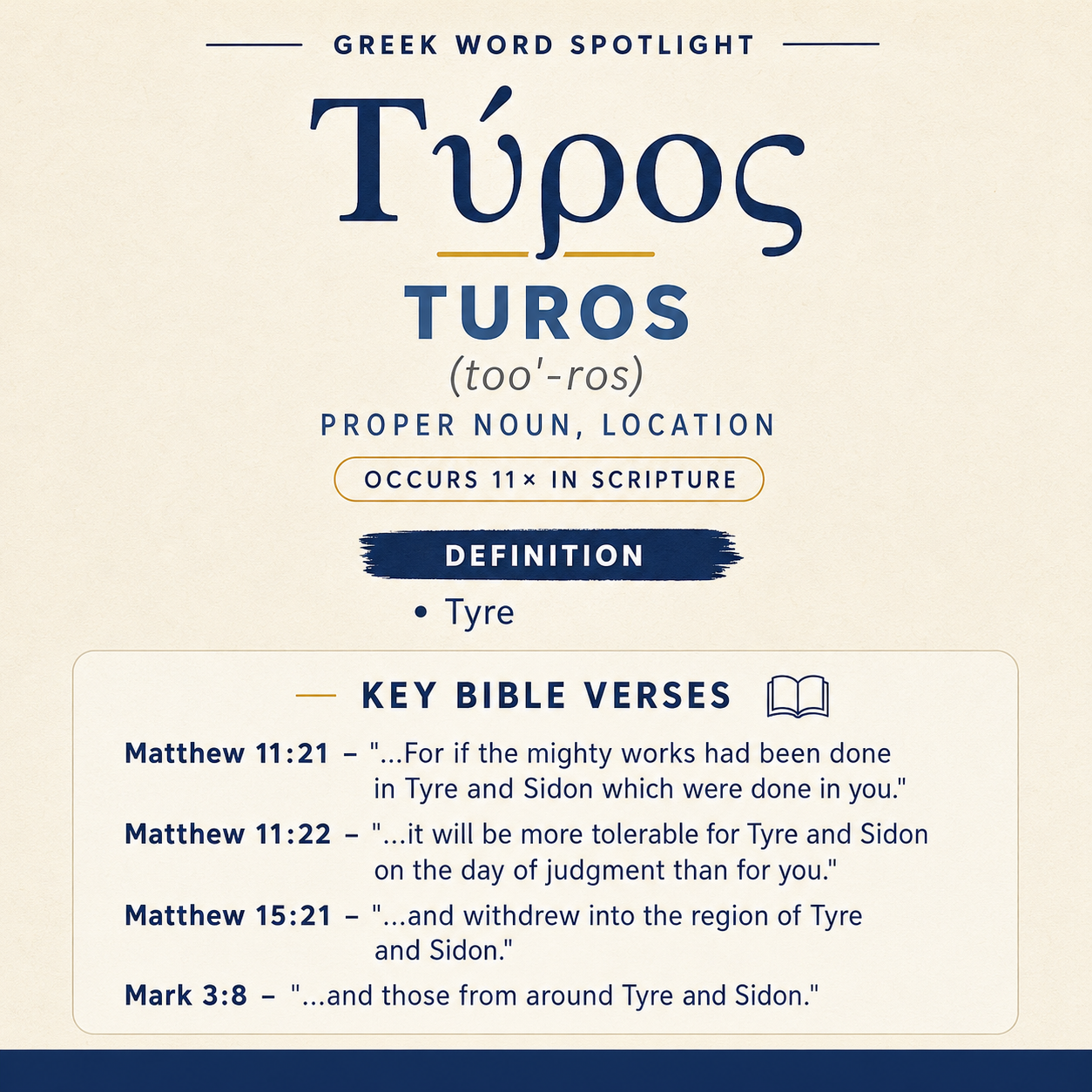
Τύρος (Turos) means “Tyre” and appears 11 times in Scripture, including in Matthew, Mark, and Luke.
Meaning
Τύρος is the Greek name for Tyre. It is used as a place name in the New Testament.
Learn More →Gospel Occurrences
Τύρος appears in Matthew 11:21–22 and Luke 10:13 in Jesus’ sayings alongside Sidon. It also appears in travel and region notes in Matthew 15:21 and Mark 7:24, 7:31.
Learn More →Usage Context
In Mark 3:8 and Luke 6:17, people are described as coming from around Tyre and Sidon. The term regularly appears paired with “Sidon” in the cited passages.
Learn More →Τύρος names the place Tyre. In these passages it functions as a point of comparison in Jesus’ pronouncements, a geographic marker along his movements, a descriptor for crowds along the coast, and a concrete port of call in Acts.
Occurrences
“Woe to you, Chorazin! Woe to you, Bethsaida! For if the mighty works had been done in Tyre and Sidon which were done in you, they would have repented long ago in sackcloth and ashes. (Matthew 11:21)
Tyre serves as a benchmark in a hypothetical comparison. The saying contrasts the reception of “mighty works” in Chorazin and Bethsaida with a counterfactual response in “Tyre and Sidon,” presenting Tyre as a city whose inhabitants, in this scenario, would have responded with visible signs of repentance (“sackcloth and ashes”).
But I tell you, it will be more tolerable for Tyre and Sidon on the day of judgment than for you. (Matthew 11:22)
Tyre stands within a judicial contrast: the “day of judgment” is framed as having degrees of tolerability. The name anchors the comparison in specific places—Tyre and Sidon—so that the warning is not abstract but calibrated against recognizable cities.
Jesus went out from there, and withdrew into the region of Tyre and Sidon. (Matthew 15:21)
Here Tyre marks a destination region into which Jesus “withdrew.” The wording casts Tyre not simply as a city on a map but as part of a broader “region,” paired with Sidon, giving the reader an immediate geographic frame for the next events.
from Jerusalem, from Idumaea, beyond the Jordan, and those from around Tyre and Sidon. A great multitude, hearing what great things he did, came to him. (Mark 3:8)
Tyre identifies one of the diverse origin points of the “great multitude.” People come not only from Judea-centered locales (“Jerusalem”) and neighboring regions (“Idumaea,” “beyond the Jordan”) but also “from around Tyre and Sidon,” emphasizing breadth of reach; Tyre contributes to the sense that news of Jesus’ deeds has traveled widely.
From there he arose, and went away into the borders of Tyre and Sidon. He entered into a house, and didn’t want anyone to know it, but he couldn’t escape notice. (Mark 7:24)
Tyre appears as “borders,” a liminal zone rather than a single urban point. The scene links this geographic shift with attempted privacy (“didn’t want anyone to know it”) and its failure (“he couldn’t escape notice”), so Tyre functions as the setting for withdrawal that nevertheless becomes permeable to public awareness.
Again he departed from the borders of Tyre and Sidon, and came to the sea of Galilee, through the middle of the region of Decapolis. (Mark 7:31)
Tyre marks the point of departure in a travel notice. The movement is traced from “the borders of Tyre and Sidon” toward “the sea of Galilee,” with an additional routing detail (“through the middle of the region of Decapolis”); Tyre thus helps locate the narrative in a sequence of departures and arrivals.
He came down with them, and stood on a level place, with a crowd of his disciples, and a great number of the people from all Judea and Jerusalem, and the sea coast of Tyre and Sidon, who came to hear him and to be healed of their diseases; (Luke 6:17)
Tyre is evoked through “the sea coast of Tyre and Sidon,” associating the place name with a coastal strip rather than an inland district. The phrase helps characterize the crowd: they come “to hear him and to be healed,” so Tyre contributes to a portrait of people traveling from coastal areas, alongside those from “all Judea and Jerusalem,” drawn by teaching and healing.
“Woe to you, Chorazin! Woe to you, Bethsaida! For if the mighty works had been done in Tyre and Sidon which were done in you, they would have repented long ago, sitting in sackcloth and ashes. (Luke 10:13)
As in Matthew’s parallel, Tyre operates inside a moral comparison driven by response to “mighty works.” The addition of “sitting in sackcloth and ashes” supplies a concrete posture for repentance, and Tyre is again the imagined location where such a response would have taken place.
But it will be more tolerable for Tyre and Sidon in the judgment than for you. (Luke 10:14)
Tyre is again part of a comparative verdict “in the judgment.” The name functions rhetorically: it makes the warning measurable by placing Chorazin and Bethsaida under a harsher prospect than Tyre and Sidon.
When we had come in sight of Cyprus, leaving it on the left hand, we sailed to Syria and landed at Tyre, for the ship was there to unload her cargo. (Acts 21:3)
Tyre is a specific landing point in a voyage narrative. It is not merely passed by: the ship “landed at Tyre” for a practical purpose—“to unload her cargo”—so the place name anchors the itinerary to maritime commerce and the concrete logistics of travel.
When we had finished the voyage from Tyre, we arrived at Ptolemais. We greeted the brothers and stayed with them one day. (Acts 21:7)
Tyre identifies the previous stop in a continuing journey: “the voyage from Tyre” sets up the arrival at “Ptolemais.” The mention of greeting “the brothers” and staying a day ties Tyre to the network of travel and fellowship, even though the activity described occurs upon arrival elsewhere; Tyre remains the point of origin for this leg.

Sense and Usage
Across these passages, Tyre functions as a stable geographic referent whose narrative role shifts with genre and context. In the pronouncements of woe (Matthew 11:21–22; Luke 10:13–14), Tyre is paired with Sidon and placed into a hypothetical moral calculus: it represents a city imagined as responsive to “mighty works,” and it becomes a comparator in the language of tolerability “on the day of judgment” and “in the judgment.” The effect is to sharpen accountability for other named towns by placing them against a known location; the place name gives the warning a concrete horizon rather than leaving it in generalities.
In the Gospel travel notices (Matthew 15:21; Mark 7:24, 7:31), Tyre is framed as a “region” and as “borders,” expressions that emphasize territory and edges. The narrative uses those geographic terms to guide the reader through movements—withdrawal into a region, entry into a house, departure toward the sea of Galilee—so Tyre contributes to the spatial logic of the story. In Mark 7:24, the location is particularly tied to a tension between withdrawal and publicity: even within the “borders of Tyre and Sidon,” privacy is sought but not secured.
In the crowd descriptions (Mark 3:8; Luke 6:17), Tyre marks the reach of Jesus’ reputation and the breadth of response. Those who come are not described as residents of Tyre proper but as people “from around Tyre and Sidon” and from “the sea coast of Tyre and Sidon.” These phrases use Tyre as a landmark for surrounding areas and coastal stretches, highlighting movement toward Jesus for two stated aims: to “hear him” and “to be healed of their diseases.” Tyre thus helps articulate the geography of attraction—how far the crowd extends and from what kinds of places they arrive.
In Acts 21:3, 21:7, Tyre is an operational stop within a seafaring itinerary. The narrative detail—“for the ship was there to unload her cargo”—connects the place name to the practical rhythms of travel by sea, then uses Tyre as a departure point for the next segment of the voyage. The overall usage here is straightforwardly locative, but it is also vivid: Tyre is not a mere dot on a route, but a landing with a purpose that shapes the pacing of the journey.
Imagery
Tyre carries two recurring images in these texts. One is public response: in Jesus’ sayings, the city name is bound to the imagined scene of repentance “in sackcloth and ashes,” serving as a foil that intensifies the woe addressed to other towns. The other is movement along edges and coasts: “region,” “borders,” “sea coast,” and “landed” place Tyre at the intersection of travel routes—overland withdrawal in the Gospels and maritime passage in Acts—so that the name consistently evokes location in motion rather than a static background.
Sources: Lexical data from Strong’s Exhaustive Concordance and the Translators Brief Lexicon of Extended Strongs for Greek (STEPBible, CC BY). Occurrence data from the Translators Amalgamated Greek New Testament (STEPBible, CC BY). Scripture quotations from the World English Bible (public domain).