Exploring the Meaning of Tolmetes in Greek
τολμητής means “bold man” and appears once in Scripture, in 2 Peter 2:10.
Scripture Occurrence
This word occurs 1 time in Scripture. Its occurrence is in 2 Peter 2:10.
Learn More →Verse Context
In 2 Peter 2:10, it is associated with those described as “Daring, self-willed,” who despise authority.
Learn More →τολμητής means “bold man” and appears once in the New Testament, in a warning about certain corrupt teachers and their conduct. In its lone setting it functions as a pointed characterization within a cluster of moral descriptors.

Root and Related Words
τολμητής derives from the verb tolmao (τολμάω), “be bold” (Strong’s G5111). The noun draws the verbal idea of boldness into a personal designation, marking someone by that quality as a recognizable type.

Occurrences
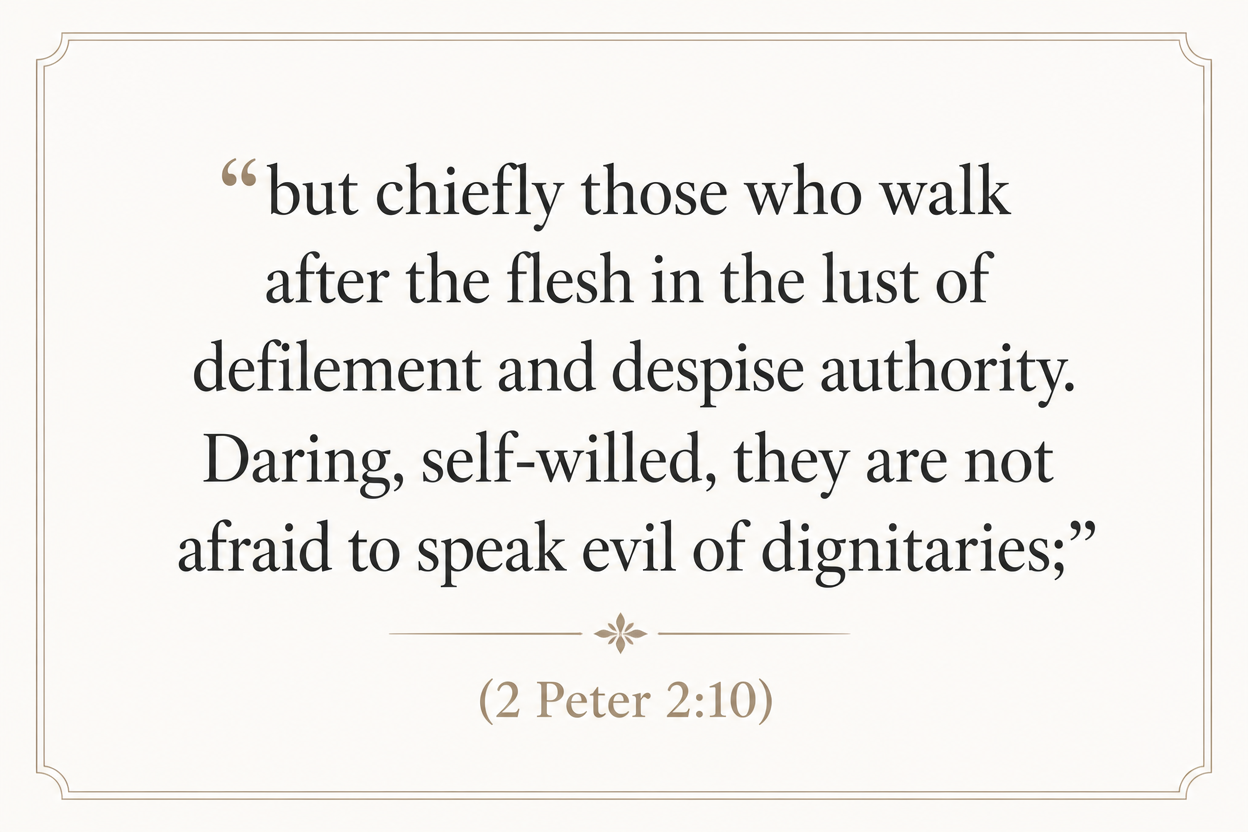
“but chiefly those who walk after the flesh in the lust of defilement and despise authority. Daring, self-willed, they are not afraid to speak evil of dignitaries;” (2 Peter 2:10)
In 2 Peter 2:10 τολμητής stands in a chain of descriptions that intensify one another. The verse first locates the people in question by their pattern of life: they “walk after the flesh in the lust of defilement.” It then names their posture toward rule and order: they “despise authority.” Within that portrait, the term rendered “Daring” assigns to them a particular kind of personal profile—people marked by boldness as a defining trait. The boldness is not presented as neutral; it is immediately paired with “self-willed,” so the bold man is not simply courageous but headstrong within this moral frame.
The next clause shows what this boldness produces in speech: “they are not afraid to speak evil of dignitaries.” In the flow of the sentence, “Daring” helps account for the absence of fear. The description is not of hesitant grumblers but of people who act and speak with a forward, unrestrained confidence. By placing “Daring” before the statement about slanderous speech, the verse makes their boldness a contributing feature of their behavior: they do not hold back when addressing “dignitaries,” and their lack of fear becomes part of the indictment.
Because the verse is constructed as a warning (“but chiefly those…”) the word also has a classificatory function: it helps the reader recognize a certain sort of person by the traits listed. “Daring” is therefore not merely an internal disposition but a public-facing quality seen in actions and speech—bold enough to cross a boundary the author assumes should restrain a person. The term, set between “despise authority” and “not afraid to speak evil,” acts like a hinge: it summarizes their forwardness and helps link contempt for authority with reckless speech toward those in elevated station.
Sense and Usage
As “bold man,” τολμητής names a person characterized by boldness rather than merely performing a bold act in isolation. In its New Testament use, that characterization is framed by the surrounding descriptions, which supply the moral color and the social setting in which boldness is displayed. The verse gathers together three features—sensual pursuit (“walk after the flesh”), rejection of order (“despise authority”), and fearless verbal aggression (“not afraid to speak evil”)—and places “Daring” among them as a marker of the person’s stance.
The immediate pairing “Daring, self-willed” shows that the boldness in view is intertwined with stubborn independence. The bold man is someone who presses forward on his own terms. This is reinforced by the clause that follows: fear is absent where caution would normally operate, especially in speech directed at “dignitaries.” Thus, within this usage, boldness is expressed as audacity toward others, not as quiet resolve, and it is closely tied to the willingness to speak “evil” without restraint.
The structure of the sentence also suggests a progression from inward appetite to outward contempt and then to outspoken attack. “Walk after the flesh” indicates a habitual direction; “despise authority” indicates an evaluative stance; “Daring… not afraid to speak evil” indicates the public expression of that stance. In that progression, the “bold man” is the person who does not merely hold contempt but carries it into action with confidence. The term therefore contributes a recognizable social posture: brashness that refuses deference, especially where positions of honor or authority are involved.
Even in a single occurrence, τολμητής carries a sharper edge than a general comment about confidence. Because it is embedded in a warning about those who corrupt themselves and reject authority, it functions as a label for an aggressive kind of boldness—bold enough to override fear and embolden speech that violates respect for others. The word’s force lies not in describing how difficult the situation is, but in describing the person: the bold man is the kind of man who can be counted on to act without the restraint of fear in precisely the wrong direction.
Imagery and Tone
The imagery suggested by 2 Peter 2:10 is less visual than behavioral: people moving in a settled pattern (“walk after the flesh”), turning their backs on order (“despise authority”), and then speaking with fearless disrespect toward “dignitaries.” Within that scene, “Daring” evokes a posture of forward thrust—confidence that does not pause, weigh, or refrain. The verse presents this boldness as a feature of moral disorder: it is the boldness of those who push past reverence and use speech as an instrument of contempt.
Sources: Lexical data from Strong’s Exhaustive Concordance and the Translators Brief Lexicon of Extended Strongs for Greek (STEPBible, CC BY). Occurrence data from the Translators Amalgamated Greek New Testament (STEPBible, CC BY). Scripture quotations from the World English Bible (public domain).